
AI & SEO Strategies: What Even Big Brands Must Consider In 2025
The field of search engine optimization (SEO) is always changing on and off, and as artificial intelligence (AI) becomes highly popular in search engines, brands need to start reconsidering their approaches. Businesses of all sizes must use AI-driven SEO as we move toward 2025 in order to preserve visibility, raise rankings, and highly improve user experience. Unlike traditional SEO, AI SEO can help brands enhance their brand visibility and optimize search results efficiently.
We’ll look at the most important AI-powered SEO tactics in this blog, as well as what even the largest firms need to think about in order to remain highly competitive and maintain brand authority in the AI search landscape.
The Role of AI in SEO
AI has highly transformed how search engines rank content. Search engines are now much better able to interpret user intent due to machine learning algorithms very quickly like Google’s RankBrain and BERT. AI facilitates the automation of high optimization strategies, the analysis of huge volumes of data, and the early and accurate prediction of search trends, helping improve search visibility.
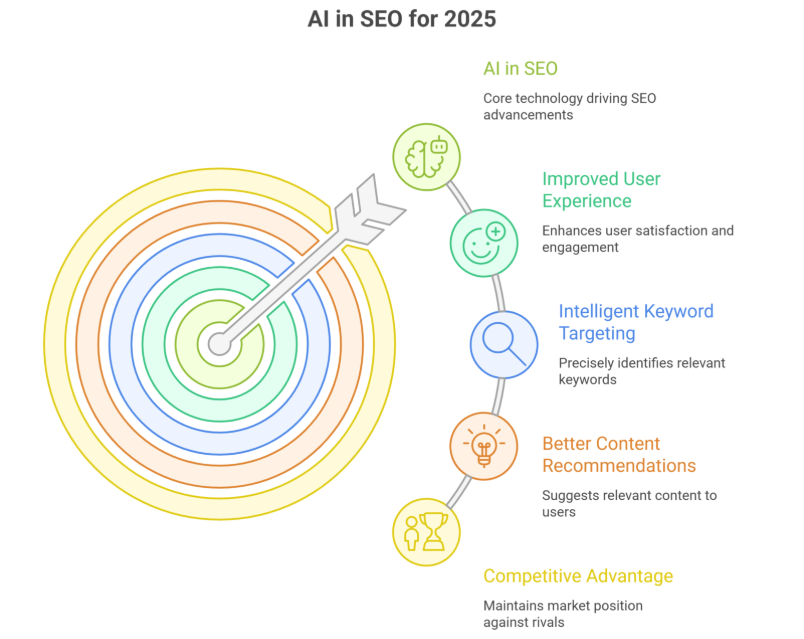
Businesses can highly benefit from improved user experience, much more intelligent keyword research, and much better content marketing recommendations by leveraging AI for SEO. Mostly ignoring AI-powered SEO tactics could cause you to lag behind rivals who are already using these highly advanced AI tools.
AI-Powered SEO Strategies for 2025
-
AI-Generated Content Optimization
Content creation is becoming much quicker and more effective due to easy-to-access AI platforms like ChatGPT, Jasper, and Copy.ai. But depending only on content produced by AI models can be dangerous. Original, superior content that offers users genuine value is given priority by search engines.
How Brands Can Adapt:
-
When creating content, use AI as a tool, not a substitute.
-
Make very certain that information produced by AI is always fact-checked and tweaked to add quite a human touch.
-
Focus on EEAT (Experience, Expertise, Authoritativeness, Trustworthiness) to highly improve credibility and brand-specific authority.
-
Voice Search Optimization
Voice search’s rise with millions of people utilizing smart assistants like Google Assistant, Alexa, and Siri every day makes AI-driven search crucial. Voice queries are typically longer-tail and more conversational.
How Brands Can Adapt:
-
Optimize content for natural language queries.
-
Focus on long-tail keywords and question-based phrases.
-
Ensure websites are mobile-friendly and load quickly for seamless AI search results.
-
AI and Predictive Search Analytics
Predictive analytics using AI help brands understand future search trends. Predictive SEO uses AI-driven insights to suggest keywords before they become popular.
How Brands Can Adapt:
-
Utilize AI SEO tools like Clearscope and SurferSEO for keyword insights.
-
Monitor emerging trends and optimize content proactively to maximize organic reach.
-
Focus on semantic search to align with how audiences are asking queries.
-
Enhanced User Experience with AI
User experience (UX) is becoming quite a higher priority in Google’s algorithm. Rankings are highly impacted by metrics such as mobile usability, Core Web Vitals, and page speed.
How Brands Can Adapt:
-
Improve relationship with customers by highly utilizing AI-powered chatbots.
-
Websites should be optimized for quick loading times and easy navigation to enhance brand awareness.
-
Highly personalize content based on user behavior with frequent AI recommendations.
-
AI-Powered Image & Video SEO
Visual content plays a critical role in search engine results. AI-powered image and video recognition help search engines understand and categorize media better.
How Brands Can Adapt:
-
Optimize images with structured data and alt text.
-
Use AI-generated captions and transcriptions for videos.
-
Leverage AI tools like Google Vision API to enhance AI search visibility.
-
Automation in SEO Strategies
High AI-driven automation saves a lot of time by handling repetitive SEO tasks like keyword tracking, backlink analysis, and frequent site audits.
How Brands Can Adapt:
-
Implement AI-powered SEO tools like SEMrush, Ahrefs, and Moz.
-
Automate technical SEO audits to fix site errors quickly.
-
Set up AI-based A/B testing to improve website performance.
-
Local SEO and AI-Driven Personalization
Local SEO is essential for companies that have physical locations. AI assists in highly customized local search results according to user behavior, location, and previous searches.
How Brands Can Adapt:
-
Make sure your website is optimized for local search phrases and Google My Business (GMB).
-
Utilize geotargeting driven by AI to customize user experiences.
-
Ensure NAP (Name, Address, Phone) consistency across all platforms to reinforce brand’s AI presence.
-
AI and Mobile-First Indexing
Google now highly prioritizes mobile-friendly sites in search engine results. AI tools help businesses optimize their mobile experience effectively.
How Brands Can Adapt:
-
Assure uniformity of NAP (Name, Address, Phone) on all platforms.
-
Make good use of mobile testing solutions powered by AI, such as Google’s Mobile-Friendly Test.
-
Improve mobile site speed with AI-based caching and unique compression techniques.
-
AI-Powered Backlink Analysis
Backlinks remain a crucial ranking factor, and AI makes backlink efforts more efficient by identifying high-quality opportunities.
How Brands Can Adapt:
-
Use AI backlink analysis tools to track and disavow toxic links.
-
Leverage AI for content outreach and automated backlink suggestions.
-
Prioritize quality over quantity in link-building efforts to boost brand authority.
-
Evolving Search Algorithms and AI
Google is increasingly using AI to update its algorithms. Brands need to stay ahead of the curve by staying very up-to-date with AI-powered search innovations.
How Brands Can Adapt:
-
Stay updated with Google’s latest AI-driven changes.
-
Adapt content strategies based on AI-generated insights.
-
Continuously refine on-page and technical SEO practices.
The Future of AI in SEO
AI will drive SEO in the future. Artificial intelligence will continue to influence search engine results through automation, content customization, and real-time analytics. Companies may find it very difficult to stay competitive if they don’t incorporate AI into their SEO plans.
Key Takeaways:
-
The way search engines interpret and rank material is changing due to AI.
-
To remain relevant, businesses need to use AI-driven SEO tools and strategies.
-
It’s crucial to give user experience, technical SEO, and excellent content top priority.
-
In 2025, staying way ahead of algorithm upgrades driven by AI will be crucial.
-
Brands can highly raise their search engine ranks, increase organic search traffic, and improve user experience by highly utilizing AI SEO tactics. To produce content that genuinely connects with people, it is very crucial to strike a balance between AI automation and human creativity.
Meta Description:
Find out the best AI-powered SEO tactics that all major firms need to implement by 2025. Learn how AI is improving digital marketing, influencing search rankings, and boosting brand visibility.
Frequently Asked Questions (AI & SEO Strategies: What Even Big Brands Must Consider In 2025)
How is AI changing SEO in 2025?
AI is making SEO more personalized, predictive, and intent-driven. Search engines analyze user behavior, context, and real-time data to deliver smarter results. Brands must use AI tools, automation, and advanced content optimization to stay competitive and maintain strong search visibility.
Why should big brands adopt AI-driven SEO?
AI-driven SEO helps big brands gain faster insights, improve keyword targeting, and deliver personalized content at scale. It enhances rankings, boosts efficiency, and reduces competitive pressure. AI also streamlines large-content management, making overall SEO performance stronger and more consistent.
What role does machine learning play in modern SEO?
Machine learning predicts user intent, identifies search patterns, and evaluates content quality. In 2025, ML-driven algorithms prioritize relevance, engagement, and behavior signals. This helps brands make data-informed SEO decisions and optimize content for better visibility across multiple search environments.
How can AI improve content quality for SEO?
AI tools identify content gaps, enhance readability, and recommend topic clusters. Real-time editors improve tone, structure, and keyword optimization while reducing plagiarism. This results in higher-quality, search-friendly content that aligns with user intent and improves overall ranking potential.
Leave a Reply