
What worked on shopify in 2025 (and what failed)
Why do some shopify businesses grow steadily while others struggle to generate consistent results? Why does one shopify store achieve higher conversion, even when selling similar products? The difference is rarely the platform itself. Performance is shaped by multiple factors website structure, development quality, load speed, data-driven decisions, and how effectively the checkout experience is optimized.
In 2025, Shopify worked best when businesses focused on performance-driven design, optimized checkout, automation, and data-based decisions. Stores failed when relying on poor development, bloated apps, weak conversion strategy, and no long-term planning. Success came from scalable builds, not shortcuts.
In 2025, shopify continued to evolve, but success depended on how professionally it was implemented. Businesses that invested in thoughtful design, reliable support, and ongoing maintenance saw stronger outcomes than those relying on quick setups or shortcuts. A well-built shopify solution typically ranges from a basic setup to a professionally developed system with advanced functionality, long-term support, and measurable returns. The upfront cost may vary, but the long-term value comes from stability, adaptability, and informed decision-making powered by analytics.
This blog explores what truly worked on shopify in 2025, what failed to deliver results, and how smart development choices directly impact growth, efficiency, and sustainable success.
What Worked on Shopify in 2025 for Scalable Growth
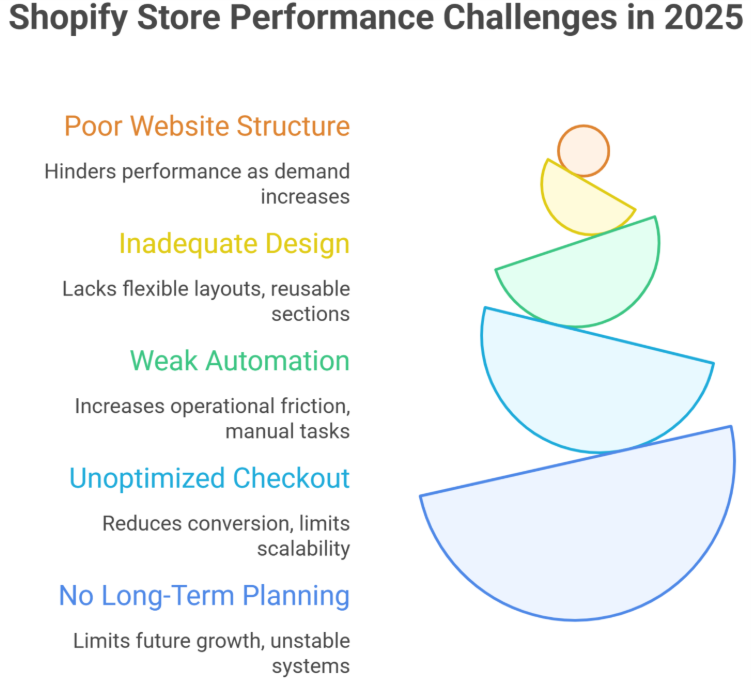
Step 1: Build a Strong Foundation
In 2025, scalable growth on Shopify started with structure. Every successful shopify business focused on clean architecture that could optimize performance as demand increased. Poor foundations are a key reason shopify stores fail when growth begins.
Step 2: Design for Scalability
A scalable Shopify setup avoided unnecessary complexity. Flexible layouts, reusable sections, and performance-first logic allowed store owners to grow without rebuilding their systems later.
Step 3: Implement Smart Automation
Effective automation reduced operational friction. Order handling, customer communication, and reporting workflows were streamlined so teams could focus on strategic decisions instead of manual tasks.
Step 4: Optimize for Conversion
High-performing brands continued to optimize product pages, navigation, and checkout flow. These improvements directly supported stronger conversion while maintaining long-term scalability.
Step 5: Plan for Sustainable Growth
Many store owners learned that rushing a launch limits future growth. Brands that planned early avoided the pattern where many shopify stores fail during scaling and instead built systems ready for long-term success.
The Hidden Shopify Decisions That Drove Real Conversion
Strategic Choices Most Store Owners Miss
- Many store owners focus on visuals, but conversion is driven by structure and decision flow.
- Poor early decisions explain why shopify stores fail, even when traffic is strong.
- A conversion-focused shopify business aligns design, logic, and data from day one.
Conversion Starts With Structure
- A scalable setup allowed brands to grow without rebuilding systems.
- Weak foundations are a reason many shopify stores fail as traffic increases.
- Planning for scalability early protected long-term performance.
Product-Level Decisions That Matter
- Clear product pages reduced hesitation and improved buying confidence.
- Well-written product descriptions guided decisions without overwhelming users.
- Teams continued to optimize layouts based on behavior, not assumptions.
Automation That Supported Conversion
- Smart automation reduced friction across the buying journey.
- Automated workflows helped a shopify business respond faster to customer actions.
- Over-automation, however, was avoided excessive tools are why shopify stores fail operationally.
Balancing Growth and Control
- A scalable system ensured growth did not harm performance.
- Thoughtful automation supported operations without replacing strategy.
- Maintaining scalability allowed teams to optimize experiences consistently.
Why Some Stores Converted and Others Didn’t
- Many store owners chased trends instead of fundamentals.
- Many store setups lacked testing and refinement.
- Successful brands continued to optimize, stayed scalable, and avoided the patterns where shopify stores fail repeatedly.
Conclusion
The results from Shopify in 2025 made one thing clear: success depended on strategy, structure, and execution not the platform alone. Businesses that invested in scalable architecture, professional development, and continuous optimization achieved stronger conversion and long-term growth. Those who rushed launches or relied on shortcuts often faced performance limits as demand increased.
Many Shopify stores failed due to poor planning, bloated systems, and the absence of expert guidance. Visual design without structure, automation without strategy, and growth without scalability consistently led to lost opportunities.
So the real question is this: if your Shopify store is not converting, scaling, or performing as it should do you need another platform, or do you need a development partner like Integriti Studio to fix what’s holding it back?
Frequently Asked Questions (What worked on shopify in 2025 (and what failed)
Is Shopify still profitable in 2025?
Yes Shopify is still profitable in 2025. It has reported consistent revenue growth and positive free-cash-flow margins, marking multiple consecutive profitable quarters and continued bottom-line strength as the company grows.
Why does the Shopify store fail?
Most Shopify stores fail due to poor product research, weak branding, slow website performance, lack of SEO, and ineffective marketing. Many owners rely only on ads without optimizing user experience, pricing strategy, or conversion funnels, leading to low trust, high bounce rates, and unsustainable costs.
What is Shopify and how does it work in 2025?
Shopify is a cloud-based eCommerce platform that lets businesses create, manage, and scale online stores. In 2025, it works with AI-powered tools, built-in payments, automation, and analytics, enabling sellers to manage products, marketing, orders, and customer experience from one dashboard efficiently.
Why did Shopify fall?
Shopify “fell” mainly because its stock and market sentiment weakened, not because the business completely collapsed. Investors got worried by slowing growth, high valuation multiples, rising costs (especially big AI investments), and competition, leading to downward pressure on its share price.
Leave a Reply