
Why Simpler Shopify Stores Outperformed Complex Ones in 2025
Why do some Shopify stores consistently outperform others in 2025, even when selling similar products? The answer lies not in the platform itself but in the combination of factors influencing website performance. From clean coding and seamless integrations to intuitive navigation, checkout optimization, and AI-powered analytics, every decision impacts your store’s conversion and overall brand perception. Professional development plays a pivotal role without expert guidance, even a visually appealing Shopify store can struggle to deliver better conversion rates or a smooth customer experience.
Simpler Shopify stores outperformed complex ones in 2025 because streamlined design, optimized checkout, and focused user experience boosted conversion rates. Professional development, AI-driven analytics, and effective marketing strategies allowed merchants to scale efficiently, enhance customer experience, and strengthen their brand, proving that simplicity drives better performance in ecommerce.
Investing in high-quality design, ongoing support, and timely maintenance is no longer optional. For instance, engaging professional development teams can cost a fraction of your expected revenue but yield measurable improvements in sales and shopper satisfaction. Smart choices in website optimization and marketing strategies can make the difference between a stagnant online store and a thriving ecommerce presence.
This blog will explore why simpler Shopify stores outperformed complex ones in 2025, highlighting the key factors driving conversion, the role of professional development, the impact of design and support, and actionable insights you can apply to your own Shopify store for sustainable growth and enhanced customer experience.
Why Shopify Stores Achieved Better Conversion Rates 2025
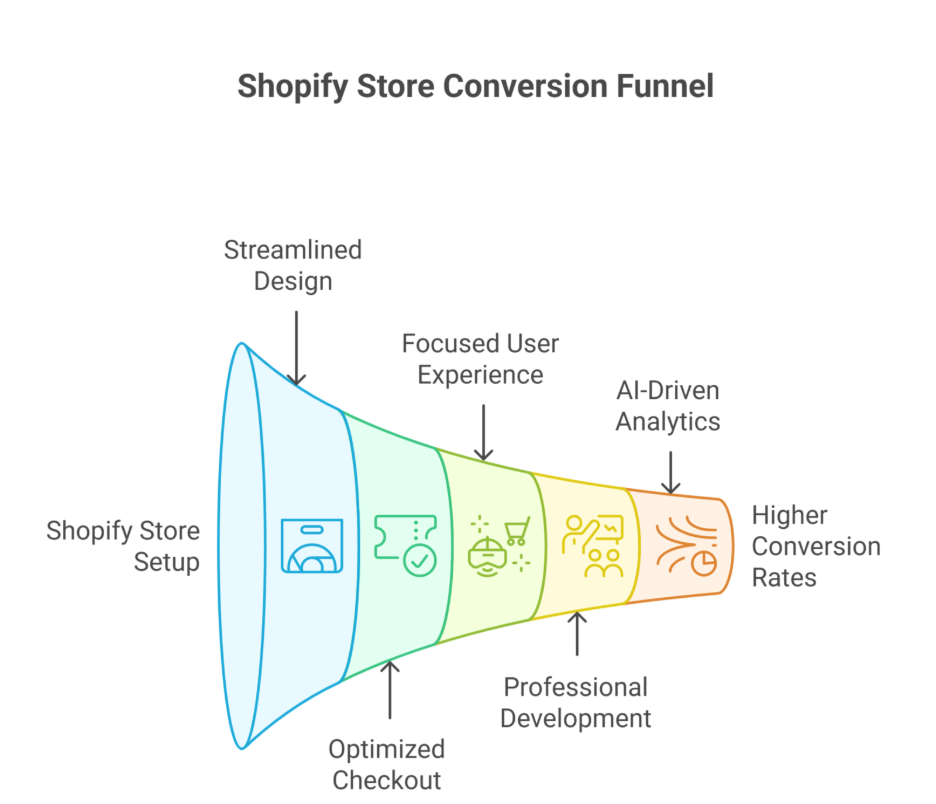
In 2025, many Shopify stores saw measurable improvements in conversion, outperforming complex or poorly optimized competitors. By focusing on user experience, strategic Shopify marketing, and leveraging the platform’s robust features, store owners were able to achieve higher conversion rates, directly impacting their revenue and brand growth.
Streamlined Shopify Platform and Checkout Experience
One key reason for high conversion is the Shopify platform itself. Shopify in 2025 offered enhancements to Shopify payments, checkout flows, and overall store performance that simplified the shopping experience. By reducing friction in the checkout process, Shopify store owners increased customer trust, leading to high conversion and repeat purchases. Statistics for 2025 show that stores worldwide implementing these optimizations consistently surpassed the average Shopify conversion rate.
Importance of Conversion Rate Optimization
Conversion rate optimization (CRO) became a critical focus for ecommerce brands looking to maximize ROI. Active stores using data-driven analytics, A/B testing, and AI-powered recommendations saw their overall conversion rate improve significantly. Compared to the average conversion rate for Shopify, these optimized stores reported higher conversion rates, proving the direct impact of CRO strategies on revenue.
Leveraging Shopify’s App Ecosystem
The Shopify app store provides tools for marketing automation, upsells, email campaigns, and analytics. By integrating apps strategically, store owners enhanced the shopping experience, personalized offers, and encouraged repeat engagement. This contributed to high conversion across millions of active stores, showing that thoughtful app integration directly correlates with a higher conversion rate for Shopify stores.
Global Ecommerce Trends and Brand Strategy
Global ecommerce statistics highlight that the global ecommerce market continues to expand, with growth rate projections indicating billions in online sales. Shopify store owners who aligned their strategies with global brands and optimized for cross-border commerce captured a larger share of the ecommerce platform market. Leveraging insights from global ecommerce data, merchants improved engagement, retention, and ultimately, high conversion metrics.
Data-Driven Shopify Marketing
Effective Shopify marketing in 2025 combined analytics, targeted campaigns, and optimized content to attract qualified traffic. Many Shopify stores reported that conversion improved when marketing decisions were informed by metrics such as traffic sources, product page performance, and shopper behavior. By aligning marketing with store optimization, ecommerce brands maintained a sustainable advantage in overall conversion rate and long-term growth.
Smart Marketing Strategies Enhanced Brand and Customer Experience
Leveraging Modern Commerce Platforms
- Using Shopify and tools like Shopify, merchants streamlined store creation and management.
- Shopify Plus has evolved, offering advanced features for enterprise-level stores globally.
- Commerce platforms like Adobe Commerce and headless commerce enable flexible, personalized shopping experiences.
- Insights into customer behavior help brands tailor marketing campaigns and product recommendations.
Optimizing Store Design and Checkout
- Simplified store builder and store creation tools improved navigation for store visitors.
- Reducing complex checkout flows led to better conversion rates and higher customer satisfaction.
- Many stores focused on mobile-first design, enhancing the overall shopping experience.
Data-Driven Marketing and Analytics
- Latest Shopify statistics provide key statistics for merchants to track growth and engagement.
- Using analytics, merchants understand store visitors’ behavior and optimize campaigns for better conversion rates.
- Shopify growth trends indicate millions of active stores worldwide leveraging insights to improve marketing strategies.
Expanding Reach and Brand Visibility
- Borderless ecommerce strategies allowed stores globally to reach international audiences.
- Number of Shopify stores continues to rise, creating a competitive environment that rewards strategic marketing.
- Store owners using Shopify site optimization and targeted campaigns strengthened brand loyalty and enhanced customer experience.
Conclusion
In 2025, the success of Shopify stores clearly demonstrated that simplicity, strategy, and smart execution drive better results than complexity alone. Stores that focused on streamlined design, optimized checkout, and a seamless user experience consistently achieved higher conversion rates and stronger brand performance. Professional development, AI-powered analytics, and strategic marketing empowered merchants to make data-driven decisions, scale efficiently, and enhance customer satisfaction.
By leveraging Shopify’s robust platform features, app ecosystem, and insights into global ecommerce trends, store owners were able to align their marketing strategies with shopper behavior and optimize every touchpoint. The rise of borderless ecommerce and millions of active stores worldwide emphasized the importance of staying agile, prioritizing user experience, and adopting proven optimization techniques.
Ultimately, simpler Shopify stores proved that thoughtful design, ongoing support, and targeted strategies are essential for sustainable growth, better conversion rates, and long-term success in the competitive ecommerce market. Ready to boost your Shopify store? Contact Integriti Studio today.
Frequently Asked Questions (Why Simpler Shopify Stores Outperformed Complex Ones in 2025)
Is Shopify worth doing in 2025?
Yes Shopify is worth doing in 2025 if you want a scalable, easy‑to‑use ecommerce platform with strong AI tools, global reach, and many apps to grow sales. It has costs and customization limits, but for most online sellers it still offers excellent value.
What is the outlook for Shopify in 2025?
The outlook for Shopify in 2025 is generally positive: the company is forecast to deliver mid‑to‑high‑20% revenue growth, strong free‑cash‑flow margins, and continued merchant expansion, supported by AI tools and global adoption. Some risks remain from competition and macro factors, but overall growth momentum persists.
Why are businesses moving from Drupal to Shopify in 2025?
Businesses are moving from Drupal to Shopify in 2025 mainly because Shopify offers managed hosting, simpler maintenance, and lower technical overhead, freeing teams from infrastructure tasks. It also delivers faster setup, built‑in security, better scalability, and extensive app integrations, making e‑commerce easier and more cost‑predictable.
Who is Shopify’s biggest competitor?
Shopify’s biggest competitor is WooCommerce, the WordPress-based e-commerce platform, due to its flexibility, large user base, and open-source ecosystem. Other significant competitors include BigCommerce, Wix, Squarespace, and Magento, but WooCommerce remains the top rival for merchants seeking customizable and cost-effective online store solutions.
Leave a Reply