
Building A Shopify Store Structure That Supports Sustainable Growth
Why do some ecommerce brands grow steadily on Shopify while others struggle to scale despite strong products? The answer often lies in how your shopify store is structured, optimized, and maintained over time. A high-performing shopify setup goes beyond visuals it reflects strategic planning, clean architecture, and development choices that support sustainable growth as your business evolves.
Building a Shopify store structure that supports sustainable growth requires strategic planning, scalable design, and ongoing optimization. By focusing on performance, SEO, user experience, and professional maintenance, you ensure your Shopify store can handle growth, improve conversions, and support long-term ecommerce success.
Website performance is shaped by multiple factors working together, including design consistency, technical structure, load efficiency, and how well your store is built to optimize both search visibility and user experience. Professional development ensures your shopify store remains scalable, secure, and aligned with modern seo and scalability requirements. Strong design, ongoing support, and structured maintenance directly improve conversion and protect long-term performance. Many businesses typically invest a few hundred dollars per month in optimization and support far less than the cost of rebuilding a poorly structured store later.
Building a scalable Shopify store structure for sustainable ecommerce growth
Why scalability matters for Shopify success
When building a scalable Shopify store, the goal is to create a foundation that supports sustainable ecommerce growth without frequent overhauls. A scalable Shopify store ensures your infrastructure can handle increased traffic, a growing product catalog, and higher order volumes, while maintaining speed, security, and a seamless user experience. Planning for scalability from the start reduces future costs and prevents disruptions as your business expands.
Core principles for building a scalable Shopify store
- Modular store architecture: Use flexible templates and modular sections that allow you to add new products, collections, and pages without redesigning the entire site.
- Optimized apps and integrations: Choose apps that integrate efficiently with your store and avoid unnecessary plugins that can slow performance or create conflicts.
- Performance and SEO focus: Ensure product pages, collections, and checkout workflows are optimized to improve load speed and conversion, while aligning with shopify’s SEO best practices.
Sustainable ecommerce practices in store design
Incorporating sustainable business practices into your store can enhance brand reputation and appeal to eco-conscious consumers. Examples include highlighting sustainable products, using energy-efficient hosting, and reducing digital waste. A sustainable ecommerce approach not only supports environmental responsibility but also builds trust with a loyal customer base.
Strategies to scale your Shopify store effectively
To scale your Shopify store, invest in professional development services to ensure long-term stability. Regularly review workflows, optimize apps and integrations, and monitor analytics to inform decisions. By building with scalability in mind, your store can grow organically, improve customer retention, and achieve ecommerce success over time.
Optimizing Shopify store user experience SEO and conversion scalability
Creating a scalable Shopify store isn’t just about adding products it’s about ensuring every aspect of your store drives ecommerce success, improves customer retention, and supports long-term growth. Optimizing user experience (UX), SEO, and conversion processes in a structured, step-by-step manner allows you to scale a Shopify store efficiently while maintaining performance and engagement.
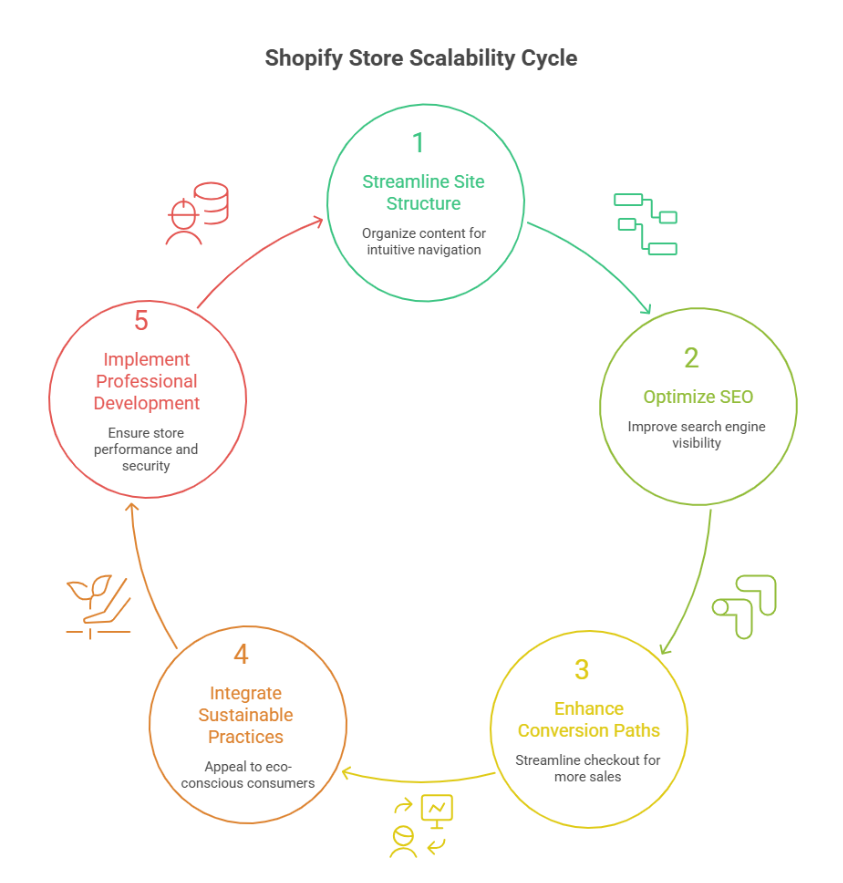
Step 1: Streamline site structure for better user experience
A modular layout makes navigation intuitive and scalable. Organize collections, menus, and product pages logically to ensure a seamless browsing experience. Highlight sustainable products and eco-conscious messaging to appeal to eco-conscious shoppers, improving trust and encouraging repeat purchases.
Step 2: Optimize SEO for discoverability
Use shopify’s built-in SEO features and carefully structured URLs to improve search rankings. Optimize product titles, meta descriptions, and images to enhance visibility. This helps attract new traffic while also supporting organic growth from existing customers. Implementing proper SEO practices ensures your scalable Shopify store grows sustainably without losing relevance.
Step 3: Enhance conversion paths
Focus on streamlining checkout flows, optimizing product pages, and improving page speed to maximize conversion. Integrate apps and analytics tools to monitor customer behavior and test actionable strategies. This step ensures your building a scalable Shopify plan converts visitors into loyal buyers efficiently.
Step 4: Integrate sustainable business practices
Show your commitment to sustainable operations, whether through eco-friendly packaging, energy-conscious hosting, or messaging about sustainable products. Incorporating sustainable practices reinforces brand values, builds a loyal customer base, and supports long-term scalability.
Step 5: Implement professional development services
Leverage expert development services to audit, optimize, and maintain your store. Regular updates, testing, and apps and integrations ensure your scalable Shopify store remains fast, reliable, and capable of handling growth without compromising user experience or SEO.
Conclusion
Building a Shopify store that truly supports sustainable growth requires more than attractive design or product variety. It demands a carefully scalable Shopify store structure, optimized user experience, strong SEO, and professional maintenance. By focusing on modular layouts, efficient apps and integrations, streamlined conversion paths, and eco-conscious practices, you ensure your store can handle increasing traffic, improve customer retention, and achieve long-term ecommerce success. Regular audits and professional development services further safeguard performance, allowing your store to grow organically while maintaining reliability, speed, and engagement.
Every strategic choice from highlighting sustainable products to optimizing checkout flows contributes to building a sustainable business that appeals to both eco-conscious and loyal shoppers. By combining performance, scalability, and sustainability, your Shopify store becomes a robust platform ready to evolve with your business needs.
if building a truly scalable, sustainable Shopify store could transform your growth, why not reach out to Integriti Studio and see how they can help you achieve it?
Frequently Asked Questions (Building A Shopify Store Structure That Supports Sustainable Growth )
How to make your Shopify store grow?
To grow your Shopify store, focus on strong product positioning, fast and mobile-optimized design, SEO-friendly structure, and data-driven marketing. Use email and paid ads strategically, improve conversion rates, analyze customer behavior, and continuously optimize checkout, apps, and performance for long-term scalable growth.
What is the organizational structure of Shopify?
Shopify follows a decentralized, product-led organizational structure. Teams are arranged around functions like product development, engineering, design, marketing, sales, and operations. This structure promotes cross-functional collaboration, faster decision-making, innovation, and scalability while supporting millions of merchants globally.
How to make a retail store more sustainable?
Make a retail store sustainable by using eco-friendly materials, reducing energy consumption, minimizing waste, sourcing locally, offering reusable packaging, promoting recycling, and adopting green supply chain practices.
Is Shopify eco-friendly?
Yes Shopify is considered eco-friendly in several ways. Its platform runs on renewable-energy cloud hosting that is carbon neutral, and it offers tools like the Planet app for carbon-neutral shipping. Shopify also supports sustainable packaging, carbon offset programs, and eco-focused merchant integrations.
Leave a Reply