Category: Studioblogs

  • How To Use Responsive Web Design for Your Ecommerce Store in 2025: A Future-Proof Guide

    How To Use Responsive Web Design for Your Ecommerce Store in 2025: A Future-Proof Guide

    How To Use Responsive Web Design for Your Ecommerce Store in 2025: A Future-Proof Guide

    Picture this-A customer browses your Shopify store on their phone while waiting for their coffee. Your product images load instantly, buttons are thumb-friendly, and checkout takes fewer taps than ordering a latte. By the time their name is called, they’ve bought two items and tagged your brand on Instagram.  

    This isn’t just convenience—it’s 2025’s make-or-break standard for ecommerce success. With mobile shoppers projected to drive 75% of global online sales by next year (Statista), responsive web design (RWD) is no longer optional. For Integriti’s clients, it’s the secret weapon turning casual browsers into loyal buyers. Let’s unpack how to future-proof your store today.  

    Discover more

    Why 2025 Demands a Mobile-First Overhaul (Hint: It’s Not Just Phones)

    Google’s 2024 “Mobile-First Evolution” update made one thing clear: Sites not optimized for all devices will vanish from search results. But “responsive” in 2025 means more than fitting screens—it’s about anticipating how, where, and why people shop:  

    • 73% of shoppers abandon sites that feel “clunky” on their device (Baymard Institute)  
    • AI-driven layouts now adjust to ambient light and user grip patterns  
    • Voice commerce is exploding, with 45% of Gen Z using smart speakers to shop (Adobe)

    5 Game-Changing Responsive Design Tactics for 2025

    1. AI-Powered “Self-Healing” Layouts

    Forget manual tweaks. Tools like Google’s Auto-RWD now:  

    • Fix overlapping elements in real-time  
    • Adjust font sizes based on reading distance (hello, smartwatches!)  
    • Prioritize “tap zones” for left- vs. right-handed users
    2. Haptic Feedback Menus That Guide Thumbs

    The 2025 shopper expects tactile responses:  

    • Vibrating CTAs confirm button presses  
    • Pressure-sensitive scrolling (light vs. hard swipes)  
    • Edge-swiping menus inspired by TikTok’s UX
    3. 6G-Optimized Media That Loads in 0.2 Seconds

    With 6G rolling out globally, shoppers expect lightning speed:  

    • Context-aware images (show winter coats if local temp drops)  
    • Auto-degrading video quality during spotty connections  
    • Predictive caching that pre-loads products you’ll likely view
    4. Voice-First Navigation for Hands-Free Shopping

    “Hey Shopify, find eco-friendly yoga mats under $50”:  

    • Voice-search hotspots in headers  
    • Audio product descriptions for accessibility  
    • Tone-analysis suggesting items based on vocal stress cues
    5. “Invisible” Checkouts That Feel Like Magic

    2025’s gold standard? Checkouts that:  

    • Auto-fill details via biometric scans (no more typing CVV codes)  
    • Offer dynamic payment options (Apple Pay on iOS, GPay on Android)  
    • Use device tilt to confirm orders (tilt right = purchase)

    The Hidden Costs of Outdated RWD (And How to Avoid Them)

    PSA: Google’s 2025 Core Web Vitals will penalize sites that:  

    • Take >0.5 seconds to respond to taps  
    • Lack foldable/flexible screen support  
    • Ignore “ambient commerce” (shopping via AR glasses, car dashboards)

    Scary Stat: 81% of shoppers distrust sites that fail basic mobile tests (McKinsey).  

    Your 3-Step 2025 Responsive Design Checklist
    1.Audit Ruthlessly
    1. Test on emerging devices: Samsung Rollable Phones, Meta VR headsets  
    1. Simulate 6G speeds with Cloudflare’s new testing suite  
    1. Track “rage clicks” (frustrated multiple taps) via Hotjar
    2.Prioritize Profit-Boosting Fixes
    1. First: Checkout flow & core product pages  
    1. Then: Blog/media layouts  
    1. Finally: Experimental features (AR try-ons)
    3.Prepare for the Next Shift
    1. Bookmark Google’s 2025 RWD guidelines (updated quarterly)  
    1. Invest in AI tools that auto-adapt to new devices  
    1. Train staff on “anticipatory design” principles

    “But Wait—My Desktop Traffic Still Matters!”

    Here’s the kicker: 2025’s best-performing sites use device-agnostic design:  

    • Desktops get keyboard shortcuts (Ctrl + “/” opens search)  
    • Tablets activate stylus hover menus  
    • TVs show 3D product zooms during ads

    3 RWD Myths Debunked (Stop Believing These!)

    “Mobile-first means mobile-only”
    → Truth: 2025’s RWD is context-aware. Your site should:
    • Enlarge buttons in cold weather (gloves!)
    • Simplify layouts during peak commute hours

    “All devices get the same content”
    → Truth: Smart RWD delivers tailored experiences:

    • Show video demos on Wi-Fi
    • Display text summaries on cellular

    “Shopify handles it automatically
    → Truth: Shopify provides tools, not strategy.  

    Need help with Shopify website design and development? Integriti’s team of Shopify website designers are your best bet!

    Click here for Shopify support and maintenance

    How to Future-Proof Any Site (Shopify or Not)

    Test on 2025’s devices (not just iPhones):

    • Meta Quest VR headsets
    • BMW’s in-car browsers
    • Samsung’s Flex In & Out laptops
    Adopt AI-powered RWD tools:
    • Adobe Firefly: Auto-generates responsive images
    • Google’s Aurora: Predicts device trends (e.g., surge in AR shopping)
    Audit quarterly:
    • 67% of sites break after adding new features (WebAIM)
    The Bottom Line

    Responsive web design is non-negotiable for every website—Shopify, WordPress, or custom-coded. The difference? Shopify gives you a head start; other platforms require more heavy lifting.  

    Here’s the kicker: 58% of shoppers won’t recommend brands with poor mobile experiences (2024 Moz data). In 2025, shoppers won’t just prefer responsive sites—they’ll demand them. But with Integriti’s RWD solutions, you’re not just keeping up. You’re staying 10 steps ahead.  

    Claim your spot with Integriti

    SEO Optimization

  • How a Shopify App Development Agency Can Solve Your eCommerce Pain Points

    How a Shopify App Development Agency Can Solve Your eCommerce Pain Points

    How a Shopify App Development Agency Can Solve Your eCommerce Pain Points

    Introduction

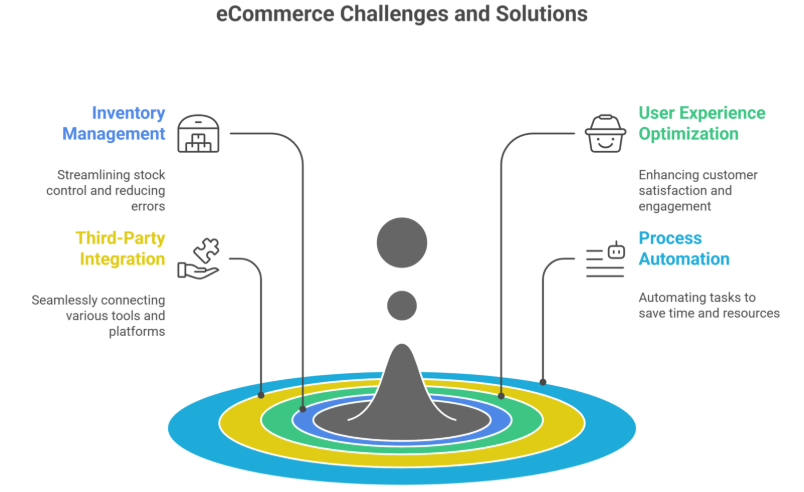
    Running a complete online store on Shopify comes with many immense opportunities. However, it also presents quite some challenges. From managing inventory and highly optimizing user experience to integrating third party tools and automating processes. Business owners often face hurdles that slow down growth on their ecommerce platforms and Shopify stores.

    This is where a Shopify App Development Agency or a Shopify development partner will come in. These agencies highly specialize in creating custom Shopify apps and solutions tailored to a store’s unique business needs. Helping businesses overcome bottlenecks, streamline operations, and scale effectively to achieve ecommerce success.

    In this blog, we will explore the common eCommerce challenges and Shopify merchant pain points. These problems can be solved by a Shopify app development agency smartly with custom development solutions.

    Common eCommerce Pain Points & Their Solutions

    Common eCommerce Pain Points & Their Solutions

    1. Limited Store Functionality

    While Shopify offers quite a huge range of built-in features, many business owners require advanced features that aren’t available by default. A Shopify app developer or app development agency can create custom apps to:

    • Add advanced filtering and search options.
    • Develop custom pricing models for wholesale or B2B customers.
    • Build unique checkout experiences that fit business needs.
    • Integrate subscription based models for many recurring purchases.

    With a tailored app, your ecommerce store can function exactly the way you need it to, highly improving the overall shopping experience and increasing average order value.

    2. Slow & Inefficient Order Management

    Managing orders efficiently is crucial for customer satisfaction and business growth. A Shopify app development agency can automate and optimize order processes by:

    • Creating automated invoicing systems.
    • Developing custom dashboards for real-time order tracking.
    • Highly Integrating order fulfillment solutions with third party logistics (3PL) services.
    • Enabling bulk order processing to save time and reduce manual effort.

    This results in faster deliveries, fewer errors, and improved efficiency.

    3. Integration Issues with Third-Party Tools

    Many businesses rely highly on external tools such as CRM, ERP, accounting software, and marketing platforms. However, integrating these third-party apps with Shopify can be very complex. A Shopify app development company can:

    • Seamlessly connect Shopify with inventory management and POS systems.
    • Sync customer databases with email marketing platforms.
    • Develop real-time data synchronization between Shopify and third-party services.
    • Ensure all integrations are stable and secure.

    These integrations streamline business operations and provide a unified workflow, enabling data-driven decision-making.

    4. Poor User Experience (UX) & Design Limitations

    A cluttered or confusing store layout can drive potential customers away. A Shopify design agency enhances user experience (UX) by:

    • Creating custom, responsive themes tailored to brand aesthetics.
    • Optimizing page speed and mobile performance.
    • Implementing user friendly navigation for much better product discovery.
    • Highly personalizing the shopping journey with total AI driven recommendations.

    A well designed store leads to much increased engagement and pretty high conversions.

    5. Cart Abandonment & Low Conversion Rates

    Cart abandonment is a very major issue for ecommerce businesses. A Shopify app development agency can help reduce drop-offs by:

    • Developing one-click checkout solutions.
    • Implementing exit-intent popups with discounts.
    • Creating automated abandoned cart recovery emails.
    • Integrating multiple payment gateways for a highly seamless transaction experience.

    These improvements make the checkout process very smooth and completely hassle free. This leads to higher conversions.

    6. Limited Analytics & Data Insights

    Without proper analytics, it’s quite hard to make data-driven decisions. A Shopify app development company can:

    • Develop custom analytics dashboards for sales tracking.
    • Implement heatmaps and user behavior tracking.
    • Enable AI driven demand forecasting for much better inventory management.
    • Integrate Shopify with Google Analytics and other highly advanced tools.

    These insights help businesses optimize their strategies and improve performance.

    7. Scaling & Performance Issues

    As your Shopify store grows, handling increased traffic and transactions can become challenging. A Shopify app development agency ensures your store remains scalable by:

    • Optimizing database queries for faster load times.
    • Implementing server-side caching for better performance.
    • Enabling cloud-based solutions for high-traffic handling.
    • Creating multi-store setups for international expansion.

    This ensures a seamless shopping experience even during peak sales periods.

    8. Security & Compliance Concerns

    With rising cybersecurity threats, keeping your Shopify store secure is a top priority. A Shopify development agency enhances security by:

    • Implementing SSL encryption and PCI compliance.
    • Enabling two-factor authentication (2FA) for store access.
    • Securing customer payment information with tokenization.
    • Regularly updating apps and security patches.

    A secure store builds trust and protects both business and customer data.

    Why Work with a Shopify App Development Agency?
    1. Expertise in Shopify Ecosystem

    A Shopify app development agency understands Shopify’s architecture, APIs, and best practices. This ensures that your store operates efficiently and leverages the full potential of the Shopify app store.

    2. Custom-Tailored Solutions

    Instead of relying on generic third-party apps, an agency develops custom solutions based on your business requirements.

    3. Ongoing Support & Maintenance

    A Shopify app development company offers continuous support, regular updates, and improvements to keep your store running smoothly and ensure customer satisfaction.

    4. Time & Cost Efficiency

    Custom-built apps eliminate the need for multiple third-party apps, reducing development costs and improving operational efficiency in the long run.

    Conclusion

    A Shopify app development agency can solve many critical ecommerce challenges. From improving store functionality and order management to enhancing user experience, conversion rates, and security, custom Shopify app development empowers businesses to scale efficiently.

    If you are looking to take your Shopify store to the very next level. Partnering with a Shopify development agency will highly ensure you stay pretty competitive in the ever evolving eCommerce landscape.

    Want your business to be seen and heard online? Explore our Services
     

    Frequently Asked Questions (How a Shopify App Development Agency Can Solve Your eCommerce Pain Points)

    What are the pain points of Shopify?

    Shopify’s main pain points include high app and transaction costs, limited design flexibility without coding, dependency on third-party apps, slower load speeds with heavy plugins, and challenges in SEO customization. Scaling can also get expensive as advanced features often require paid apps or higher-tier plans.

    What does a Shopify developer do?

    A Shopify developer builds, customizes, and optimizes Shopify stores. They handle theme development, app integrations, speed improvements, custom features, and bug fixes. They ensure the store looks professional, functions smoothly, converts well, and aligns with the brand’s goals while providing ongoing technical support.

    What are the skills required for Shopify developer?

    A Shopify developer needs strong skills in HTML, CSS, JavaScript, and Liquid for theme customization. They should understand UX/UI, Shopify APIs, app integrations, site speed optimization, and eCommerce best practices. Problem-solving, debugging, and knowledge of SEO and conversion-focused design are also essential.

    How difficult is Shopify development?

    Shopify development is moderately difficult. Basic setup is easy, but advanced customization requires strong coding skills in Liquid, JavaScript, HTML/CSS, and API handling. Challenges arise with complex features, performance optimization, and integrating third-party apps. With practice, developers can build highly customized, high-converting stores.

  • How a Shopify Plus Development Agency Improves Store Performance & UX

    How a Shopify Plus Development Agency Improves Store Performance & UX

    How a Shopify Plus Development Agency Improves Store Performance & UX

    Introduction

    Running quite a success full eCommerce store isn’t just about having very great products. It’s also about delivering a very exceptional user experience (UX). Also maintaining top-notch performance. This is exactly where a Shopify Plus Development Agency will come in handy. With highly advanced features, custom development, and optimization strategies. They help brands scale efficiently and provide a very seamless shopping experience.

    In this blog, we will explore how working with a Shopify Plus Development Agency can highly enhance your store’s performance and user experience. It will ensure customers stay highly engaged and convert more often.

    What is Shopify Plus?

    Shopify Plus an enterprise level e Commerce platform is highly designed for growth of  many businesses. Not similar to standard Shopify. It offers highly enhanced customization, automation, and scalability options. In order to unlock its full potential, brands often need high expertise of a Shopify Plus Developer or a very specialized Shopify Plus Development Company.

    A Shopify Plus Development Agency provides highly technical expertise. It ensures that your store is pretty optimized for speed, performance, and seamless user experience.

    How a Shopify Plus Development Agency Enhances Store Performance

    1. Optimizing Page Speed

    A very slow loading website leads to high bounce rate and lost quite sales. A Shopify Plus Development Company helps a lot to optimize your store’s speed by:

    • Implementing lazy loading for images and videos.
    • Compressing and optimizing images without losing quality.
    • Reducing unnecessary code and scripts.
    • Utilizing Content Delivery Networks (CDNs) to highly speed up load times globally.
    • Enabling browser caching to improve return visitor experience.
    • Minifying CSS, JavaScript, and HTML files to highly enhance load times.
    • Optimizing Shopify’s Liquid code for total efficiency.

    2. Customizing Shopify Plus for Performance

    A Shopify Plus Developer can fine-tune your store’s architecture for better performance by:

    • Creating custom themes that eliminate bloated code.
    • Optimizing server response times.
    • Improving database queries for faster backend operations.
    • Enabling progressive web app (PWA) features for better mobile performance.
    • Ensuring third-party apps do not slow down your store.
    • Enhancing API performance for smooth integrations.

    3. Ensuring Mobile Optimization

    With mobile shopping on the high rise. Ensuring a very seamless mobile experience is quite crucial. A Shopify Plus Development Agency will:

    • Implement mobile-first design principles.
    • Optimize touch elements and navigation for smaller screens.
    • Reduce excessive pop-ups and intrusive elements.
    • Improve checkout flows for effortless mobile transactions.
    • Ensure pages load within three seconds for mobile users.
    • Develop Accelerated Mobile Pages (AMP) for quite faster load times.

    How a Shopify Plus Development Agency Improves UX

    1. Enhancing Navigation & Site Structure

    A well-structured website improves usability and keeps visitors engaged. A Shopify Plus Development Company can:

    • Design intuitive navigation menus.
    • Optimize category pages for easier product discovery.
    • Implement AI-driven search functionality.
    • Create a user-friendly mega menu for large inventories.
    • Ensure breadcrumb navigation for better user journey tracking.
    • Improve internal linking to enhance product discoverability.

    2. Improving Checkout Experience

    A lengthy or complicated checkout process leads to cart abandonment. A Shopify Plus Developer can simplify it by:

    • Enabling one-click checkout.
    • Integrating multiple payment gateways.
    • Auto-filling customer details for returning buyers.
    • Reducing form fields to the essentials.
    • Implementing trust signals like secure payment icons and guarantees.
    • Offering post-purchase upsell opportunities.

    3. Personalization & Customer Engagement

    Personalization plays a key role in modern eCommerce UX. A Shopify Plus Development Agency can enhance engagement by:

    • Implementing AI-driven product recommendations.
    • Enabling dynamic content based on customer behavior.
    • Using chatbots and live chat for quite real-time support.
    • Automating follow-up emails and abandoned cart recovery messages.
    • Creating customer segments for targeted marketing campaigns.

    4. Enhancing Security & Trust

    Customers are more likely to shop on secure websites. A Shopify Plus Development Company ensures top-tier security by:

    • Implementing SSL certificates for encrypted transactions.
    • Enabling fraud detection tools.
    • Ensuring compliance with PCI DSS security standards.
    • Providing secure customer data management.
    • Regularly updating and patching possible security vulnerabilities.

    Why Work with a Shopify Plus Development Agency?

    While Shopify Plus offers powerful features, maximizing them requires expertise. A Shopify Plus Development Agency ensures your store remains competitive by:

    • Handling complex customizations that go beyond built-in features.
    • Providing continuous maintenance to prevent performance issues.
    • Implementing data-driven strategies for optimization.
    • Offering dedicated support to resolve technical challenges.
    • Scaling your store efficiently as your business grows.
    • Integrating third-party applications very seamlessly with your Shopify Plus store.
    • Creating automation workflows to highly improve operational efficiency.

    Conclusion

    A Shopify Plus Development Agency plays a quite vital role in enhancing your store’s performance and user experience. From much faster page speeds and mobile optimization to highly improved navigation and checkout flows. Their expertise helps you provide quite a seamless shopping journey.

    If you’re looking to highly scale your eCommerce business. Partnering with Shopify Plus Development Company quite ensures you stay way ahead in today’s highly competitive market.

    Want your business to be seen and heard online? Explore our Services
  • How a WooCommerce Development Company Can Build Your Brand’s Identity

    How a WooCommerce Development Company Can Build Your Brand’s Identity

    Beyond Templates: How a WooCommerce Development Company Can Build Your Brand’s Identity

    Introduction

    In today’s highly competitive eCommerce landscape, simply having an online store isn’t enough. Your store needs to totally reflect your brand identity, ensuring that customers recognize and highly trust you. While WooCommerce offers soo many ready-made themes, they may not always capture your brand’s unique personality or overall brand message. This is where a WooCommerce Development Company can make a huge difference.

    By leveraging WooCommerce development services, businesses can create totally custom, high-performance WooCommerce stores that completely align with their branding and business goals. Whether you are a startup or a well-established WooCommerce store owner, working with a WooCommerce specialist can help you a lot in going beyond standard templates and craft a store that totally stands out, reflecting your new logovisual identitybrand voice, and tone of voice.

    Why Branding Matters in WooCommerce

    Why Branding Matters in WooCommerce

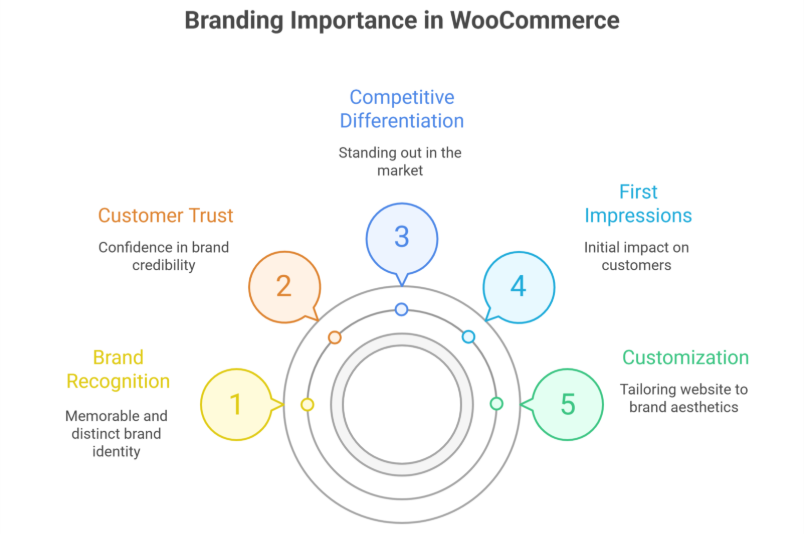
    1. First Impressions Count

    Your website is mostly the first interaction a customer has with your new brand. A very generic, template-based design can make your store look like countless others, highly reducing brand recognition. Investing in WooCommerce web development allows you to totally customize every aspect of your website. It will reflect your brand colors, typography, and refreshed color palette.

    2. Enhancing Customer Trust

    A well-branded WooCommerce store instills high confidence. Consistency in design, tone, and visuals makes a strong brand appear highly professional and very credible. Customers are more likely to buy from a store that looks polished and very trustworthy, helping brand awareness grow.

    3. Competitive Differentiation

    The e-commerce space is very saturated with businesses selling pretty similar products. Custom branding helps highly differentiate your store from competitors. Making your brand more recognizable and very memorable, allowing your overall user experience to connect with your audience.

    How a WooCommerce Development Company Builds Your Brand Identity

    1. Custom Design Tailored to Your Brand

    WooCommerce Development Company in USA or anywhere else can help design a WooCommerce store that totally aligns with your brand identity. This includes:

    • Custom layouts that highly reflect your brand’s personality.
    • Personalized fonts, colors, and graphics.
    • A user interface (UI) that completely enhances user experience (UX).

    Unlike pre-built themes, a totally custom design ensures that every visual element contributes highly to your brand story and overall brand.

    2. Personalized User Experience

    Every WooCommerce store owner has a unique audience with specific needs. A WooCommerce development company can optimize your site’s UX by:

    • Creating intuitive navigation structures.
    • Developing personalized product recommendations.
    • Implementing smooth checkout processes.

    This results in a highly engaging shopping experience, leading to higher conversion rates and reinforcing your brand identity isn’t generic.

    3. Custom Functionalities and Features

    Out-of-the-box WooCommerce themes may not always fully support the functionalities your business requires. A WooCommerce specialist can highly integrate features such as:

    • Custom product filters.
    • Subscription services.
    • Dynamic pricing strategies.
    • Advanced analytics tools.

    These tailored features ensure that your store meets both your business and the entire Woo expectations.

    4. Mobile-Optimized Experience

    More than half of online shopping happens completely on mobile devices. A WooCommerce web development team highly ensures your store is very responsive, providing a highly optimal shopping experience across devices.

    5. Seamless Third-Party Integrations

    To highly enhance branding and operations, you may need integrations such as:

    • Email marketing tools (e.g Mailchimp, Klaviyo).
    • CRM software (e.g HubSpot, Salesforce).
    • Social media feeds for high much brand engagement.

    A WooCommerce development company helps integrate these tools seamlessly, making brand communication more effective.

    6. SEO Optimization for Better Visibility

    SEO is essential for your WooCommerce product visibility and overall brand update. Developers ensure your site is totally SEO friendly, optimizing factors such as:

    • Page speed and performance.
    • Schema markup for better search engine indexing.
    • SEO-friendly URLs and meta descriptions.

    An optimized WooCommerce store improves search rankings, driving organic traffic and reinforcing brand credibility.

    The Role of Custom WooCommerce Themes

    While ready-made themes provide convenience, they often come with pretty limitations in customization and branding. A WooCommerce Development Company can build total custom themes that:

    • Align with your brand’s vision.
    • Provide better scalability and performance.
    • Ensure high security and compliance.

    Custom themes give you great control over the website’s design and functionality, allowing for a highly unique Woo identity.

    Choosing the Right WooCommerce Development Company

    Not all development services are equal. Here’s what to look for when hiring a WooCommerce development company:

    1. Experience and Portfolio

    Check if the company has experience in your industry and has worked on similar projects. A strong portfolio is a really good indicator of expertise.

    2. Client Reviews and Testimonials

    Look for client feedback and ratings. Platforms like Clutch, Upwork, or Google Reviews can be used to gauge reliability and better quality.

    3. Technical Expertise

    A good WooCommerce specialist should be skilled in:

    • Custom theme development.
    • Plugin development and integration.
    • Performance optimization.

    4. Post-Launch Support

    Your WooCommerce store will need ongoing maintenance and updates. Choose a company that offers post-launch support to ensure highly smooth operations.

    Conclusion

    Your WooCommerce store should be more than just a selling platform. It should be a true reflection of your brandbrand elements, and brand voice. A WooCommerce development company helps create a store that stands out by highly customizing design, functionality, and user experience. This aligns with your brand identity and overall user experience.

    By investing in WooCommerce development services, you highly ensure that your store not only looks very unique but also provides a pretty seamless shopping experience. Whether you’re starting totally fresh or looking to upgrade, partnering with a WooCommerce specialist can highly elevate your brand to new heights.

    Want your business to be seen and heard online? Explore our Services
     

    Frequently Asked Questions (How a WooCommerce Development Company Can Build Your Brand’s Identity)

    How to build a WooCommerce?

    To build a WooCommerce store, first install WordPress and choose a suitable theme. Then, install the WooCommerce plugin, configure store settings, add products with descriptions and images, set up payment and shipping options, and optimize for SEO. Finally, test the store before going live.

    What is WooCommerce built on?

    WooCommerce is built on WordPress, which is a PHP-based content management system. It uses MySQL for database management and relies on HTML, CSS, and JavaScript for front-end design. WooCommerce leverages WordPress’s plugin architecture, making it highly flexible, customizable, and compatible with themes and extensions.

    What is a WooCommerce developer?

    A WooCommerce developer is a specialist who creates and customizes eCommerce websites using the WooCommerce plugin on WordPress. They manage store setup, theme and plugin integration, payment and shipping configuration, and performance optimization, ensuring a smooth, secure, and fully functional online shopping experience.

    What programming language does WooCommerce use?

    WooCommerce primarily uses PHP as its core programming language since it is built on WordPress. It also relies on MySQL for database management and uses HTML, CSS, and JavaScript for front-end design and interactivity. Developers can extend functionality through PHP, hooks, and WordPress APIs.

  • How to Design a Shopify Website

    How to Design a Shopify Website

    How to Design a Shopify Website

    Introduction

    A well designed Shopify website is highly important to engage and retain customers. Whether you have launched a complete new Shopify store or revamped an existing online store, having a well structured Shopify site in context to website design ensures quite a seamless shopping experience.

    In this blog, we will highlight the very essential steps to design a Shopify website. Covering almost everything from Shopify themes selection to mobile optimization. Whether you are a total beginner or working with web designers or a Shopify website designer, this blog will help you completely understand the process of creating a very user friendly and visually appealing shopify web design or Shopify store design.

    Why Shopify for eCommerce?

    Shopify is a highly well known eCommerce platform only due to its high ease of use, extreme scalability, and unique customization options. Unlike other platforms that require highly complex codingShopify makes it easy for business owners to set up their Shopify website very quickly with very intuitive design tools and complete built-in features.

    Shopify design agency or individual developers can help highly enhance the platform’s default capabilities. However even without technical expertise, you can build your site or design a beautiful Shopify store with Shopify’s completely unique tools and resources, including no-code options and Shopify app store integrations.

    Step-by-Step Guide to Designing a Shopify Website

    Step-by-Step Guide to Designing a Shopify Website

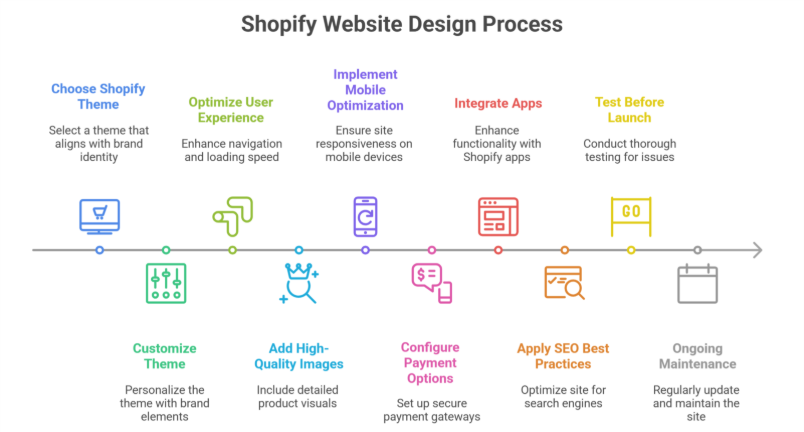
    1. Choosing the Right Shopify Theme

    Your Shopify themes highly determine the entire look and feel of your Shopify site. Shopify provides free and paid themes that cater to specific business needs. To select the best theme:

    • Consider your brand identity and aesthetics.
    • Ensure the theme is mobile-responsive.
    • Look for customization options.
    • Check customer reviews and ratings.
    • Test the demo version before committing.

    If you need more flexibility, hiring a professional Shopify designer or developer can help create a completely custom template tailored to your business unique requirements.

    2. Customizing the Theme

    Once you’ve chosen a theme, the next step is to customize your Shopify store. Shopify allows you to highly modify your store’s complete appearance using the theme editor. Key customizations include:

    • Changing fonts and color schemes.
    • Uploading a high-resolution logo.
    • Adjusting homepage layout and sections.
    • Adding promotional banners and sliders.
    • Configuring the navigation menu for easy browsing.
    3. High Optimizing for User Experience (UX)

    A well designed Shopify website focuses highly on user experience to keep visitors very engaged. Consider the following UX principles:

    • Clear Navigation: Ensure menus and categories are easy to understand.
    • Fast Loading Speed: Optimize images and remove unnecessary scripts.
    • Simple Checkout Process: Reduce cart abandonment by offering a quick checkout.
    • Consistent Branding: Maintain uniform colors, fonts, and styles.

    A Shopify design agency can help fine-tune these elements for maximum conversions.

    4. Adding High-Quality Images & Product Descriptions

    Your product pages are the heart of your online store. To make them effective:

    • Use high-quality images with multiple angles.
    • Include zoom functionality for better viewing.
    • Write detailed product descriptions highlighting features and benefits.
    • Add customer reviews and ratings to build trust.

    5. Implementing Mobile Optimization

    With a majority of online shoppers using mobile devices, ensuring a mobile-friendly Shopify site is quite crucial. Shopify themes are inherently responsive, but additional steps include:

    • Using a mobile-friendly menu.
    • Ensuring buttons and CTAs are easily tappable.
    • Optimizing image sizes to prevent slow loading.
    • Testing the site on multiple devices before launch.

    6. Configuring Payment & Shipping Options

    A very seamless checkout process is pretty vital for conversion rates. Shopify integrates with multiple payment gateways, allowing customers to pay via credit cards, PayPal, or many other methods. Set up:

    • Secure payment options with Shopify Payments.
    • Transparent shipping policies.
    • Tax calculations based on customer location.
    • A return and refund policy for clarity.

    7. Integrating Apps for Enhanced Functionality

    Shopify’s App Store offers quite numerous plugins to highly enhance your Shopify store functionality. Some must-have apps include:

    • SEO apps to improve search rankings.
    • Live chat support for real-time assistance.
    • Email marketing tools to boost customer engagement.
    • Abandoned cart recovery apps to increase sales.

    These tools ensure a smooth user experience and improved performance.

    8. Complete Search Engine Optimization (SEO) Best Practices

    To attract complete organic traffic, implement SEO strategies:

    • Use relevant keywords like Shopify website design services in product descriptions and meta tags.
    • Optimize URLs for readability.
    • Write informative blog posts related to your products.
    • Use alt tags for images.
    • Submit your total sitemap to Google Search Console.

    SEO plays quite a significant role in bringing visitors to your Shopify store without highly relying solely on paid ads.

    9. Testing Before Launch

    Before going live, conduct a thorough test of your Shopify site:

    • Check for broken links.
    • Ensure all pages load correctly on different devices.
    • Test the checkout process.
    • Verify email notifications.
    • Run speed tests using tools like Google PageSpeed Insights.

    Addressing these issues beforehand ensures a highly smooth launch with very minimal technical glitches.

    10. Ongoing Maintenance & Updates

    Shopify website isn’t just a one-time project. Regular maintenance helps keep your Shopify store updated and secure. Best practices include:

    • Updating plugins and themes regularly.
    • Monitoring analytics to understand customer behavior.
    • Refreshing content and product listings.
    • Conducting A/B testing for design improvements.
    • Keeping up with Shopify’s latest features.

    Conclusion

    Designing a Shopify website involves some specific steps. From choosing a Shopify theme to optimizing for UX and SEO, whether you do it totally yourself or hire a Shopify design agency. Ensuring a high user-friendly, mobile-optimized, and high performing Shopify site is quite essential for success.

    By following this guide, you can take your Shopify store to the next level and build a highly visually appealing and highly functional eCommerce website that stands out in a competitive market.

    Want your business to be seen and heard online? Explore our Services

    Frequently Asked Questions (How to Design a Shopify Website)

    Can I design a website on Shopify?

    Yes, you can design a website on Shopify. It provides an intuitive drag-and-drop editor, customizable themes, and a wide range of apps to enhance functionality. Even without coding skills, you can create a professional, responsive eCommerce site tailored to your brand and business needs.

    How to design a Shopify store step by step?

    To design a Shopify store, first sign up and choose a theme. Customize it using the editor, add products with descriptions and images, set up navigation, payment, and shipping. Enhance functionality with apps, test your store on desktop and mobile, then connect a domain and launch it live.

    How to custom design a Shopify website?

    To custom design a Shopify website, select a flexible theme, use the drag-and-drop editor to adjust layouts, colors, fonts, and sections, and add custom code if needed. Incorporate your branding, upload products, configure navigation, and use apps to enhance functionality, then preview and launch your store.

    Does Shopify require coding?

    No, Shopify does not require coding for most users. You can create and manage a fully functional online store using its drag-and-drop themes and built-in tools. Coding is only needed for advanced customizations, unique features, or modifying the underlying Liquid templates and CSS.

  • How to make the most of your Google Business Profile for online advertising?

    How to make the most of your Google Business Profile for online advertising?

    A Google Business Profile (GBP) aka Google My Business (GMB) is an essential tool for any company, especially those targeting local markets. Few firms make the most of their profiles, despite the fact that many develop them. Having a well-maintained business listing can significantly improve your online visibility and search rankings in Google search results.

    According to Google’s GBP statistics, if your profile is complete, users are 50% more likely to think about making a purchase and 70% more likely to visit your shop. Optimizing your Google business profile helps customers find your business in local searches and boosts your local SEO strategies.

    In this blog, we’ll explore how optimizing your Google Business Profile can enhance visibility, attract local customers, boost engagement, and improve your business’s online presence.

    Why does Google Business Profile matter?

    Customers can find your company immediately through Google Maps and Search with a Google Business Profile, which is more than simply a digital listing. Regardless of the size of your business, having a well-optimized GBP helps you reach a wider audience, be more visible in search engines, interact with potential clients, and gain their confidence. Your business pin ensures your listing is trusted across directories.

    Many potential buyers search Google to start their buying journey, often looking for products or services by the label “near me.” Your company can more easily show up in local searches if your profile is completely optimized, giving you an advantage over the competition. A GBP serves as an instant point of contact for customers to phone, message, or locate your company, making it an essential component of your customer service and engagement plan.

    Knowing how to make the most out of it:

    Now that Google has made it possible for companies to include social media accounts in their Google Business Profile, this is a fantastic chance to improve your SEO efforts and digital marketing approach. By displaying your services, contact details, business description, landing page, and photographs, GBP aims to make it simple for consumers to learn about your business’s offerings without them having to visit your website. Having your business’s GBP optimized is crucial for visibility since paid advertisements are driving organic results lower on the search results page.

    You may greatly expand the reach of Google My Business, interact with clients, and stand out in the congested search results of today by preserving your GBP with genuine material, adding photos and videos, connecting it to social media accounts, and maintaining consistent information across all directories.

    Steps to take for your Google Business Profile/ Google My Business improvement:

    Optimizing your Google Business Profile (GBP) is important for improving your online presence and connecting with potential customers. Here’s how to do it efficiently:

    __wf_reserved_inherit
    Steps to take for your Google Business Profile/ Google My Business improvement:

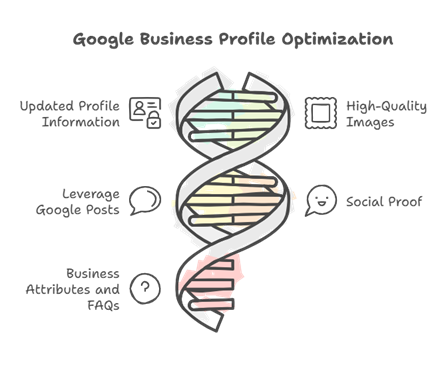
    1. Updated Profile Information:

    Make sure that all of your company’s information, including your name of your business, address, phone number (NAP), and operating hours (keep in mind to adjust your hours in accordance with special occasions or holidays) is correct and up to date. Moreover, a well-written business description that includes relevant keywords and search terms draws attention, making it easier for clients to find you, boosting your SEO efforts, and improving your search rankings.

    2. High-Quality Images:

    Keep clear of stock photos and upload real shots to offer customers a sense of authenticity. Include pictures of your shopfront, staff, merchandise, and service-specific landing pages to give prospective buyers an idea of who you are. Businesses with high-quality photos get a lot more interaction and traction in local search results.

    3. Leverage Google Posts:

    By using this function, you can keep your profile interesting and up to date by sharing events, promotions, updates about your business, newsletters, and special offers right on it. Frequent postings can draw attention to new services, significant occasions, or special deals, making it simple for clients to discover what’s going on, increasing website traffic, and helping improve your business’s online visibility.

    4. Social proof:

    Good customer reviews and positive reviews increase credibility and trust. By responding to negative reviews and customer reviews, you show your concern for the client experience. Although most customers are not avid commenters, a rating of one or a rating between 0 and 5 stars is a little suspect.

    5. Add Business Attributes and FAQs:

    Use terms like “accessible,” “women-led,” or other business attributes to make a statement. By answering commonly asked questions (FAQs) immediately on your profile, you can reduce the volume of queries you have to answer, help improve customer understanding, and provide prospective clients clarity.

    Key message to take away:

    The first step to engaging local customers is creating a Google Business Profile. Optimizing it on a regular basis increases traffic, visibility, and customer attraction without incurring additional expenses. You will experience an increase in customer engagement and trust if you take the effort to update and maintain your profile on a regular basis.

    ‍Want your business to be seen and heard online? Explore our Services

    Frequently Asked Questions (How to make the most of your Google Business Profile for online advertising?)

    How do I advertise my Google Business Profile?

    To advertise your Google Business Profile, optimize your listing with accurate info, high-quality photos, and engaging posts. Use Google Ads Local campaigns to target nearby customers, encourage reviews, and share promotions. Consistently update your profile to improve visibility and attract more local traffic.

    Is $10 a day enough for Google Ads?

    A $10 daily budget for Google Ads can work for small campaigns or local businesses, but results may be limited. It’s enough to test keywords, ads, and targeting, but scaling or competing in high-demand markets usually requires higher budgets to achieve meaningful traffic and conversions.

    Is $500 a month enough for Google Ads?

    A $500 monthly budget for Google Ads can be enough for small to medium local businesses or niche campaigns. It allows testing multiple keywords, optimizing ads, and driving some conversions. However, highly competitive industries may need larger budgets to achieve significant traffic and measurable ROI.

    How to maximize your Google Business Profile?

    To maximize your Google Business Profile, ensure complete and accurate information, add high-quality photos, and regularly post updates or offers. Encourage customer reviews and respond promptly. Use relevant keywords, enable messaging, and track insights to optimize visibility, engagement, and local search performance effectively.

  • Lost Sales Due to Poor UX? Custom Shopify Development Can Help

    Lost Sales Due to Poor UX? Custom Shopify Development Can Help

    Lost Sales Due to Poor UX? Custom Shopify Development Can Help

    Introduction

    Have you ever visited an online store. Struggled a lot to find what you were looking for, and left very frustrated? If so, you’re not the only one in this. A very poor user experience (UX) can turn away many potential customers in the matter seconds, costing businesses thousands in lost sales. When a Shopify store isn’t fully intuitive, fast, or very visually appealing, shoppers are more likely to abandon their carts and never ever return. The very good news? Investing highly in Shopify design services can make a huge difference by ensuring a very smooth and seamless shopping journey.

    Why UX Matters in eCommerce

    Think about the very last time you made a purchase online. What made it easy? What made it frustrating? The user experience plays quite a huge role in whether a visitor converts into a highly  paying customer. If a website is very slow, difficult to navigate, or has a highly complicated checkout process. Shoppers won’t think twice before heading to a fellow competitor. Research shows that even a one second delay in page load time can decrease conversions very significantly. This is where Shopify development services always come in. Helping businesses highly optimize their stores for high speed, accessibility, and ease of use.

    Common UX Issues That Lead to Lost Sales

    1. Slow Loading Speeds

    Online shoppers have very little patience for slow websites. If your store takes even longer than three seconds to load. There’s a pretty good chance visitors will leave before even seeing your site’s products. Slow speeds are often caused by very large images, excessive code, or a possible third party app running in the background. With Shopify development services, you can highly optimize images, streamline code, and implement caching strategies to highly improve site speed, ultimately leading to a totally different shopping experience.

    2. Complicated Checkout Process

    How many times have you completely abandoned a cart because the checkout process was very long or confusing? It happens quite often than you think. Customers want a much quicker, completely hassle-free way to complete their purchases. Simplifying checkout by offering auto filled fields, guest checkout options, and quite multiple payment methods can make a very big difference. Custom Shopify development services in the USA can highly tailor the checkout experience to reduce cart abandonment and totally boost conversions.

    3. Poor Mobile Responsiveness

    With particularly more than half of online shoppers using mobile devices. A store that isn’t very mobile friendly is pretty much bound to lose sales. If visitors struggle alot with tiny buttons, highly unresponsive pages, or text that’s very small to read, they won’t hesitate a bit to leave. Shopify Plus development highly ensures your store looks and works very flawlessly on any of the screen sizes. Providing mobile users with the same amazing experience as desktop shoppers.

    4. Difficult Navigation

    Customers should be quite able to find what they need within the matter of seconds. If they have to dig deeply through multiple menus, very unclear categories, or a confusing layout, the frustration will set in fast. A well-organized site with easy-to-use menus, search filters, and category structures can keep shoppers engaged. Shopify design services can help refine navigation to make product discovery effortless.

    5. Lack of Personalization

    Today’s shoppers expect a highly personalized experience. If your store isn’t offering pretty tailored recommendations, highly dynamic content, or even customized user journeys, you may be missing out on many potential sales. Custom Shopify development services in the USA can highly integrate AI-driven tools to display very relevant products, send highly personalized email campaigns, and create a very unique shopping experience for each visitor.

    6. Weak Branding & Visual Appeal

    First impressions always matter so much. A very cluttered or completely outdated design can turn visitors totally away before they even start their browsing. A very strong, cohesive brand presence builds so much trust and keeps shoppers highly engaged. Investing highly in Shopify design services allows businesses to create a highly visually appealing, modern store that aligns with their brand identity a lot and totally attracts customers.

    How Custom Shopify Development Can Improve UX

    Personalized Store Design

    Using a pretty default Shopify theme might work initially, but as your business grows. A custom design can set you quite apart. With custom Shopify development services in the USA, businesses can create very unique and engaging store completely tailored to their specific audience. Helping them stand out in a competitive market.

    Enhanced Features & Functionality

    Standard Shopify themes have limitations, but custom development unlocks a wide range of possibilities. From AI-powered product recommendations to interactive elements and loyalty programs, advanced features keep customers engaged. Smart search, chatbots, and automated customer support can also improve the overall shopping experience.

    Better Site Performance

    A very slow website doesn’t just annoy customers. It also highly affects search engine rankings. Optimizing performance highly through custom coding, pretty faster loading times, and backend improvements can reduce the bounce rates and keep visitors on your site much longer. Shopify development services ensure that your store runs efficiently without unnecessary delays.

    Seamless Third-Party Integrations

    From payment gateways and CRM systems to marketing automation tools. Integrating third-party services can totally enhance customer interactions and pretty much streamline business operations. Custom Shopify development services in the USA allow for very seamless integrations that help a lot in businesses automate processes, manage inventory, and totally boost sales effortlessly.

    Security & Reliability

    A secure store is a trustworthy store. Customers want to always know their data is completely safe when making a purchase. Custom Shopify development also includes security features like SSL certificates, very secure payment gateways, and quite regular software updates to keep your store highly protected from cyber threats.

    Scalability for Future Growth

    As your business grows a lot, so should your online store. A very scalable Shopify store always allows you to add new products, easily handle increased traffic, and highly integrate additional features without any major disruptions. Custom development totally ensures that your store is quite future-proof and very adaptable to changing market demands.

    Conclusion

    A very poor UX silently drives many potential customers away. Leading to much lost revenue and missed opportunities. Investing in Shopify development services can help a lot in optimizing your store for a much better shopping experience. Ensuring quite smooth navigation, fast loading times, and a very seamless checkout process. Custom Shopify development services in the USA provide much tailored solutions to make your store highly efficient, user-friendly, and highly conversion-focused. In a very competitive eCommerce landscape, quite prioritizing UX is not just a luxury it’s a necessity.

    Want your business to be seen and heard online? Explore our Services
  • Make your Store a Must-Visit with these 13 Tried and Tested Strategies for 2025

    Make your Store a Must-Visit with these 13 Tried and Tested Strategies for 2025

    Make your Store a Must-Visit with these 13 Tried and Tested Strategies for 2025

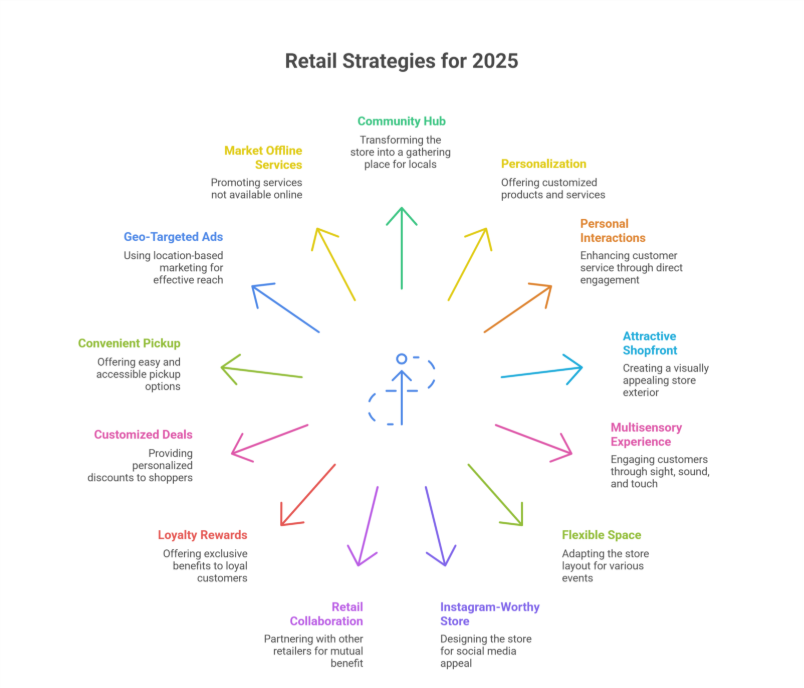
    With their lightning-fast checkout processes and personalized offerings, online retailers have set a new standard for traditional stores. People now demand the same degree of customization and ease when they visit physical stores, just as they did when they shopped online before the pandemic. Shops in brick-and-mortar locations must therefore do more than meet consumers’ fundamental necessities; they must also entice them to leave the comfort of their homes. This is essential for any retail store looking to grow and implement effective retail marketing strategies in 2025.

    Secure Your Store with Shopify Support and Maintenance (CTA Button)

    Retailers need to make in-store visits more appealing by providing customers with reasons to visit in person. People can easily shop online with only a few clicks, thus providing the basics is no longer enough. Implementing retail strategies and using digital tools can help increase foot traffic and overall retail growth.

    Let’s be real, businesses have physical locations; the question is, how can they increase sales and foot traffic there while keeping customers coming back and boosting retail sales?

    1.Turn your store into a community hub

    2. Add a personal touch with customization

    3.Make the most of personal interactions

    4. Create a more attractive shopfront  

    5. Engage customers in a multisensory journey  

    6.  Make your store a flexible space

    7. Create an Instagram-Worthy store

    8.Collaborate with fellow retailers

    9. Reward loyalty with exclusive perks

    10. Offer customized deals to shoppers

    11. Provide convenient pickup choices

    12. Run Geo- Targeted Ads for effective Digital Marketing

    13.Market services not offered online

    1.Turn your store into a community hub
    Turn your store into a community hub

    Customers want more than just goods; they want a connection. Make your store a gathering spot by sponsoring in-store events, offering workshops, or simply creating an area for people to engage. Gym+Coffee’s running groups are an excellent example of retail-based community engagement and experiential retail.

    2. Add a personal touch with customization

    Personalized products can be quite appealing. Providing unique gifts or experiences, such as Sequoia Soaps’ build-your-own gift baskets, helps customers feel more connected to the products they purchase. This enhances the customer experience and builds a loyal customer base.

    3.Make the most of personal interactions

    In-store purchasing offers several benefits, one of which is personalized service. Shopify POS allows employees to support customers from anywhere in the store, moving away from the counter to offer individualized assistance. They can easily verify item availability at different locations, retrieve a customer’s past purchases, or complete an earlier-in-the-day online shopping cart.

    Casual browsers become purchasers thanks to these tools. Businesses that integrate their online and in-store systems with Shopify POS receive an average 8.9% boost in revenues. This frees up employees’ time to help clients instead of juggling many systems or looking for information, streamlining the point of sale process.

    Click here to learn more about Shopify App Development (CTA Button)

    4. Create a more attractive shopfront  

    Customers are more inclined to set foot in your store and prolong their visit if it exudes a welcoming atmosphere. By incorporating a well-organized design scheme, chic furniture, and refined lighting, any space can be entirely transformed. Along with fostering a more comfortable environment for your customers, this will also motivate them to spend additional time browsing with you. This is something that companies like July have perfected, employing cozy, warm lighting to entice clients to stay and interact, enhancing dwell time and the in-store experience.

    5. Engage customers in a multisensory journey

    Making an effort to engage all five senses when shopping enhances the store experience. Think about how your store can improve its ambiance, greeting, music, aromas, and even little snacks just like Chicago French Press does with its welcoming, fragrant feel. This improves the overall shopping experience and helps attract new customers.

    6.  Make Your store a flexible space

    Combine retail with additional activities, such as cafes or workshops, to keep customers in-store for longer. Forth & Nomad accomplishes this by offering coffee and classes alongside its lifestyle products, enticing customers to remain and browse. This flexible approach supports strategies for retail growth and encourages foot traffic.

    7. Create an Instagram-Worthy store

    Customers are more inclined to take pictures and discuss their experiences at a store that is visually appealing. Wish’s Atlanta location, with its art-gallery-inspired exhibits, is an excellent example of how to create a social media-worthy environment, generating buzz and increasing brand awareness.

    8.Collaborate with fellow retailers

    Collaborating with other retailers is one strategy to increase client reach. With the finest of both brands available to customers in one convenient location, the cooperation between Leesa and West Elm has increased foot traffic and revenue. These partnerships act as complementary retail marketing strategies that work effectively in 2025.

    9. Reward loyalty with exclusive perks

    A fantastic strategy to retain consumers is to implement a loyalty program. Customers are more likely to return and form stronger ties with businesses that offer incentives for in-store visits and purchases, such as Kenny Flower’s Island Society program. Loyalty programs directly impact conversion and keep customers coming back.

    10. Offer customized deals to shoppers

    Imagine a more meaningful connection with your clients through personalized adverts that cater to their individual preferences. With a mobile POS system, this becomes a piece of cake. You can provide customers with more relevant recommendations and promotions if you keep tabs on what they buy. Ultimately, your relationship with your clients will be strengthened and they will feel valued. This technique builds customer loyalty by making them feel appreciated and understood.

    In addition, you can create personalized promos and campaigns by analyzing your audience’s previous encounters with your brand. 

    If you own a swimwear business, for instance, and you introduce a new print to an existing model, you might contact all of your customers who have bought that suit style in the past to offer them a discount.

    Shopify POS makes it easy to create and maintain client profiles. With this function, you can keep tabs on what your consumers buy and what they like, which opens the door to targeted advertising.

    11. Provide convenient pickup choices

    Stores see an increase in foot traffic when customers have more flexible pickup alternatives, such as Buy Online, Pick Up In-Store (BOPIS). Offbeat Bikes had a notable surge in sales when they introduced this option, streamlining the purchasing process for their clients and creating a seamless omnichannel experience.

    12. Run Geo- Targeted Ads for effective Digital Marketing

    Google searches for “near me” and similar terms are common among consumers looking for local businesses and products. The phrase “shoe store near me” is one example of a possible search query. Traditional retailers should significantly spend on local SEO to entice these clients.

    Traditional retailers should significantly spend on local SEO to entice these clients.

    Want to boost your local visibility? Start with the basics:

    -Put your shop’s name, address, and phone number front and center on your website. Make it impossible to miss!

    -Then, claim your spot on Google My Business. It’s like giving your store a megaphone in the digital world.

    Pro tip: Keep your information consistent across both platforms. It’s the secret sauce for helping customers find you easily!

    Additionally, it’s important to encourage clients to post pictures and write reviews. To further improve your position in local search engine results, you should also develop “citations” in other internet business directories.  

    13.Market services not offered online

    Do something that your online competitors can’t if you want to bring in more customers to your physical store. Offering professional recommendations is equally important because it gets people to talk to you before they make a purchase, instead of blindly buying things online. 

    A hybrid business model that combines online and in-store shopping is something to think about. Ensure that buying in person is as painless as it may be. Nowadays, customers are accustomed to receiving mediocre service; therefore, going above and beyond to guarantee their happiness would distinguish you from the competition.

    For the majority of companies, providing services exclusively in person can yield enormous benefits. More people will visit your store because of this novel strategy, which boosts consumer satisfaction and retail business growth.

    In a nutshell,

    Bring the Buzz back with these Proven Tactics

    Shops have been and will continue to be vital to the retail industry. Nevertheless, their strategic significance has changed over time. These days, drawing in customers is all about making their in-store experiences memorable, using data-driven strategies, digital marketing, and AI-powered tools. 

    Frequently Asked Questions (Make your Store a Must-Visit with these 13 Tried and Tested Strategies for 2025)

    What are the in store shopping trends in 2025?

    In‑store shopping trends in 2025 include hyper‑personalised experiences using AI and data, seamless omnichannel integration, immersive phygital tech like AR/VR, automated self‑service and checkout, and sustainability‑focused products and layouts that appeal to eco‑conscious consumers.

    How to create a complete marketing strategy in 2025?

    To create a complete marketing strategy in 2025, start with data‑driven audience insights, define clear goals, and integrate AI-powered personalization. Combine omnichannel campaigns, immersive content, influencer collaborations, and sustainable messaging. Continuously track KPIs, optimize using real-time analytics, and adapt to emerging technologies and consumer behaviors.

    What are the challenges in retail in 2025?

    Retail challenges in 2025 include adapting to rapidly evolving consumer expectations, integrating seamless omnichannel experiences, managing supply chain disruptions, ensuring data privacy and security, adopting AI and automation effectively, and meeting sustainability demands. Rising competition and economic uncertainties further pressure retailers to innovate and stay agile.

    How do I attract customers to my store?

    To attract customers to your store, offer personalized experiences using AI insights, create engaging in-store events, leverage social media and local marketing, provide exclusive promotions or loyalty rewards, ensure a seamless omnichannel experience, and focus on a welcoming, visually appealing, and sustainable store environment.


  • Migrating From Magento to Shopify Successfully

    Migrating From Magento to Shopify Successfully

    Migrating From Magento to Shopify Successfully

    Introduction

    Migrating completely from Magento to Shopify is a very decisive move. Only for businesses seeking a very user friendly, highly scalable, and cost effective eCommerce solution. While Magento is known for its high flexibility and customization. It often requires quite extensive technical expertise to manage properly. On the other hand, Shopify offers a highly intuitive platform with built in tools. Making it ideal for merchants looking for high efficiency and growth.

    A successful migration requires careful planning to highly ensure data integrity, SEO rankings, and very smooth functionality. In this blog, we will walk you through the very essential steps to migrate from Magento to Shopify. That too without disrupting even a fraction of your online business.

    Why Migrate from Magento to Shopify?

    Before jumping into the migration process, it is highly crucial to understand why businesses choose to switch from Magento to Shopify:

    • Ease of Use : Shopify has a highly intuitive and beginner friendly interface as compared to Magento.
    • Lower Maintenance Costs:  Shopify pretty much eliminates the need for highly extensive development and hosting management.
    • Scalability:  Shopify’s cloud based infrastructure quite supports businesses of all sizes without the need for any additional servers or maintenance.
    • App Ecosystem: Shopify has a vast app store for extending functionality without custom development.
    • Security & Reliability: Shopify handles security, updates, and hosting, reducing the burden on store owners.

    Pre-Migration Considerations

    1. Analyze Your Current Magento Store

    Before migrating, audit your current Magento store to understand what needs to be transferred. Key elements include:

    • Products & Categories
    • Customer Data
    • Order History
    • Website Content (pages, blogs, policies, etc.)
    • SEO Elements (meta titles, descriptions, URLs)
    2. Choose the Right Shopify Plan

    Shopify offers multiple plans. Including Basic Shopify and Advanced Shopify. If you run a large scale store, Shopify Plus can also be an option. Select a plan based on your business needs and budget.

    3. Backup Your Magento Store

    Before proceeding with migration, always create a full backup of your Magento database to prevent data loss. Export the entire important data including products, customers, orders, and CSV file imports for a smooth data migration.

    Step by Step Complete Guide to Migrating from Magento to Shopify

    1. Set Up Your Shopify Store

    Once you’ve chosen your plan, set up your Shopify store by:

    • Registering a domain (or connecting your existing one)
    • Selecting a theme that quite perfectly aligns with your brand
    • Configuring general settings such as currency, tax rules, and payment gateways
    2. Use an Automated Migration Tool

    Manual data migration can be highly time consuming and prone to errors. Consider using helpful tools like Cart2Cart, LitExtension, or Matrixify. This will completely automate the process. These tools help transfer:

    • Products and categories
    • Customers and orders
    • CMS pages and blog posts
    3. Manually Review & Clean Up Data

    Once the migration is complete, review your data in Shopify to ensure everything has transferred correctly. Look for:

    • Missing product descriptions or images
    • Incorrect pricing or stock levels
    • SEO settings like URLs and metadata
    4. Redesign Your Store for Shopify

    Since Magento themes cannot be directly transferred, you’ll need to choose a Shopify theme or build a custom design. A Shopify website designer or Shopify design agency can help create a visually appealing and optimized store.

    5. Reconfigure Essential Apps & Integrations

    Shopify offers various apps to replace Magento’s extensions. Ensure that your Shopify store has the necessary apps for:

    • Email marketing
    • Inventory management
    • Analytics and reporting
    • Customer support (Live chat, Helpdesk)
    6. Test Your Store Thoroughly

    Before making your Shopify store live, conduct thorough testing:

    • Check product pages and categories
    • Verify payment and checkout processes
    • Test website speed and mobile responsiveness
    • Ensure customer accounts and order history are intact
    7. Set Up 301 Redirects

    To prevent broken links and maintain SEO rankings, set up 301 redirects for all important URLs. Shopify allows you to redirect old Magento URLs to new ones, ensuring a smooth transition without losing search engine rankings.

    8. Launch Your Shopify Store

    Once everything is in place it will be time to go live! Before officially launching:

    • Announce the migration to customers via email and social media
    • Monitor performance and fix any post-launch issues
    • Keep an eye on analytics to track sales and traffic

    Post-Migration Tips

    1. Monitor Website Performance

    Use tools like Google Analytics and Shopify’s built-in reports to track performance post-migration. Pay attention to traffic fluctuations, conversion rates, and new store functionality.

    2. Optimize SEO & Content

    To maintain and improve SEO rankings:

    • Update meta descriptions and page titles
    • Submit a completely new sitemap to Google Search Console
    • Optimize product pages with relevant keywords
    3. Train Your Team on Shopify

    If your team is used to Magento, they might need some time to get quite familiar with Shopify’s admin interface. Provide training and resources to ensure a very smooth transition.

    4. Engage with Customers

    Keep customers informed about the changes and offer assistance if they face issues. Ensure smooth communication through:

    • FAQs about the new store
    • Live chat support
    • Promotional offers to welcome them to the new platform

    Conclusion

    Migrating from Magento to Shopify can be a total game changer for your entire business. Making store management easier while highly improving user experience. With proper planning, the right migration tools, and thorough testing, you can transition quite smoothly without losing data or customers.

    Following this Magento to Shopify migration checklist and step-by-step guide will help ensure a very successful and hassle free migration process.

    Want your business to be seen and heard online? Explore our Services
     

    Frequently Asked Questions (Migrating From Magento to Shopify Successfully)

    Why should I migrate from Magento to Shopify?

    Shopify offers a highly user-friendly, scalable, and cost-effective eCommerce solution. Unlike Magento, which requires extensive technical knowledge, Shopify simplifies store management with built-in tools, making it ideal for businesses aiming for growth with less complexity.

    Will I lose my SEO rankings during migration?

    Not necessarily. By carefully redirecting old Magento URLs to Shopify URLs and preserving meta titles, descriptions, and alt tags, you can maintain most of your SEO value. Proper planning is crucial.

    How long does the migration take?

    The timeline depends on store size and complexity. Small stores may migrate in 1–2 weeks, while larger stores with thousands of products and custom functionalities could take 4–8 weeks.

    Can I migrate all my data automatically?

    Many tools and apps can automate migration of products, customers, and orders. However, some custom data or extensions may require manual adjustments.