
How Webflow Development Approaches Are Gradually Evolving
Why do some websites built with Webflow scale effortlessly while others struggle to deliver consistent performance? The answer lies in how Webflow development approaches continue to evolve, shaping both the user experience and the technical efficiency of modern web design. Factors such as SEO, optimization, scalability, and integration determine whether your website can maintain fast load times, seamless functionality, and long-term growth.
Webflow development approaches are gradually evolving toward more scalable, no-code, and SEO-optimized solutions. Modern web design now emphasizes seamless integration, faster launch times, and improved user experience, allowing businesses to streamline workflows, reduce reliance on coding, and achieve long-term growth with efficient, future-ready websites.
Professional Webflow development ensures your site is not just visually appealing but also strategically structured for performance. Investing in skilled development, thoughtful launch planning, and ongoing maintenance allows you to avoid common bottlenecks and optimize no-code workflows. Typical professional support may range from a few hundred to a few thousand dollars often a modest investment compared to the revenue lost from inefficiencies, slow sites, or poor user experiences.
This blog will explore how Webflow development approaches are gradually evolving. You’ll learn about emerging trends, scalable design techniques, advanced integration, and strategies to improve SEO and long-term site performance, empowering your business to stay competitive while maximizing both efficiency and growth.
Webflow development trends shaping scalable modern web design
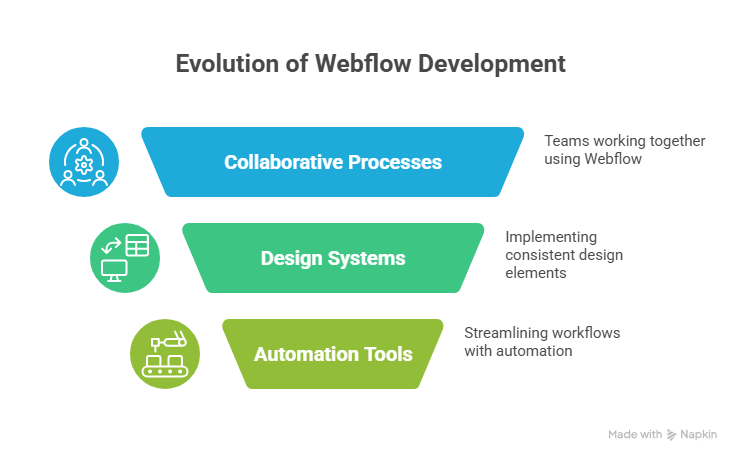
The landscape of modern web design is evolving rapidly, and Webflow is at the forefront of this change. Businesses today demand websites that are not only visually appealing but also scalable, fast, and optimized for performance. By embracing Webflow development, you can reduce bottlenecks common in traditional approaches while delivering a seamless design and development experience.
No-Code Platform Empowering Efficiency
Webflow is the future for many businesses because it combines design elements and content management into a no-code platform. This allows teams to scale your website without heavy reliance on traditional web development or extensive coding. Features such as real-time editing and responsive design tools let your site adapt instantly, improving responsiveness and fast load times, which positively impact LCP and core web vitals.
Optimized Performance and SEO
Performance optimization is critical for both user experience and search engine rankings. With Webflow, pages are automatically structured to reduce load times, prevent bottlenecks, and maintain smooth website loads. Efficient workflows improve bounce rates, support better SEO rankings, and enhance organic traffic.
Customization and Professional Support
A Webflow development agency or Webflow experts can help you create a custom website tailored to your brand. With access to advanced plugins and the ability to unlock additional features, you can build scalable landing pages and full websites that maintain aesthetic quality, functionality, and speed.
No-code tools integration optimizing launch seo and scalability
In today’s fast-paced digital landscape, leveraging no-code tools has become essential for businesses building websites efficiently while maintaining high performance and scalability. Unlike traditional approaches, no-code platforms empower teams to launch websites without heavy coding dependencies, ensuring faster go-to-market and simplified maintenance. By integrating these tools strategically, organizations can optimize search engine optimization, enhance fast load times, and set their digital presence up for long-term success.
Step 1: Choosing the Right No-Code Platform
Selecting a robust no-code platform is the foundation of scalable web development. Platforms like Webflow today are revolutionizing web design by combining intuitive interfaces with professional-grade development capabilities. Key considerations include:
- Availability of a free starter plan for testing features.
- Ability to unlock additional features such as CMS, e-commerce, and advanced analytics.
- Pre-built design elements that accelerate development while maintaining brand consistency.
Step 2: Optimizing Site Performance for Fast Load Times
Site speed is critical for both user experience and search engine optimization. No-code tools often integrate built-in performance optimization, which allows your website loads quickly across devices. Key strategies include:
- Utilizing content delivery networks (CDNs) to deliver content rapidly to global users.
- Compressing images and minimizing scripts to reduce page weight.
- Prioritizing metrics like LCP (Largest Contentful Paint) and CL (Cumulative Layout Shift) to improve perceived and real performance.
Step 3: Enhancing Scalability and Flexibility
One of the primary advantages of no-code tools is their inherent scalability. As your website grows, these platforms allow you to:
- Easily add new pages, sections, or design elements without a developer.
- Implement advanced integrations like marketing automation and analytics, which enables marketing teams to act on user behavior insights.
- Maintain a consistent structure while supporting global expansion through global content delivery.
Step 4: Leveraging SEO and Conversion Optimization
Integrating no-code tools with SEO best practices provides a competitive edge. Steps to maximize visibility include:
- Structuring URLs, headings, and metadata effectively for search engine optimization.
- Leveraging built-in tools for meta tags, sitemaps, and schema markup.
- Performing conversion rate optimization by analyzing user flows and implementing CTAs strategically.
Step 5: Continuous Improvement and Monitoring
The true benefit of websites without heavy coding lies in ongoing optimization. No-code platforms allow teams to:
- Test new design elements without downtime.
- Monitor fast load times and LCP metrics continuously.
- Adjust strategies based on real-time user behavior insights.
Conclusion
Webflow development and no-code tools integration are no longer optional they are central to creating websites without traditional coding bottlenecks, ensuring fast load times, improved LCP, and a scalable, future-proof site. By strategically selecting platforms, optimizing performance, leveraging design elements, and continuously monitoring user behavior, businesses can achieve higher conversion rates, streamline workflows, and maximize their digital presence.
Investing in professional development, thoughtful launch planning, and unlocking additional features allows teams to combine efficiency with functionality, delivering websites that are both visually appealing and technically robust. In the modern landscape, the difference between a website that thrives and one that struggles often comes down to how effectively no-code tools are integrated into long-term growth strategies.
Ready to take your website to the next level and see how Webflow today can transform your business? Or, to make it a little trickier why not contact Integriti Studio and see what they would suggest for your unique goals?
Frequently Asked Questions (How Webflow Development Approaches Are Gradually Evolving)
What is the future of Webflow?
Webflow’s future looks strong as it continues evolving beyond traditional web design, focusing on no-code development, seamless CMS integration, and scalability for businesses. With growing adoption, advanced SEO features, and a user-friendly interface, it’s positioned to remain a key platform for modern, flexible, and visually-driven websites.
What are the 7 stages of web development?
The 7 stages of web development are: 1) Planning – defining goals and requirements, 2) Analysis – understanding target users, 3) Design – creating layouts and UI/UX, 4) Development – coding the website, 5) Testing – fixing bugs and ensuring functionality, 6) Deployment – launching online, 7) Maintenance – ongoing updates and improvements.
What are the approaches to website development?
Website development approaches include traditional coding, where developers build from scratch using HTML, CSS, and JavaScript; CMS-based development using platforms like WordPress for faster setup; and no-code/low-code solutions like Webflow or Wix, enabling rapid, visual-driven development with minimal technical expertise.
How has web development changed?
Web development has shifted from purely code-based approaches to no-code and low-code platforms, emphasizing speed, scalability, and user experience. Modern practices prioritize responsive design, SEO, and integration with third-party tools, enabling businesses to launch and maintain websites efficiently without heavy reliance on traditional coding.
Leave a Reply