Are you seeing the wrong image, featured image, post thumbnail, or thumbnail show up for a team member, product, post, or post or page—only for it to fix itself after a refresh? This glitchy behavior usually points to caching, cache, caching plugins, theme conflicts, or misconfigured image logic in your theme templates, theme’s, or theme’s functions.php file.
What We Discovered
Some images, upload images, or new images appeared mismatched on first load, image display, image urls, image urls, or image loading.
Refreshing or returning later fixed the issue, display, display, or image display.
The problem happened inconsistently and was hard to reproduce, archive page, wordpress site, wordpress website, or wordpress themes.
It often stemmed from reused variables, php, file permissions, or caching layers interfering with image rendering, image loading, or image display.
How We Solved It
1. Cleaned Up the Image Source
Ensured each item’s image, featured image in wordpress, media library, image file, or image url was properly stored in the database—either as a featured image, featured image box, post thumbnail, or custom field—and referenced that field directly during rendering, image display, or displaying images.
2. Fixed Loop Logic
Scoped image variables inside the loop so they didn’t accidentally carry over values between items. This stopped images, images also, images without, or image urls from being reused incorrectly.
3. Isolated the Cache Issue
Disabled all caching, cache, caching plugins, or cdn and tested in staging to confirm whether the issue was logic-based, php, or cache-related. This helped narrow down the source quickly, optimize images, or image size.
4. Used Logging for Visibility
Temporarily added debug logs inside the loop to check which images, new images, image urls, or upload images were loading per item. This helped validate fixes and catch any lingering problems, error when uploading images, http error, or image exists.
5. Cleared Cache Across the Board
After final adjustments, we purged site caches, browser caches, clear your browser cache, clear your cache, and CDN layers to ensure everything loaded cleanly moving forward, page load, or loading times.
The Result
✅ Image mismatches are gone
✅ Listing pages now load with the correct images, every time
✅ The user experience feels more polished and professional
This fix is ideal for portfolios, staff directories, or product grids that rely on dynamic layouts.
Want Reliable Image Loading on Your WordPress Site?
Let Integriti Studio help you fix theme logic and caching conflicts for good.
Even though the form works and the images land in the Media Library, they’re invisible on the actual post, post, page, or blog page. Here’s how we helped fix this issue by adjusting Beaver Builder’s, beaver builder, BB, template connection—without touching the core Gravity Form, gravity form, or form structure.
What Was Going Wrong?
Users submitted images using a Gravity Form.
The form created a custom post entry, and images were uploaded successfully.
But nothing showed up on the live page.
The issue? The post creation add-on, advanced-post-creation, or field setup in the Beaver Builder template, beaver builder, BB, or template. Even though the backend, backend, server, or directory had the data, it wasn’t being displayed properly, properly, or fetch.
Why It Happens
When using Gravity Forms, gravity form, or custom-post-types, it’s not enough to just store image, image, file, or gallery data. You must display, display, or add it through:
Gravity Forms → correctly assigning custom fields
ACF → setting up gallery fields
Beaver Builder → pulling that data visually into the layout
If any one link in that chain is missing—nothing shows up.
How We Fixed It
1. Double-Checked Form Field Mapping
In Gravity Forms, gravity form, or form, we ensured the image, image, file, or upload upload was connected to the correct custom fields, field, acf custom, or gallery_images, like: gallery_images | {Image Upload:3}.
2. Reviewed ACF Field Group
In acf, acf custom, or advanced-post-creation, we created a Gallery Field, gallery, gallery_images, or featured-image and attached it to the relevant custom post type, custom post, or post creation add-on.
3. Updated the Beaver Builder Template
In Beaver Builder, beaver builder, BB, or template, we edited the Single Post Template, template, post, or page for the CPT. We added a post-image, custom field, or gallery field, linked it to gallery_images, and styled it as a carousel, grid, or medium display.
4. Ran a Full Workflow Test
We submitted a fresh form, gravity form, or file upload with new images, confirmed their upload, post created, or post-image, and verified that they now appeared correctly, appear, or properly on the live page, page, post, or blog page.
Bonus: Smarter Email Notifications
While improving the form, we also updated email settings:
Verified the “From” address in Gravity Forms.
Used dynamic tags in email subjects for personalization (e.g., “New Listing: {Custom Field:2}”).
The Result
With the right field connection, field, acf custom, or post creation add-on added in Beaver Builder, beaver builder, BB—no double entries, broken layouts, images missing, or images won’t appear. The form works end-to-end, just as it should, fix, or resolve.
Want Help With Gravity Forms + CPT Workflows?
Struggling with hidden fields, display bugs, or form-to-post challenges in WordPress? We’re pros at getting Gravity Forms, ACF, and Beaver Builder to play nicely together.
A client approached us after noticing that posts labeled as “Featured” or featured content were no longer showing on their homepage or featured area. They were using a custom category called “Featured Post” to organize and display these posts—but even after applying the correct category to new posts, the homepage, post section, or block remained empty.
To make matters worse, their WordPress dashboard, WordPress admin, or admin area had become cluttered—columns were misaligned, and the “All Posts” screen, screen, or post editor was hard to read.
Diagnosis
After auditing the site, our developers found that:
The “Featured Post” category was still functioning as expected.
The homepage used a page builder, page builder module, Elementor, or library module (like Divi or WPBakery) to display those posts.
That specific module, template, or display module had stopped pulling content, pulling posts, or pulling featured image option from the “Featured Post” category, likely due to plugin updates, theme updates, configuration, conflict, or misconfiguration.
In short, the post content was there—but the tool showing it had broken.
✅ The Fix: Swap Out the Module
Rather than spending hours troubleshooting, troubleshooting, or debugging the old module, we took a simpler route:
We replaced the existing Posts display module, display, or block with a more stable one from the builder’s library.
Reconfigured it to fetch posts, pull content, or pull featured images from the “Featured Post” category.
Matched the styling, layout, or appearance so the layout remained visually consistent.
This fresh setup bypassed the broken logic, restored visibility, and future-proofed the section, section, or featured area against plugin hiccups, error, or theme conflict.
Want smoother WordPress layouts? Book a quick call.
Bonus Fix
The client also struggled with a messy “Posts” screen, screen, or post editor in the admin panel. Here’s what we did:
Used the Screen Options menu (top right of the admin area).
Hid unnecessary columns and enabled only the relevant ones.
Increased the number of posts displayed per page for easier management.
Small tweak—big difference in usability.
Need help cleaning up your dashboard? We’ve got you.
Why This Works
WordPress page builders rely on display modules to pull and show content. But when:
Plugins update
Theme conflicts arise
Caching interferes
Or modules simply break
your front-end content can vanish even if everything else is set up correctly.
Starting fresh with a new module ensures cleaner queries and fewer bugs.
Need Hands-On Help?
If your homepage layout, homepage, section, featured area, or block isn’t doing what it should—whether it’s broken post sections, weird formatting, post not showing, or content not pulling.
We help you clean up the backend, streamline the frontend, and make sure everything just works.
After updating both the theme and TEC plugin, the events archive page (e.g., /events/) showed a blank screen or 404 errors. The issue stemmed from a compatibility conflict between the theme’s archive layout, template overrides, and TEC’s rendering logic for upcoming events or dynamic content. This often happens after plugin or theme updates, plugin updates, or upgrading your WordPress theme without staging environment testing.
How We Diagnosed It
✅ Tested on staging first
We replicated the issue on a staging site, staging environment, or stage to avoid affecting the live site. Screenshots and browser inspection helped reproduce the issue.
✅ Checked known conflicts
Forum threads, Themeco forum, and WordPress.org knowledgebase revealed a known issue between newer Impreza theme versions, theme-specific layout, and TEC’s archive view templates or default events template.
✅ Isolated the problem
Blank screens typically mean a PHP error, template conflict, or custom code issue—especially when it only affects a dynamic page, events page, or calendar view like /events/.
What Fixed It
1. Synced all updates
We updated both the Impreza theme, theme update, and The Events Calendar plugin, events calendar plugin, events calendar plugins, or events calendar pro to their latest version. Partial updates or previous version roll back can cause functionality issues.
2. Switched archive templates
Under display settings, display, or template overrides, we changed the archive layout to “Default Events Template” instead of the theme-integrated option or events template override. This resolved display issues in list view, style, or CSS.
3. Cleared cache and reset permalinks
We flushed caches and re-saved permalinks via Settings → Permalinks to ensure proper routing.WordPress dashboard to ensure proper URL routing and front end display.
4. Applied fix to live site
Once confirmed on staging site, staging environment, or stage, the changes were safely mirrored on the live site, live site front end, or front-end view without disrupting new events or dynamic content.
Final Result
The events archive now loads properly with no blank screens, broken views, or 404 errors. Keeping both the theme and TEC updated, using the right template display settings, and monitoring plugin or theme updates ensures stable functionality, restores event calendar functionality, and allows the page editor or builder to render content correctly.
Need Help with Plugin Conflicts?
We help WordPress sites stay stable after updates—no broken layouts or missing content.
Talk to Integriti Studio — your experts in theme + plugin compatibility.
A client’s contact form emails, sending emails via WP Mail SMTP and Twilio SendGrid, included a link to a key application page. But users reported that the link either broke, redirected incorrectly, or caused a 404. The emails contained tracking links, branded links, and links in outgoing emails. This often happens when links are broken, rewritten links fail, or email clients improperly render URLs.
Root Cause
Link Rewriting by SendGrid
SendGrid’s click tracking feature, sendgrid click tracking, or SendGrid configuration was rewriting the original links (https or actual url) to go through their tracking domain. These rewritten links weren’t functioning as expected, causing a link issue or broken link in the email content.
️ DNS or Tracking Misconfig
The click tracking subdomain, CNAME record, or DNS records hadn’t been correctly set or were not properly resolving. Sender authentication, proper DNS, and SendGrid account setup issues can lead to links being broken or emails containing improperly rewritten URLs
Steps to Fix It
1. Check the Setup
Go to your WordPress WP Mail SMTP settings, SMTP configuration, and email sending options to confirm that SendGrid is the active mailer and correctly configured. Inspect the API key, backend, and server settings to ensure deliverability and email delivery.
2. Review Click Tracking Settings
In SendGrid:
Go to Settings > Tracking
Look at the domain listed under click tracking
Make sure the proper CNAME DNS record is set up and active
3. Test the Links
Send yourself a test email or email campaigns. Inspect the source to diagnose rewritten link issues, original links, specific URLs, actual URL destinations, and final URL results. Try clicking them — if they fail, it’s definitely a SendGrid redirect or proxy issue.
4. Disable Click Tracking (if needed)
The quick fix or solution is to disable SendGrid’s click tracking feature. This stops the URL rewrite, removes tracking links, and ensures links work correctly.
5. Clean Up the Template
While testing, verify your email templates, email content, and links in outgoing emails are free from broken links, unnecessary tracking codes, or improperly rewritten URLs.
The Result
Once click tracking was disabled or corrected, links worked perfectly. The autoresponder emails, marketing campaigns, and contact form messages now route users to the original destination, helping the client avoid lost leads, improve email delivery, and prevent similar issues when sending emails.
Trouble with your WordPress emails or SMTP setup? Let Integriti Studio handle it — from mailer configs to link integrity.
On a WordPress site powered by CPTs and custom post types in WordPress, a recently re-published listing failed to appear in specific filtered views, custom search forms, and WordPress search results, despite being publicly accessible on its individual page. This often happens when:
Key custom fields that power filters are left empty
Query logic relies on future-dated schedules
Filters are stacked in a way that excludes incomplete records
Cache or replication delays skew the frontend display
What We Found
To isolate the issue, our team at Integriti Studio reviewed the content setup, content types, and filtering logic:
✅ Custom Field Checks
One required custom post type content field—used by the filter system to group CPTs—was empty. Because the query expected a value, this post was silently skipped in WordPress search results and post type archives.
✅ Filter Query Debugging
The PHP behind the filter logic (functions.php file) was relying on meta_query conditions that excluded empty fields. The logic also compared scheduling dates, which can block visibility if not configured properly in your WordPress theme or template.
✅ Display Context Audit
The post was missing from filtered lists, custom post types manually displayed, or post type archives but appeared on its standalone page, default post types, and in some unfiltered queries. This inconsistency confirmed that the filtering code—not post status—was to blame for content display issues on your WordPress site.
How We Fixed It
1. Populated Required Fields
We ensured the post had a valid value in the “all centers” field, custom post type using filters, or add your custom post setup so it would be picked up by filters expecting that key.
2. Adjusted Conditional Logic
Updated the custom template, template, or PHP code to include posts if they met a valid future date condition, appropriate assignment, or location taxonomy.
3. Ordered Output Clearly
Added a fallback orderby parameter to maintain predictable sorting (like alphabetical order), improving both user experience, UX, and debugging clarity.
4. Cleared Caches and Retested
Purged all plugin, server, and object caches. Then tested the result in:
Global site search
Filter-based listings
CPT archives
Location-based views
The Result
The entry now displays as expected across all views. This fix ensures future posts won’t fall through the cracks due to incomplete fields, custom post types not appearing, or overly strict filters—keeping directories complete and content on your WordPress site accurate.
Struggling with CPT Search and Filters?
We help WordPress sites avoid broken listings and patchy search results with clean, scalable logic.
Get in touch with Integriti Studio — and make every listing count.
Variable products are supposed to display a price range (e.g., variable product price range or full price range) on WooCommerce category pages. But sometimes, especially with products with multiple variations or new product entries, only the starting price appears. This happens when the minimum price, variation price, and variable product price values aren’t being synced properly between WooCommerce and Algolia search integration.
Other symptoms might include:
Missing or incorrect sale prices
Price formatting errors (like $108.5 instead of $108.50)
Products showing $0.00 due to stale or invalid data
How to Fix It
1. Update Your Algolia Index
Make sure variation prices, minimum price, and price of the product fields are being pushed to Algolia during product indexing. If they’re missing, category pages won’t be able to display the price range display or display variable product properly.
Use bulk update methods like wp_update_post(), admin batch edits, or custom code snippets to trigger a full sync.
2. Fix the Price Template Logic
Edit your WooCommerce theme or builder templates so that:
The full price range displays when min and max values differ
Sale prices are shown clearly with correct formatting
Single-price products don’t show ranges unnecessarily
Decimal formatting stays consistent at two places
3. Improve Sale Price Sync
WooCommerce sometimes fails to notify Algolia when scheduled sales go live. Include price of the product and discount fields in the product index and modify your frontend logic, custom code, or WooCommerce’s default templates to account for these dates instead of relying on default sale status.
4. Handle the Edge Cases
Look out for older product entries, database irregularities, or default settings. Add logic to handle:
Missing price values
Outdated variations
Incorrect formatting caused by import or plugin issues
Clear all cache layers once the fixes are implemented to ensure updates appear live and WooCommerce will display or WooCommerce will show the correct price range in WooCommerce.
✅ What You’ll Achieve
After fixing the indexing and display logic:
Your category pages will accurately reflect price ranges and sales
Customers won’t get confused by misleading pricing
Algolia and WooCommerce will stay properly synced—automatically
Need help cleaning up your price logic or syncing search with WooCommerce?
At Integriti Studio, we helped one client streamline their WordPress site by removing outdated CPTs and fields—making the admin area cleaner, simpler, and easier to manage within the WordPress dashboard and admin dashboard interface.
The Problem
Old CPTs that were no longer active or useful
Custom fields still showing up in editors, but not tied to any current template, layout, or content types
Editors overwhelmed by irrelevant options, dashboard widgets, menu items, and messy interfaces
It was time for a cleanup.
️ What We Did
Identified & Removed Unused CPTs
We audited all existing custom post types, confirmed which were obsolete, and safely removed them from the theme, plugin code, and any core WordPress installation or premium addons. This reduced clutter, unnecessary database queries, and duplicate content types.
Cleaned Up Outdated Custom Fields
All registered custom fields were reviewed. Unused, redundant, or unnecessary fields were removed, especially those that made editing pages and posts, admin area, or editors harder for the team. Custom CSS and meta fields were also checked for visibility and functionality.
Improved the Admin Experience
Post and page editors now see only the fields they need, with full control over workflow, screen options, and UI elements. That means fewer clicks, less confusion, faster publishing, and a user-friendly, intuitive interface for administrators and subscribers.
Safe Testing & Rollout
Everything was tested in staging first—no surprises. Using tools like a checker and toolkit, we confirmed all functionality, addon compatibility, and plugin settings. Once validated, we deployed the clean version to the live WordPress site with zero disruption, ensuring seamless integration with front-end display, URL structures, and WooCommerce if installed.
The Results
A clean, user-friendly admin interface
No more irrelevant fields or post types
Easier, faster content updates
Slight performance boost from reduced backend bloat
Why Cleanup Makes a Difference
Less clutter = fewer mistakes
Better performance through fewer queries and a lighter database
Easier maintenance for developers and editors
Future-proof structure that’s ready for whatever’s next
Want your WordPress backend to work with your team—not against them?
This guide walks you through real-world anti-spam tactics you can use right now—especially if you’re using WordPress form plugins on a dedicated WordPress site or WordPress website.
What’s Really Causing the Spam?
Most WordPress forms come with the basics, but not real protection or built-in spam features. A site owner came to us after noticing an uptick in spam submissions, spam entries, and form spam in WordPress—and it turned out their contact form, registration form, and other WordPress form plugins had no active modern anti-spam protection at all.
That’s like leaving your front door wide open to spam bots, automated spam, or spammers using IP addresses, email addresses, and common spam patterns.
Here’s How to Stop It
Add Google reCAPTCHA
One of the best spam prevention and anti-spam features to block bots.
Works with all major form plugins
Choose v3 (invisible) or v2 (checkbox)
Add your site keys in form settings
Activate across all important forms
Use Akismet Anti-Spam
A powerful anti-spam plugin that filters out spam automatically.
Integrates with Gravity Forms, WPForms, and Ninja Forms
Requires an API key (easy to set up)
Just toggle it on inside your form settings
Enable Honeypot Protection
Bots will fall into this trap—users won’t even know it’s there.
Available in most form plugins
Add it with one click from form settings
No CAPTCHA required for users
Use Conditional Logic for Filtering
Advanced but powerful.
Block submissions with certain keywords, flagged as spam, fake domains, or odd behavior
Examples:
→ Block if the message contains “viagra”
→ Hide the submit button if the email ends in .ru
Available in Pro versions of most form builders
The Results?
After applying these simple tweaks:
Spam dropped drastically
Real users had zero friction
Forms stayed clean, fast, and accessible
Want to lock down your WordPress forms—without frustrating your users?
WordPress vs. Shopify: Which Platform is Right for You?
Choosing the right e-commerce platform is crucial for online success. WordPress with WooCommerce and Shopify are two of the most popular website builders globally. Understanding their features, SEO capabilities, customization options, and custom vs off-the-shelf solutions will help you select the best platform to maximize online store growth and efficiency.
What is WordPress?
Over 40% of websites worldwide are powered by WordPress, an open source content management system. When paired with WooCommerce, it enables businesses to build fully customizable WordPress sites.
Through custom WordPress development, companies can create a custom-built online store using custom themes, plugins and themes, third-party integration, and unique code. WordPress website development services help businesses tailor functionality, design, and branding to meet business objectives while improving online presence.
What is Shopify?
Shopify is a comprehensive e-commerce platform designed for small businesses. Its user-friendly drag-and-drop interface and pre-built templates simplify building a website, management, and scaling as your business grows.
With Shopify app development, stores can expand features without dealing with custom code or complex maintenance, making it ideal for limited budgets.
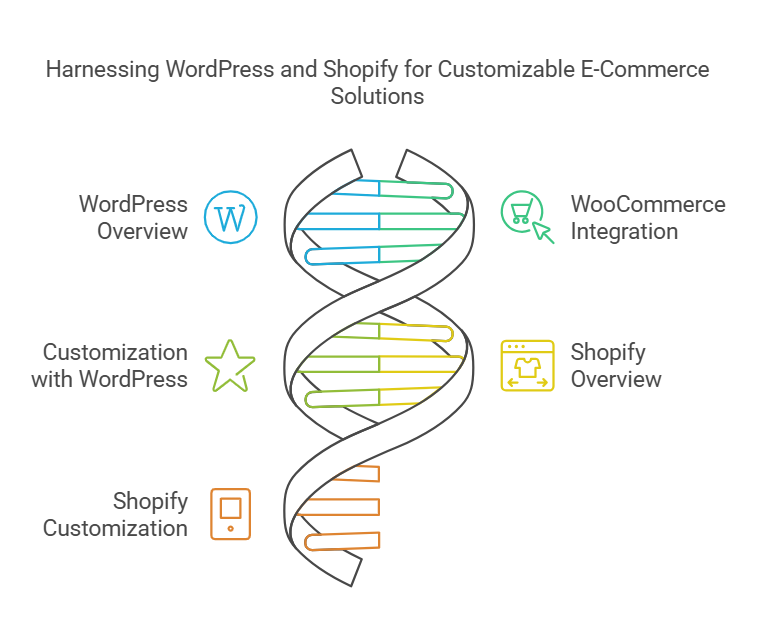
Key Differences Between WordPress and Shopify
1. Ease of Use
WordPress
Offers unmatched customization but requires technical knowledge of hosting, design, and WooCommerce. Using WordPress also requires maintenance to avoid vulnerability and performance issues, especially when using templates and plugins.
Shopify
Extremely user-friendly and handles hosting, security, and updates automatically. An ideal off-the-shelf solution for beginners.
2. Customization Options
WordPress
Provides almost unlimited customization through plugins, third-party tools, WordPress themes, and custom WordPress development. A fully custom WordPress website allows tailored solutions, advanced SEO, improved user experience, and designs tailored to your business.
Shopify
Uses pre-built platforms, themes, and apps. Experienced developers can add custom solutions, but customization is still limited compared to WordPress.
3. Cost
WordPress
The CMS is free. Costs depend on hosting, pre-built WordPress themes, plugins, or custom web development. It’s flexible for different budgets but may require a higher initial investment if opting for fully custom development.
Shopify
Subscription-based (starting at $29/month). Costs increase with premium apps and transaction fees. Works best for those who prefer off-the-shelf solutions without complexity.
4. SEO and Marketing Tools
WordPress
Excellent SEOthrough tools like Yoast and Rank Math. Ideal for content marketing, optimize performance, and long-term growth and success.
Shopify
Offers built-in SEO features and marketing tools. Good for beginners but less powerful than WordPress in terms of content management and deep customization.
5. Scalability
WordPress
Highly scalable with proper hosting and professional support. Fully custom development can help you create websites that grow with your business.
Shopify
Built for scalability without worrying about servers or security. A great pre-built platform that ensures faster load times and smooth performance.
When to Choose WordPress
WordPress is ideal for businesses that:
Require extensive customization through WordPress website development services.
Want a store tailored to your business needs
Require strong blogging and content management
Prefer deep integration options and custom WordPress themes
When to Choose Shopify
Shopify is best for businesses that:
Prefer off-the-shelf themes and ready-made tools
Want a simple, user-friendly setup
Need built-in payments, shipping, and marketing
Plan to rely on Shopify app development for enhanced functionality.
Real-World Examples
WordPress Use Case
A niche retailer wanting unique branding may choose WordPress with WooCommerce. Using custom WordPress development and custom code, they can build a store fully aligned with their brand identity and unique requirements.
Shopify Use Case
A beginner launching their first store may prefer Shopify. With pre-built themes, apps, and simple setup, they can focus on customers rather than technical tasks.
Conclusion
Both platforms are powerful. WordPress offers deep customization, custom-built solutions, and long-term scalability, while Shopify excels as a pre-built, off-the-shelf, easy-to-manage solution.
To make an informed decision , carefully analyze your needs and think about engaging with expert Shopify developers or WordPress.
Your choice depends on your business needs, budget, and technical skill level.Ready to launch a high-performing online store? Explore our custom WordPress development, Shopify services, and web solutions to build the best website for your business!
Want your business to be seen and heard online? Explore our Services
Frequently Asked Questions (WordPress vs. Shopify: Which Platform is Right for You?)
WordPress vs. Shopify: Which Platform is Right for You?
WordPress offers unmatched customization and flexibility, ideal for businesses wanting full control over design and functionality. Shopify excels in simplicity and eCommerce-focused features, perfect for those seeking a quick, secure, and scalable online store. Your choice depends on technical comfort, business needs, and growth plans.
Which platform is better than Shopify?
WooCommerce (with WordPress) is often better than Shopify if you want full control, lower long‑term costs, and customisation. It’s free to use, supports almost unlimited plugins and payment gateways, and gives you complete ownership of your data ideal for flexible, scalable and SEO‑focused stores.
Can I switch from WordPress to Shopify?
Yes, you can switch from WordPress to Shopify. The process involves migrating your products, content, and customer data, often using migration tools or expert services. Shopify simplifies store management, offers built-in hosting, and provides secure eCommerce features, making the transition smooth for growing online businesses.
Is Shopify still a thing in 2025?
Yes, Shopify is absolutely still a thing in 2025. Millions of businesses continue using it, its revenue and merchant base keep growing, and it’s still one of the most reliable, scalable eCommerce platforms. Brands choose it for ease of use, strong apps, and powerful sales features.

 Key Differences Between WordPress and Shopify