
How a Shopify App Development Agency Can Solve Your eCommerce Pain Points
Introduction
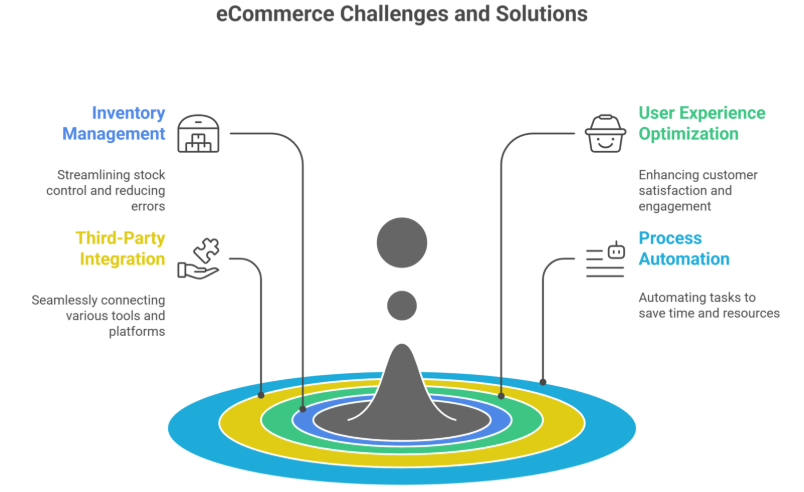
Running a complete online store on Shopify comes with many immense opportunities. However, it also presents quite some challenges. From managing inventory and highly optimizing user experience to integrating third party tools and automating processes. Business owners often face hurdles that slow down growth on their ecommerce platforms and Shopify stores.
This is where a Shopify App Development Agency or a Shopify development partner will come in. These agencies highly specialize in creating custom Shopify apps and solutions tailored to a store’s unique business needs. Helping businesses overcome bottlenecks, streamline operations, and scale effectively to achieve ecommerce success.
In this blog, we will explore the common eCommerce challenges and Shopify merchant pain points. These problems can be solved by a Shopify app development agency smartly with custom development solutions.
Common eCommerce Pain Points & Their Solutions
1. Limited Store Functionality
While Shopify offers quite a huge range of built-in features, many business owners require advanced features that aren’t available by default. A Shopify app developer or app development agency can create custom apps to:
- Add advanced filtering and search options.
- Develop custom pricing models for wholesale or B2B customers.
- Build unique checkout experiences that fit business needs.
- Integrate subscription based models for many recurring purchases.
With a tailored app, your ecommerce store can function exactly the way you need it to, highly improving the overall shopping experience and increasing average order value.
2. Slow & Inefficient Order Management
Managing orders efficiently is crucial for customer satisfaction and business growth. A Shopify app development agency can automate and optimize order processes by:
- Creating automated invoicing systems.
- Developing custom dashboards for real-time order tracking.
- Highly Integrating order fulfillment solutions with third party logistics (3PL) services.
- Enabling bulk order processing to save time and reduce manual effort.
This results in faster deliveries, fewer errors, and improved efficiency.
3. Integration Issues with Third-Party Tools
Many businesses rely highly on external tools such as CRM, ERP, accounting software, and marketing platforms. However, integrating these third-party apps with Shopify can be very complex. A Shopify app development company can:
- Seamlessly connect Shopify with inventory management and POS systems.
- Sync customer databases with email marketing platforms.
- Develop real-time data synchronization between Shopify and third-party services.
- Ensure all integrations are stable and secure.
These integrations streamline business operations and provide a unified workflow, enabling data-driven decision-making.
4. Poor User Experience (UX) & Design Limitations
A cluttered or confusing store layout can drive potential customers away. A Shopify design agency enhances user experience (UX) by:
- Creating custom, responsive themes tailored to brand aesthetics.
- Optimizing page speed and mobile performance.
- Implementing user friendly navigation for much better product discovery.
- Highly personalizing the shopping journey with total AI driven recommendations.
A well designed store leads to much increased engagement and pretty high conversions.
5. Cart Abandonment & Low Conversion Rates
Cart abandonment is a very major issue for ecommerce businesses. A Shopify app development agency can help reduce drop-offs by:
- Developing one-click checkout solutions.
- Implementing exit-intent popups with discounts.
- Creating automated abandoned cart recovery emails.
- Integrating multiple payment gateways for a highly seamless transaction experience.
These improvements make the checkout process very smooth and completely hassle free. This leads to higher conversions.
6. Limited Analytics & Data Insights
Without proper analytics, it’s quite hard to make data-driven decisions. A Shopify app development company can:
- Develop custom analytics dashboards for sales tracking.
- Implement heatmaps and user behavior tracking.
- Enable AI driven demand forecasting for much better inventory management.
- Integrate Shopify with Google Analytics and other highly advanced tools.
These insights help businesses optimize their strategies and improve performance.
7. Scaling & Performance Issues
As your Shopify store grows, handling increased traffic and transactions can become challenging. A Shopify app development agency ensures your store remains scalable by:
- Optimizing database queries for faster load times.
- Implementing server-side caching for better performance.
- Enabling cloud-based solutions for high-traffic handling.
- Creating multi-store setups for international expansion.
This ensures a seamless shopping experience even during peak sales periods.
8. Security & Compliance Concerns
With rising cybersecurity threats, keeping your Shopify store secure is a top priority. A Shopify development agency enhances security by:
- Implementing SSL encryption and PCI compliance.
- Enabling two-factor authentication (2FA) for store access.
- Securing customer payment information with tokenization.
- Regularly updating apps and security patches.
A secure store builds trust and protects both business and customer data.
Why Work with a Shopify App Development Agency?
1. Expertise in Shopify Ecosystem
A Shopify app development agency understands Shopify’s architecture, APIs, and best practices. This ensures that your store operates efficiently and leverages the full potential of the Shopify app store.
2. Custom-Tailored Solutions
Instead of relying on generic third-party apps, an agency develops custom solutions based on your business requirements.
3. Ongoing Support & Maintenance
A Shopify app development company offers continuous support, regular updates, and improvements to keep your store running smoothly and ensure customer satisfaction.
4. Time & Cost Efficiency
Custom-built apps eliminate the need for multiple third-party apps, reducing development costs and improving operational efficiency in the long run.
Conclusion
A Shopify app development agency can solve many critical ecommerce challenges. From improving store functionality and order management to enhancing user experience, conversion rates, and security, custom Shopify app development empowers businesses to scale efficiently.
If you are looking to take your Shopify store to the very next level. Partnering with a Shopify development agency will highly ensure you stay pretty competitive in the ever evolving eCommerce landscape.
Frequently Asked Questions (How a Shopify App Development Agency Can Solve Your eCommerce Pain Points)
What are the pain points of Shopify?
Shopify’s main pain points include high app and transaction costs, limited design flexibility without coding, dependency on third-party apps, slower load speeds with heavy plugins, and challenges in SEO customization. Scaling can also get expensive as advanced features often require paid apps or higher-tier plans.
What does a Shopify developer do?
A Shopify developer builds, customizes, and optimizes Shopify stores. They handle theme development, app integrations, speed improvements, custom features, and bug fixes. They ensure the store looks professional, functions smoothly, converts well, and aligns with the brand’s goals while providing ongoing technical support.
What are the skills required for Shopify developer?
A Shopify developer needs strong skills in HTML, CSS, JavaScript, and Liquid for theme customization. They should understand UX/UI, Shopify APIs, app integrations, site speed optimization, and eCommerce best practices. Problem-solving, debugging, and knowledge of SEO and conversion-focused design are also essential.
How difficult is Shopify development?
Shopify development is moderately difficult. Basic setup is easy, but advanced customization requires strong coding skills in Liquid, JavaScript, HTML/CSS, and API handling. Challenges arise with complex features, performance optimization, and integrating third-party apps. With practice, developers can build highly customized, high-converting stores.