According to Korn Ferry study, the global human talent shortage will increase to around 85 million by 2030. This highlights the severe competition for talent and the need to improve candidate experience. After all, providing a good candidate experience goes hand in hand with creating a great employer brand. Companies must evaluate their recruitment procedures to satisfy the needs of the applicants. In our humble opinion, a positive candidate experience can be derived from using:
A Consistent Point of Contact:
Interviews can be a confusing and stressful experience. Having the same person guiding the applicant through the entirety of the hiring process will certainly improve candidate comfort and engagement.
Proactive Onboarding:
The first days are usually very exciting and disorienting for the employees. Orientations and peer support programs can provide role clarity and social integration desperately desired by the new hires.
Informal interviews:
Interviewing people in a more casual setting or over coffee chats can help remove the applicant’s anxiety and stress.
Effective communication:
Often recruiters fail to fill the vacancies due to ineffective communication. Employers need to share the complete outline of the hiring process as well as address any queries related to the job description. Prompt responses at each stage will make candidates feel more valued.
Constructive feedback:
Many applicants complain about never hearing back from the recruiters. By providing feedback, companies can avoid losing out on unsuccessful candidates who might be a good fit for a different vacancy in the future. The situation could also be improved if only the recruiter pays more heed to manage candidates in a more meaningful environment – i.e. by sending them constructive feedback that contains a list of the applicant’s shortcomings, strengths, and useful information/courses.
A lot of times, reasons like technical skills gap became an excuse to shrug off candidates. However, by following these steps, there is a possibility the gap between the recruiter and the candidate be filled, enriched with a more meaningful relationship.
Application architecture is the representation of how different services and systems are joined together. It helps us to understand how applications or services are placed in a layered architecture, who are the different actors at each layer and what is the fundamental role of each layer.
It determines application components and different layers communicate with each other. These architectures are layered having different layers from the design or presentation layer to the data layer. Software architects or Web engineers ensure that all the elements or layers work together correctly.
How does system architecture for web application works?
In web application architecture, there are basically two parts working simultaneously, the client (frontend) and server (backend). The client represents the application UI on the browser from where the web server takes the request to the server, where the server has the code that responds to requests coming from the client. The Server manages the application logic and responds to HTTP requests.
Learn more about our technology stack and software development services here.
Models of web architecture
One-tier architecture
One-tier architecture involves putting all of the required components for a software application or technology on a single server or platform. This kind of architecture is often contrasted with multi-tiered architecture or the three-tier architecture that’s used for some Web applications and other technologies where various presentation, business, and data access layers are housed separately.
Two-tier architecture
The Two-tier architecture is divided into two parts: Client Application (Client-side) and Database (Server-side) respectively.
Also called a client-server application, the communication in this architecture takes place between the client (browser) and the server. The client system will send the request to the server system which will process it and send back the data to the client side.
Multiple-tier architecture
A Multi-tier Architecture is a software architecture in which different software components, arranged in tiers (layers), offer dedicated functionality. The most common example of multi-tier architecture is a three-tier system comprising a data management tier (encompassing one or several database servers), a client tier (interface functionality), and an application tier (business logic).
Microservices architecture
You might have heard of the word microservices if you’re a tech enthusiast. Microservices are independent services like applications, which exist completely on their own. These come with their logic, state, and deployment and interact with each other via API calls, queues, etc. depending on the requirements. These microservices combine to deliver the complete application solution.
With microservices architectures, applications are easier to scale and faster to develop allowing businesses to accelerate innovation and time-to-market for new features.
Layers and Components of Application Architecture
The application architecture is made up of several layers: design layer, frontend layer (HTML and CSS), backend or data layer (database and scripting languages), platform (browser/OS), and business layer. These layers are built on top of each other and depend on each other to create a successful project.
Presentation Layer
This layer represents the design and UI components on the client side. Users interact with this layer to send requests through the application layer to the server. It displays the data flow for the users. The main purpose of this layer is to take data from users and show the response from the server (data layer).
Our UI team can help you create the right experience to help your business attract customers’ attention.
Application Layer
The application layer consists of an API gateway. Front-end developers write code to pass the data from the presentation layer to the business logic layer where it is processed. Data will pass to APIs and get stored in the database, depending on the feature it is utilized in the business layer for application logic and to perform certain actions.
Business Layer
This layer has all implementation of application logic. Data from the application layer gets utilized here for example in a lead generation application a form is submitted in the presentation layer and data travels through APIs and is then used to send out emails or to perform any action on the lead before getting stored in the database.
Data or Backend Layer
All the data gets stored in the database and retrieved from it to use on the front end (client-side). Data travels from the database through APIs, from the application layer in creating modules or components that are converted to UI and the user then interacts with that in the presentation layer.
Conclusion:
To conclude, there are different ways to set up the architecture for applications software. Microservices architecture is the most popular choice of mid-sized and large companies like Amazon and Google. However, in order to find out more about which architecture to go with for building your project we recommend you reach out to any professional web development team that can guide you according to your needs and goals.
Want us to help you build your next big product? Contact us.
When it comes to modern front-end web development, how essential are JavaScript Frameworks?
In computer programming, a framework is a foundation over which programmers build their software. A JavaScript framework would provide similar assistance. It provides a set of prewritten code enabling developers to use the framework as a structure for the JavaScript program or application without having to start from scratch. These frameworks are easier to apply as most applications and websites have some common features. Hence, they provide businesses with a great opportunity to reduce their development time and make the task less laborious for the development team.
So, just as the skeleton is important for the support and shape of the human body, JavaScript frameworks are essential for providing a foundation for a given website or application.
When we talk about modern JS frameworks, there are three in particular that we must discuss given their popularity and importance and building scalable interactive web applications.
Angular
React
Vue.js
Let’s dig deep into each of these.
Angular Framework
Developed by Google, Angular is an open-source web application framework written in TypeScript and used for developing single-page applications (SPA).
The features offered by this framework are:
Free control over adaptability.
Capability to meet huge data requirements.
Data binding & Dynamic rendering.
Simple, declarative, and effective templates (with easier DOM manipulation & two-way binding).
Instant help and feedback related to Angular with practically every IDE.
Intuitive API and ability to reuse the code to meet a particular development target.
React Framework
Image Source: Google Trends
Introduced in 2013, React is a reusable framework created by Facebook. According to Google Trends, React is one of the most popular frameworks. It is ideal for developing interactive user interfaces and offers features like:
Virtual DOM Model facilitating easy integration with applications.
Reusable components making website or application development simpler.
One-way flow of data (more intuitive than bi-directional data binding).
Reload feature which allows users to immediately see the applied changes.
Vue.js Framework
A free open-source JavaScript framework, Vue.js is a progressive front-end framework that is approachable and easy to learn. Despite being a relatively new framework, it has already earned popularity due to its various features and is suitable for developing both small and large applications. Vue.js has the following features:
Reusable codes & predefined options for custom elements.
Employs an MVVM structural pattern to separate the GUI from the model’s business logic.
Dual integration mode to build high-end SPA.
Which JS framework is the best?
When it comes to web development, JavaScript continues to be the leading programming language even today. There are several frameworks, other than the three we mentioned, with their unique features, advantages, and drawbacks.
However, out of all of these, there is no “best” JS framework.
Each website or application comes with its own specific requirements which need to be decided before choosing an ideal framework. Remember, each framework has some exclusive features, and it is crucial to evaluate which one matches your requirements best.
When working for our software development clients at Integriti, we first sit down to discuss project requirements and then evaluate each framework accordingly. We also consider a framework’s complexity, learning curve, and compatibility documentation before making a choice.
How to make the right framework choice?
JavaScript frameworks are key to optimizing the entire web development process and saving time, effort, and money. However, there is not one framework that is the perfect match for all projects.
How are you going to make the right framework choice for your project and ensure a more efficient development process?
To find the right framework, you need to consider four factors.
Existing Toolstack.
Complexity
Performance Requirements
Technical Competence
Let’s explore each of these in detail below.
Existing Toolstack
It is important to make sure that the framework you are considering is compatible with the front-end programming language of the project. For example, if Java or Python is being used then you must select from their respective frameworks.
If you’re looking to apply a framework to a pre-existing site, then more factors come into play. For instance, you need to consider the time and resources needed to build a new website with a framework as opposed to implementing that framework in an already existing code.
Complexity
Some frameworks can support large applications while some are suitable for building SPAs. Hence, you need to understand and evaluate the scope of the project before selecting a framework best suited to your project requirements.
Performance requirements
Another factor that you need to consider is the speed of your website. Some frameworks prioritize quick responses due to their focus on virtual DOM. On the other hand, if your project requires more built-in functions and control then a more robust framework would be a better choice.
Technical Competence
Some JavaScript frameworks are easy to learn and implement while others are more complicated but offer extra features. If you must use a framework soon, then an easy-to-use framework would be a better choice depending upon the proficiency of your team. However, if you are not short on time then a more complex framework can be beneficial in the long run.
When deciding on the right JavaScript framework for your project you might not need to be restricted to one framework. If a project is using microservices architecture, then it might be worthwhile to use multiple frameworks.
These decisions are critical for optimizing your web development process and should be taken after consulting with a tech professional.
Single-page applications
Single-page applications are applications that work inside the browser and do not need page reloading in the course of use. SPAs are part of your everyday use and include examples like Gmail, Google Maps, GitHub, and Facebook. They serve an exceptional UX by trying to replicate a “natural” environment in the browser with no page reloads and extra wait time etc. Basically, it’s one web page that you visit which then loads other content utilizing JavaScript.
SPAs are heavily dependent on JavaScript.
They request the markup and data independently and render pages up front in the browser. We can achieve this by using advanced JavaScript frameworks like Angular (How to hire angular developers), Meteor.js, Ember.js, Knockout.js, etc.
Single-page sites are important in today’s digital age because they help keep the user in a comfortable web space where content is displayed in a simple, easy, and effective manner. They offer a much better user experience as you can easily navigate through content without waiting for the pages to load.
The major distinction between multi-page and single-page applications is that SPAs download the page a single time. SPAs are also much faster in terms of interactivity because when a user interacts with the app, only the required component is modified not the complete application.
Modern JS frameworks are essential in helping business optimize their web development process. They can help you save on time and costs when developing web applications. This is especially true for developing single-page applications (SPAs) which are very much in demand due to the fast speed of operations they offer.
If you are looking for a partner for your front-end development project, get in touch with us here.
Did you know that the retail e-commerce sales in Canada reached a record of $3.9 billion in May – a 2.3% increase over April & a 99.3% increase over February?
It would be widely inaccurate to assume only the adverse impacts of the pandemic on the retail industry in Canada when also what it did was inexcusably prompt every retailer to adopt digital expression for sales. While there was a threat lurking on the streets by the onset of COVID-19, the consumer decided to virtually shop while the retailers expanded their virtual presence, from the comfort of their homes. Symbiosis at its best.
Year over year, e-commerce sales more than doubled—with a 110.8% increase in comparison to May 2019.
Have a look at the comparative stats on online purchasing, greatly influenced by the pandemic, from Feb 2020 to onwards:
Online sales of household appliances such as electronics, building materials, and DIY have rocketed since the outbreak of the coronavirus pandemic in Canada. Sales within this sector increased by 625% between March 11 and May 3, 2020, compared to the same period in 2019.
How Ecommerce Will Change the Canadian Retail Industry
Canadian federal agency stated that small businesses increasingly turned to e-commerce platforms by the onset of COVID-19 and are still turning to use these platforms in innovative ways. And this shall continue to do so from now onwards by virtue of this immediate transition. And the degree to which the Canadian consumers continue to choose e-commerce buying options or going back to previous purchasing methods possess the potential to restructure the retail trade industry in Canada. Clearly, the retail landscape is further expected to evolve.
Online purchasing has become the new normal for the consumers, so it seems. And all for the right reasons – the consumer comfortably buys the objects of their need without having to leave their house and the retailers shift toward making their online stores more useful and functional.
Challenges for the Retailers
Having said that, e-commerce certainly made an abrupt shift and capitalized on the opportunity. But the rate at which COVID-19 accelerated digital fulfilment in the Canadian retail industry, it also created an increasing demand for tech talent and IT expertise to run the e-commerce stores.
Ecommerce software developers and engineers have contributed to keep all the digital platforms we rely on run smoothly. Many businesses also counted on online sales during this period of social distancing. Developers helped businesses ramp up their e-commerce opportunities, debug and troubleshoot existing platforms, and also to build more enterprise tools in order to help employers transition their workforce to work from home.
While it became difficult for hiring agencies to combat the scarcity of tech talent in Canada, the opportunities expanded for more tech in the e-commerce industry, resulting in competition and further demand. COVID-19 may have deprived many of jobs in these tragic times, but it also has sprung a plethora of opportunities that only a genius can place and grow from. In short, e-commerce is the need of the hour and it’s best to realize this now.
JavaScript is a powerful and popular programming language used to create dynamic and interactive websites. It’s nothing new to have robust JavaScript-based libraries and frameworks for developing single-page applications (SPAs), graphics and animation, and server-side JavaScript platforms. JavaScript is now fully commonplace in the realm of web app development, making it a crucial ability to know.
As with any programming language, there are several issues that development teams encounter when using JavaScript. From creating memory leaks to confusion about equality, developers must be aware of these common issues and how to resolve them.
In this article, we’ll discuss 10 of the most common JavaScript issues that businesses face and how to resolve them. By understanding and addressing these issues, your development team can create more efficient and reliable code.
So, let’s get started!
Creating Memory Leaks
Memory leaks occur when you allocate memory for an object or variable but do not free it when it is no longer required. This can cause your application to use more memory than it needs and can lead to performance issues. To prevent this, development teams need to be aware of the types of objects and variables they are using and ensure they are properly freed when they are no longer needed.
When creating memory leaks, developers should keep in mind the lifespan of the objects and variables they are working with. If an object or variable is not needed anymore, developers should make sure to free the associated memory as soon as possible. Furthermore, developers need to be aware of any external libraries or frameworks they are using and make sure to properly dispose of any objects or variables associated with them.
Thinking There Is Block-level Scope
One of the most common issues developers face is thinking that there is block-level scope in JavaScript. The block-level scope is the concept that variables declared within a certain block of code are only accessible within that block. This is not the case in JavaScript, as variables are scoped to the function, and they are declared in. This can lead to confusion and unexpected behaviour when working with variables.
To avoid this issue, developers should be aware of the scope of variables they are working with. In addition, developers should make use of the let keyword to ensure that variables are only accessible within the block they are declared in. This will help to avoid confusion and unexpected behaviour when working with variables.
Incorporating Helpful Error Handling into JavaScript Code
Error handling is an important part of any software application. Unfortunately, it is often overlooked or neglected when it comes to JavaScript code. Error handling is essential for ensuring that your application is stable and reliable. It can help to catch and fix errors before they become a problem.
When incorporating error handling into your JavaScript code, it is important to make use of the try/catch statement. This statement will allow you to catch any errors that occur in your code and handle them accordingly. Furthermore, you should make use of the console.error() method to log any errors that occur. This will help to ensure that any errors that occur in your application are properly handled and logged.
Setting a Breakpoint and Examining Data with Firebug
Firebug is a powerful debugging tool for JavaScript code. It allows developers to set breakpoints in their code and examine the data associated with it. This can be extremely useful for understanding how your code is working and can help to identify and fix errors quickly.
When using Firebug to debug your JavaScript code, it is important to understand the different types of breakpoints that can be set. There are line breakpoints, which will pause the code execution at a particular line of code, and conditional breakpoints, which will pause the code execution when a certain condition is met. It is also important to understand the data that can be examined with Firebug. This includes variables, functions, and objects.
Failure to Use “Strict Mode”
Strict mode is a feature of JavaScript that helps to enforce better coding practices. It helps to eliminate certain types of errors and can lead to more reliable code. Unfortunately, many developers do not make use of this feature and as a result, their code may be more prone to errors.
To make use of strict mode, developers need to add the “use strict” directive at the beginning of their JavaScript code. This will enable strict mode and help to ensure that their code is more reliable. Furthermore, developers should make use of the “strict” keyword when creating functions and classes. This will ensure that any errors that occur in these functions or classes are caught and handled properly.
Providing a String as the First Argument to setTimeout or setInterval
setTimeout and setInterval are two of the most used methods in JavaScript. They allow developers to schedule tasks to be performed later. One of the most common issues developers face when using these methods is providing a string as the first argument instead of a function. This can lead to unexpected behaviour or errors in your code.
To avoid this issue, you should always make sure to provide a function as the first argument to setTimeout and setInterval. If the function needs to be executed at a later time, developers should make sure to wrap it in an anonymous function. This will ensure that the function is executed at the correct time and with the correct parameters.
Creating Incorrect References to Instance Methods
When creating object-oriented applications in JavaScript, developers need to be aware of the instances of objects they are working with. One common issue developers face is creating incorrect references to instance methods. This can lead to unexpected behaviour or errors in your code.
To avoid this issue, developers should make sure to use the “this” keyword when referencing instance methods. This will ensure that the correct instance of the object is being used. Furthermore, developers should make use of the bind() method to bind the context of a function to a specific instance of an object. This will help to ensure that the correct instance is being referenced when the function is called.
Failure to Properly Leverage Prototypal Inheritance
Prototypal inheritance is a powerful feature of JavaScript that allows developers to extend an object’s functionality. Unfortunately, many developers do not take advantage of this feature and as a result, their code can be less efficient and less reliable.
To take advantage of prototypal inheritance, developers should make use of the prototype keyword when creating objects. This will allow them to create objects that inherit the properties and methods of other objects. Furthermore, developers should make use of the extend() method to easily extend the functionality of an existing object. This will help to ensure that their code is more efficient and reliable.
Inefficient DOM Manipulation
DOM manipulation is an essential part of any JavaScript application. Unfortunately, many developers do not take the time to optimize their DOM manipulation code and as a result, their applications can be slow and inefficient.
To optimize the DOM manipulation code, developers should make use of the querySelector() and querySelectorAll() methods. These methods will allow developers to select elements quickly and efficiently from the DOM. Furthermore, developers should make use of the createElement() and appendChild() methods to create and add elements to the DOM. This will help to ensure that their DOM manipulation code is fast and efficient.
Confusion About Equality
Equality is an important concept in any programming language. Unfortunately, many developers are confused about the different types of equality in JavaScript and as a result, their code can be unreliable.
In JavaScript, there are two types of equality: strict equality (===) and loose equality (==). Strict equality checks for both the value and the type of a variable, while loose equality only checks for the value. To avoid confusion, developers should always make use of strict equality when comparing two variables. This will help to ensure that their code is more reliable.
In this blog post, we looked at 10 common JavaScript issues that developers face. From creating memory leaks to confusion about equality, these issues can lead to unexpected behaviour or errors in your code. To avoid these issues, developers should make sure to understand the different types of errors in JavaScript and make use of the tools and features available to them. By doing so, they can ensure that their code is more reliable and efficient.
Need to get a team of expert java developers who can support your development efforts? Explore how our software engineering models can help your business here.
7 errors encountered while migrating, and how to fix them!
As newer versions of Magento are released from time to time, merchants seek out a smooth upgradation process.
Magento 2 was released in 2015 with revamped architecture and exciting new features. Magento 2 is now considered the top choice of eCommerce business owners. As Magento 1’s popularity diminishes and Magento 2 takes its place instead, businesses enlist migration services. The process of migration is not always smooth and can prove to be a challenge for some businesses.
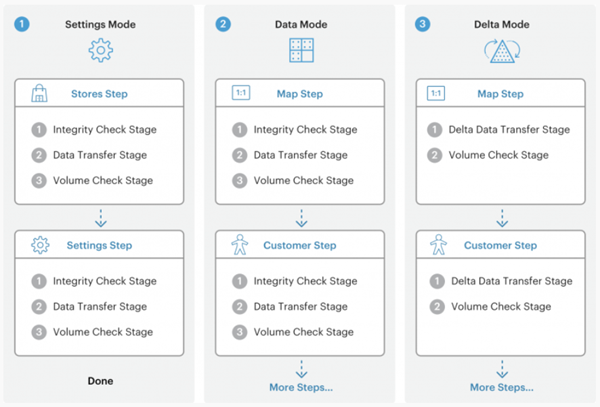
The Data Migration Tool (DMT) is a command-line interface used for migrating data from one Magento version to another. This tool verifies consistency between database structures, tracks the transfer progress, verifies tests and creates logs.
The tool operates in 3 modes which are shown in Figure 1.
Settings Mode
Manages and migrates configuration settings
Data Mode
Migrates data in bulk to the destination database
Delta Mode
Transfers incremental data updates to Magento storefront and admin panel while running previous migration modes
Figure 1: DMT modes
Before we discuss the issues faced while migrating, let’s briefly talk about the process of migration itself.
You can make a backup of your data with the following command:
In order to initiate the migration, you will use the following command:
bin/magento migrate:data [-r|–reset] [-a|–auto] {<path to config.xml>}
Now that we have covered the basics of getting started with migration, let’s move on to explore some of the most frequent issues faced when using DMT, and how you can solve them!
1. Mapping Issue with Fields and Source Documents
Have you ever seen the following error show up on your screen while migrating?
bash Source documents are not mapped: <EXTENSION_TABLE>
bash Source fields are not mapped. Document: <EXTENSION_TABLE>. Fields: <EXTENSION_FIELD>
An error like this appears when the Data Migration Tool is trying to check for consistency between the source and destination databases. Internal tests are run to check for data consistency between tables and fields. Instead of the word ‘Source’ in the error message, you may also see the word ‘Destination’ which implies the same problem.
Solution
To resolve this error, here are some practical solutions you can adopt:
Configure the Data Migration Tool Executing the –a argument will help auto-resolve errors and will ensure that the migration does not stop
You may also choose to ignore database entities that are not needed by adding <ignore> tag to the entity in the map.xml file
While migrating an error like this may also appear:
Class <extension/class_name> is not mapped in record <attribute_id=196>
This error occurs at the Entity Attribute Value migration step. Usually, it is due to the missing class of an extension.
Solution
You resolve this error, you can:
Reinstall the existing extension
In the eav-attribute-groups.xml.dist, add the attribute that causes this error to <ignore>
Add class mapping using class-map.xml.dist file
3. Foreign Key Constraint Failure
You may also encounter an error like this:
Foreign key <KEY_NAME> constraint fails on source database. Orphan records id: <id_1>, <id_2> from <child_table>.<field_id> has no referenced records in <parent_table>
This occurs when there are missing database records in the parent_table, to which the field_id of the child_table is pointing to.
Solution
Some viable solutions for this can be:
Delete the records from the child_table if not needed.
Disable the Data Integrity step by modifying the DMT’s config.xml.
4. URL Rewrite Duplication
There are duplicates in URL rewrites:
Request path: towel.html Store ID: 2 Target path: catalog/product/view/id/10
Request path: towel.html Store ID: 2 Target path: catalog/product/view/id/12
The above error occurs when two entries use the same request path and store ID pair but with two different target path values. The target path in a URL must be specified by a unique pair of request path + store ID.
Solution
Resolution to this can be to enable the auto_resolve_url_rewrite_duplicates in the config.xml file. This configuration adds a hash-string to the conflicting records of URL rewrite and shows the resolution result in the command line interface.
5. Entity Mismatch
Mismatch of entities in the document: <DOCUMENT> Source:
Mismatch of entities in the document: <DOCUMENT> Source:


<COUNT_ITEMS_IN_SOURCE_TABLE>


Destination: <COUNT_ITEMS_IN_DESTINATION_TABLE>
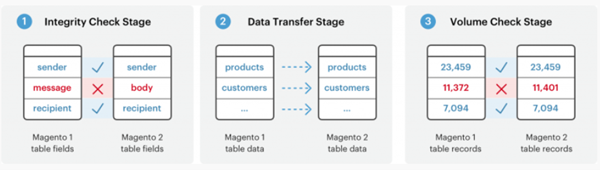
This error usually shows up when a customer places an order while the store is under active migration. To be precise, this occurs during the volume check setup (the stages are shown in Figure 2 below). This is when the Adobe Commerce database record encounters a mismatch between the original destination, and the final destination. It is common when a store is under migration for the website to say so and not take any orders. But some stores do allow orders to be compiled, and as soon as migration is done, those orders are automatically given the status of placed orders.
Solution
A possible solution to resolve this error would be to run the Data Migration Tool in delta mode to transfer incremental changes.
Figure 2: Check-stages for migration
6. Deltalog not installed
You may encounter this error as well:
Deltalog for <TABLE_NAME> is not installed
This means that deltalog tables (with prefix m2_c1_*) were not found. Data Migration Tool (DMT) installs these tables during data migration as well as database triggers which track changes and fill deltalog tables.
Encountering this error means that you are trying to migrate from a copy of the store and not the live store itself. Copy does not contain triggers and deltalogs needed to complete delta migration therefore resulting in a failure.
Solution
To troubleshoot this, testing of the migration process needs to be done. A specialized team is responsible for carrying out testing and the process usually entails scoping, dependencies/interactions, test cases, non-functional testing, and functional application tests.
Here are some important arguments for migration configuration:
bin/magento migrate:settings [-r|–reset] {<path to config.xml>}
[-r|–reset] stands for an optional argument that starts the migration from the beginning, which can be used for testing migration.
[-a|–auto] is also an options argument that prevents the migration from stopping if it encounters integrity check errors.
{<path to config.xml>} is the absolute file system path to the migration tool’s config.xml file: this argument is required.
7. MySQL Packets
MySQLError1153 – got a packet bigger than ‘max_allowed_packet’ bytes
This error occurs when MySQL is running in default settings.
Solution
To solve this error, use the following steps.
For the client, specify the following command:
mysql –max_allowed_packet=100M -u root -p database < dump.sql
Change the my.cnf or my.ini file (usually found in /etc/mysql/) under the mysqld section and set:
max_allowed_packet=100M
You can also use the MySQL console to log these commands:
set global net_buffer_length=1000000;
set global max_allowed_packet=1000000000;
We have discussed 7 common errors that one can encounter while upgrading Magento versions and migrating data. If you are considering migrating your own e-store to Magento or if you are considering upgrading your Magento version, it’s better to discuss with experts who have hands-on experience.
At Integriti, we have a capable team of web developers who can make your migration process smoother! Explore our Magento development services here.
Are you feeling stressed out about your next tech interview?
A technical interview is a demanding and specialized process where candidates are tested on their coding and problem-solving skills as well as soft skills and personality. This can be quite a stressful experience for candidates, especially where whiteboard interviews are concerned. As an award-winning IT services provider, we want to share our expertise and offer guidance on how to shine in your next technical interview.
Smart practice
It is extremely important to research and practice common coding challenges and tech interview questions beforehand. Familiarity with the type of problems you are likely to encounter in the interview will help in improving your confidence in your knowledge. We recommend practicing coding without the help of a code editor. Also, consider timing yourself to get accustomed to the time pressure. Remember, creating a more realistic scenario makes the preparation more effective.
Don’t panic
In technical interviews, interviewers are not just evaluating how a candidate breaks down a problem but are also interested in analyzing how they debug a problem. So, if there is an error with your code, do not panic! Avoid thrashing the code in desperation and maintain your logical flow. Treat your mistake as an opportunity to impress the interviewer.
Communicate
While completing your coding challenges, it is recommended to communicate your thought process to the recruiters. Good Interviewers are not always looking for completely accurate solutions. Instead, they are more concerned with your critical thinking abilities and tech fundamentals. It is recommended to talk out loud while solving the problem to avoid losing out on the position due to a minor blunder. Remember most interviews are designed to test the basic requirement of a job. While recruiters will not try to pull additional information out of you, we encourage our candidates to share their expertise and knowledge organically in the interview.
Recruiters often write off good candidates by citing reasons like technical skills gap. Hence, candidates need to exhibit their technical expertise effectively. We hope these suggestions can assist job seekers in out-performing their next tech interview.
If you have any additional queries or are interested in collaborating, contact us now!
Do you know that the cost of a defect increases by an order of magnitude for each consecutive stage of the software development cycle?
This means that discovering bugs earlier can significantly save money in terms of the effort of the technical teams and can lead to better ROI. Moreover, once issues are allowed to reach the production stage, they become more difficult to diagnose and solve.
In order to execute the project on time and within budget, preventing errors is better than fixing them. One great asset in identifying issues early on is a rigorous code review process. Code Review is the practice of systematically convening with one’s fellow programmers to check each other’s code for defects and has been shown to boost code quality and streamline the software development process. Moreover, it is also a great way to facilitate cross-training, mentoring, and learning among developers.
Coding Sans’s State of Software Development in 2018 report highlighted that 67.66% of software developers utilized peer code review to safeguard code quality. Additionally, that percentage is even higher among successful software developers; 73.53% of the top developers employ this practice. Despite its virtues, many people still often turn a blind eye to peer code reviews as they perceive performance testing to be adequate for validation. However, neglecting code reviewing can result in severe consequences for your project delivery.
So why are code reviews critical in executing software development smoothly? Here are four ways in which peer code reviews can add value to your IT project:
Code Quality And Defect Detection
Strong Collaboration And Knowledge Exchange
Streamlined Testing and Development
Enhanced Project Delivery
High Code Quality
Code reviews promise high quality as issues and errors are resolved before they skyrocket out of control. These inspections build quality into your process with excellent ROI and can reduce defects in your code by around 80%. Reviews also bring about consistency in meeting coding standards and project requirements. It improves the quality of code by concentrating on readability, maintainability, complexity, performance, and duplicated code.
Any discussion and collaboration on code will inherently improve readability. Also, a comprehensive review process will result in the style of code becoming similar in the team. This code standardization will provide for enhanced readability with superior support and maintenance. Developers also bring in their A-game and are more likely to write clean and concise code if they’re aware that their co-workers would be reviewing it.
Collaboration & Knowledge Exchange
All projects have unwritten rules and implicit understandings often referred to as “institutional” or “tribal” knowledge. Code review can facilitate the transfer of this knowledge from an expert professional to a new team member. This knowledge-sharing between team encourages internal learning and presents opportunities for mentoring junior team members. With the mentor directly reviewing his junior’s work but the junior developer examining the senior’s code, junior team members’ progress will be accelerated.
Collaboration between developers along with code standardization will bolster team productivity. This will reduce schedule delays if a team member is unavailable as any developer can take up the reins and continue steering the ship. Good reviews also encourage the development of T-shape professionals. These are individuals who are specialists in one area but have enough knowledge in the other domains to assist the continuous flow of the software development process.
Improved Testing & Development
Code reviews also take into account whether the code has well-designed automated tests or not. Moreover, optimizing code and consistently meeting standards will bear fruit in the form of a source code that is easier to understand for testers and specialists. Also, discovering bugs early on will help save time and money as there will be fewer delays in development due to further testing and revisions.
When the QA team gets involved in the code reviewing process, both the programming knowledge of quality analysts and the communication between teams will be improved significantly. Testers will know what part of the code defines a particular functionality of the project, therefore strengthening teamwork.
Effective Project Delivery
Every software project starts with a well-defined scope and requirements. There’s a high chance of a developer misinterpreting one of these requirements and creating a useless feature. An effective code review process will validate the developed feature against the expected one. This verifies developed features and guarantees that all misinterpretations associated with the project scope or requirements are addressed at the earliest.
Employing a consistent coding pattern and better documentation under code reviewing will make it convenient for developers to analyze existing code. This will help the project stay on track as developers will be spending more time adding features or upgrading existing ones. Also, this will benefit in the long run as well as it will be easier to onboard new developers to the project. Technical collaboration via code reviews also results in better estimates and project planning.
Conclusion
Overall, the peer code review process remains a critical stage in the software development lifecycle and can play a key role in enhancing the quality of code, team collaboration, and project delivery. When done right, it is a great tool to not only streamline development but also reduce the effort needed by the development team. Moreover, software testing alone has limited efficacy in defect detection. In his book, Code Complete, Steve McConnel reports that the average bug detection rate is 25% for unit testing, 35% for function testing, and 45% for integration testing. In comparison, design and code inspections have an average defect detection rate of 55% and 60%. These reviews are also crucial in establishing consistency in the source code and enabling superior testing and smoother integration. By mitigating errors, code reviews ensure the delivery of high-value solutions to clients on budget and time.
In recent years, cybercrime has become more sophisticated, professionalized, and personalized. And it is only headed to become graver. Small and large companies of all backgrounds are prone to threats which include but are not limited to malware, ransomware, and data breaches. Research shows that 37% of IT companies were targeted for ransomware in 2021 alone. Out of which only 8% of data was recovered after ransom payment.
The threat not only pertains to software, companies and employees, but to other concerned parties too. Mitigating these threats should be the goal. While it may not be entirely possible, going forward, implementing the following practices can secure software development frameworks for businesses.
Zero Trust & Access Control
Zero trust policies consider every individual that interacts with the software as a threat. It requires identity verification at every step to protect IT resources. It would be advisable for developers to implement the zero-trust architecture in the initial stages of the SDLC (software development lifecycle) to secure software applications from the source code up.
When targeting supply chains, attackers are heavily dependent on the trust present in the organization. Having to prove their identity at every step can help limit attacks.
Furthermore, attacks in a system do not always occur from outside the firewall. Limited access policies should be introduced where only required permission is shared with individuals for them to complete a job.
Investing Adequately:
By far, the largest security threat that software face is bad-quality code. Shifting Left is a practice that can avoid additional costs when the software has progressed into production. Moving left suggests that code be analyzed and vulnerabilities eliminated early in the process.
As it is considered expensive and time-consuming, the practice is still relatively more economical than when a product has moved into production. Research from Ponemon Institute suggests that it cost $80 to fix a software defect during development whereas it was $7,600 to fix during production.
Therefore, an initial investment of time, money and resources in good quality code can help companies forego higher costs down the line.
Close-Coordination Work & Upskilling:
Decision-makers for businesses should work closely with the IT department to take security-driven initiatives. By keeping cybersecurity at the forefront, taking preventative measures with the input of IT professionals can create secure products and result in cost-saving in the long run. Safety is at the center of all tasks and development, and future decisions revolve around it.
Improving the developers’ skill set can positively impact cybersecurity. By investing in the IT department through training, workshops, and classes, developers and engineers upskill and add further value to a business. Also, providing them with suitable resources can result in significant profit dividends.
SBOM goes public
Though the SBOM has been around for the past few years, its wide usage is predicted to begin soon. An SBOM (software bill of materials) requires the software development company to list all materials used in building the product.
SBOMs can help maintain security essentially by showcasing a software’s components. Companies can identify vulnerable access points and draw up security measures to avoid threats. Several federal agencies in the US have also shown support for SBOMs, making it a requirement for every software used by government agencies.
It is crucial to keep in mind that a single step-initiative will not solve a company’s cybersecurity, rather an entire step-by-step system needs to be put into place. Every organization has different security needs. It is crucial to identify the issues first and then create the best practices for secure software development.
The world of eCommerce is saturated with cutthroat competition over getting customers’ attention, particularly in the apparel industry. With the rise of online shopping over the recent years, eCommerce has become an important playing ground for most fashion and apparel brands. Research shows that by 2025, the e-commerce fashion market is expected to generate a revenue of approximately 331.7 billion U.S. dollars in North America alone.
With Ecommerce more valuable today than ever before, it’s important to unlock the doors to new ideas and styles. Apparel brands need to create their eCommerce site differently than their competitors and get a lot of new visitors to their sites.
Most visitors take about 0.05 seconds to form an opinion about a website. This is where a good user experience comes in. For Ecommerce, UX is crucial because it makes sure that your customers can easily navigate your website, find the product they require, buy it, and move on.
As per UX Planet, for every dollar spent on UX, the company can expect a return on investment of up to $100. A good UX design raises a website’s conversion rate by approximately 200% and 80% of consumers are ready to pay extra for a better experience. The easier it is for people to buy from you, the greater your online revenue will be. That’s why it’s important for businesses to make sure they offer the best UX possible and stay ahead of all the new trends.
So, how can apparel brands create high-converting digital experiences?
User-centered design (UCD) is a design process that concentrates on users and their requirements. In UCD, a variety of research and design techniques are used to build highly compatible and accessible products for users. User-centric design is a great tool for you to develop a more inclusive online platform.
More and more businesses are starting to grasp the significance of being inclusive and there is a shift in attitudes toward gender and cultural inclusion. Non-English naming conventions are displayed in forms with non-binary options and “preferred name” fields. All such features provide users with a more customized and wide-ranging customer experience. Inclusivity is also reflected in the diversity of participants selected for user research.
Overall, by adopting this trend, companies can benefit from close user involvement in the design process and ensure an online shopping experience that meets users’ expectations and requirements. This results in increased sales and reduced costs incurred by customer services.
The barriers between the digital and real worlds are blurring due to advances in AR/VR technology. Designing with VR/AR has changed how companies are optimizing user experience on digital platforms. In UX design, extended reality particularly rose to fame during the COVID-19 pandemic when companies wanted to reach end-users who were stuck at home.
Employing this technology would mean that users are no longer required to issue any commands to applications in order to use them. Instead, user actions are interpreted in real time by the gadget which reacts to the user’s surroundings.
The fashion and retail sectors can employ this technology to connect with their customers in completely innovative ways. With the help of 3D designs, VR/AR technology will allow apparel brands to offer a first-person perspective to customers. Users will be able to engage with design components face-to-face and will get an immersive shopping experience.
Mobile-first Designs
Mobile devices have become an essential part of the current digital landscape and will continue to remain so in the future as well. If an apparel brand wants to increase its online sales, then they need to focus on mobile E-commerce. When making a purchase decision, 59% of shoppers consider being able to buy products on mobile as an important factor.
In the Mobile-first design approach, designers will first work on creating a product design for mobile devices. This is done by prototyping the app’s design for the smallest screen first and then moving on to larger screen sizes. it makes sense to adopt this approach as devices with smaller screen sizes have space limitations and UX designers have to ensure that the key components of the website are prominently displayed for users.
If your business incorporates this UX trend in its fashion eCommerce, designers would be compelled to remove unnecessary elements to deliver seamless website rendering and navigation.
Voice-over Interfaces
User interface design is much more than just the visual screen. It takes into consideration other senses as well. Voice search is another design trend that is gaining hype. The speech and voice interface market is estimated to grow to approximately 25 billion dollars by 2025.
Users’ attention spans have declined over the years, and they demand more speed and ease. Businesses are moving towards voice-activated user interfaces to bring a whole new level of convenience to their customers. This offers users the ability to carry out a task hands-free and without looking at a device.
Fashion and retail companies can utilize sophisticated voiceover interfaces to provide users with a more personalized and highly efficient user experience as they would have someone to assist them. In fact, customers will have a personal store clerk with them to guide them along their digital shopping experience.
Conclusion
In conclusion, fashion eCommerce is a highly competitive arena to survive in, and apparel brands need to be open to experimenting with modern UI design trends. Retail businesses should be able to anticipate their users’ needs and ensure that they have the necessary tools to keep up with trends to provide the best user experience possible and achieve customer satisfaction. Adopting approaches like User-centric design and Mobile-first design can help you meet the current need of your customers. Similarly, incorporating voice-activated user interfaces and VR/AR technology in your eCommerce strategy can help you create more immersive, customized, and distinctive digital experiences. The need for this shift towards virtual and augmented reality will likely intensify in the future with the rise of Metaverse.