What webflow 2025 growth signals for the future
Why do some websites built on popular platforms struggle to convert, while others thrive effortlessly? The difference often comes down to more than just the choice between Webflow or WordPress it lies in factors influencing website performance, from professional development quality to thoughtful design and ongoing maintenance. In 2025, businesses increasingly recognize that the real value of good web design extends beyond aesthetics. A carefully optimized user experience, accessible layouts, and seamless AI-driven personalization can dramatically improve engagement and SEO, while data-driven decisions and smart integrations help marketing teams maximize ROI.
Webflow in 2025 signals a future driven by AI, no-code efficiency, and seamless integrations. Marketing leaders leverage its SEO, analytics, and personalization capabilities to optimize user experience, improve conversions, and enable data-driven decisions. Businesses using Webflow can scale faster while maintaining modern, high-performing web design.
Professional development ensures that your website not only looks modern but functions reliably, with features that support growth. Maintenance and support often overlooked keep your site secure, fast, and optimized for conversions. Small investments, such as allocating $2,000–$5,000 for focused improvements or enhancements, can yield measurable results without breaking budgets.
This blog will explore the growth signals for Webflow in 2025, highlighting how AI, SEO, integration, and no-code capabilities are shaping the future. You’ll learn how marketing leaders use Webflow to optimize websites, improve user experience, and leverage data-driven insights for smarter decisions.
AI, SEO, Analytics: Key Webflow 2025 Takeaways
Webflow in 2025 continues to redefine how marketing websites are designed, optimized, and scaled. For businesses looking to build smarter, leveraging AI, SEO, and analytics is no longer optional—it’s essential. Understanding these core areas helps marketers, designers, and developers create future-proof web experiences that maximize ROI and deliver measurable impact.
AI-Driven Personalization Enhances User Experience
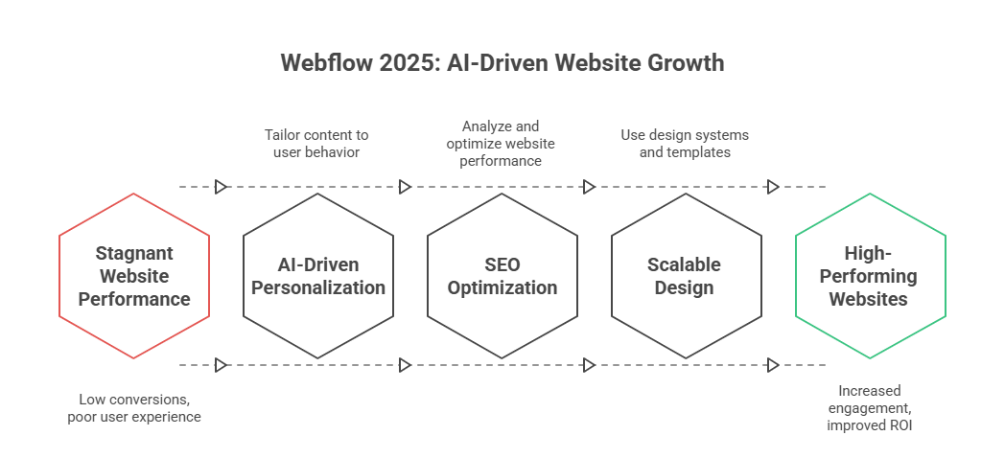
One of the most significant growth signals for Webflow in 2025 is AI-driven personalization. Platforms like Webflow now allow marketers to dynamically tailor content based on user behavior and preferences. By integrating AI, teams can deliver relevant experiences without code, reducing the bottleneck of manual content updates. Designers and developers can combine AI with visual web development and motion design to create immersive digital experiences that resonate with audiences.
Benefits for Marketing Leaders and Teams
- Deliver content-rich, personalized experiences across entire websites.
- Automate repetitive tasks, freeing teams to focus on strategy and design.
- Improve ROI by increasing engagement and conversion through smarter, data-driven personalization.
SEO Optimization and Analytics Integration
In 2025, SEO rankings are increasingly tied to data and user engagement. Webflow’s new tools make it simple to analyze and optimize websites using integrated analytics, allowing marketers to track performance in real-time. Whether you use Webflow for scalable websites or smaller webflow sites, having built-in insights reduces reliance on third-party tools and empowers non-developers to make informed decisions.
Key Takeaways for SEO in Webflow
- Leverage analytics to understand user behavior and optimize layout and content placement.
- Combine dynamic content with AI-driven strategies to improve search visibility.
- Ensure future-proof websites by aligning design systems, templates, and reusable components with evolving website trends.
Designing Scalable, Data-Driven Web Experiences
Webflow’s 2025 state highlights the importance of design and development workflows that support scalable websites. From core areas like accessibility and inclusive design to backend logic and content management, Webflow provides tools to iterate efficiently. Freelancers, teams, and agencies can leverage reusable components and curated collections to streamline projects, ensuring future-proof websites that meet modern web standards.
Practical Applications
- Use design systems and templates to maintain consistency across large projects.
- Integrate analytics to continuously refine digital experiences.
- Adopt AI and automation for dynamic content, ai-driven personalization, and smarter team collaboration.
Takeaways:
By focusing on AI-driven personalization, integrated analytics, and SEO optimization, Webflow in 2025 enables marketers and designers to build content-rich, scalable websites without code. These innovations help teams analyze and optimize continuously, delivering relevant experiences that drive growth, improve ROI, and future-proof web projects.
Conclusion
Webflow in 2025 clearly demonstrates that the future of websites is no longer just about aesthetics—it’s about building smarter, scalable, and data-driven digital experiences. By leveraging AI-driven personalization, integrated analytics, and SEO optimization, businesses can create marketing websites that not only engage users but also deliver measurable ROI. Thoughtful webflow design, professional development, and ongoing maintenance ensure your site remains reliable, future-proof, and optimized for growth.
Marketing leaders and teams who use Webflow effectively can streamline workflows, reduce dependency on developers, and implement dynamic content strategies that respond to real-time user behavior. Small, targeted investments in design systems, templates, and AI integrations can yield outsized results, making modern web development both efficient and impactful.
Ultimately, the growth signals for Webflow in 2025 point toward a future where content-rich, scalable websites powered by AI and analytics become the standard. By embracing these capabilities, businesses can stay ahead of website trends, improve user experience, and make confident, data-driven decisions for long-term success.
Are you ready to take your website to the next level why not contact Integriti Studio today and see how we can help?
Frequently Asked Questions (What webflow 2025 growth signals for the future)
What is the future of Webflow?
The future of Webflow is promising, as it continues evolving into a full-fledged no-code platform for designers and developers. In 2025, its focus on AI-driven design, real-time collaboration, and scalable workflows enables businesses to build responsive, visually compelling websites efficiently, bridging creativity with production-ready functionality.
Should I learn Webflow in 2025?
Yes, learning Webflow in 2025 is valuable. Its no-code capabilities, AI-driven design tools, and real-time collaboration features empower designers and developers to build responsive, scalable websites efficiently. Mastering Webflow can enhance your skillset, improve workflow efficiency, and open opportunities in modern web design and digital agencies.
Is web design still in demand in 2025?
Yes, web design remains in high demand in 2025. Businesses increasingly prioritize user experience, responsive design, and AI-driven functionality. Skilled designers who can create visually appealing, optimized, and future-ready websites are essential for brand growth, digital engagement, and maintaining a competitive edge in the evolving online marketplace.
What will marketing look like in 2025?
Marketing in 2025 will be data-driven, AI-powered, and highly personalized. Brands will leverage advanced analytics, automation, and real-time collaboration tools to deliver targeted campaigns across multiple channels. Creative content, seamless user experiences, and predictive insights will define strategies, making marketing more efficient and measurable than ever.