
Why do some websites struggle to engage visitors despite sleek layouts and flashy visuals? The difference often lies in a combination of factors influencing website performance from page speed and accessibility to AI-driven personalization and SEO integration. A future-ready website in 2026 isn’t just about how it looks; it’s about how it functions, converts, and adapts to evolving user expectations.
A website becomes future-ready in 2026 by combining AI-driven personalization, fast and accessible layouts, SEO integration, and seamless user experience. Prioritizing professional development, regular maintenance, and modern design trends ensures your site transforms web experiences, builds trust signals, and stays adaptable to evolving technologies and user expectations.
Professional development plays a crucial role in this transformation. Investing in expert web design, maintenance, and support ensures your site remains secure, fast, and compatible with modern tools. Good design goes beyond aesthetics it builds trust signals, guides users efficiently, and enhances the overall user experience. For businesses, this often means allocating budgets that reflect quality development, with typical professional website projects ranging from moderate to higher-end pricing depending on complexity and features.
This blog will explore what makes a website truly future-ready in 2026. You’ll discover emerging design trends, AI-powered tools, accessibility standards, layout strategies, and techniques to transform web experiences. We’ll also highlight practical ways to ensure your new website attracts search engines, engages users, and stays ahead of the trends of 2026.
How To Make Your Website Future-Ready In 2026
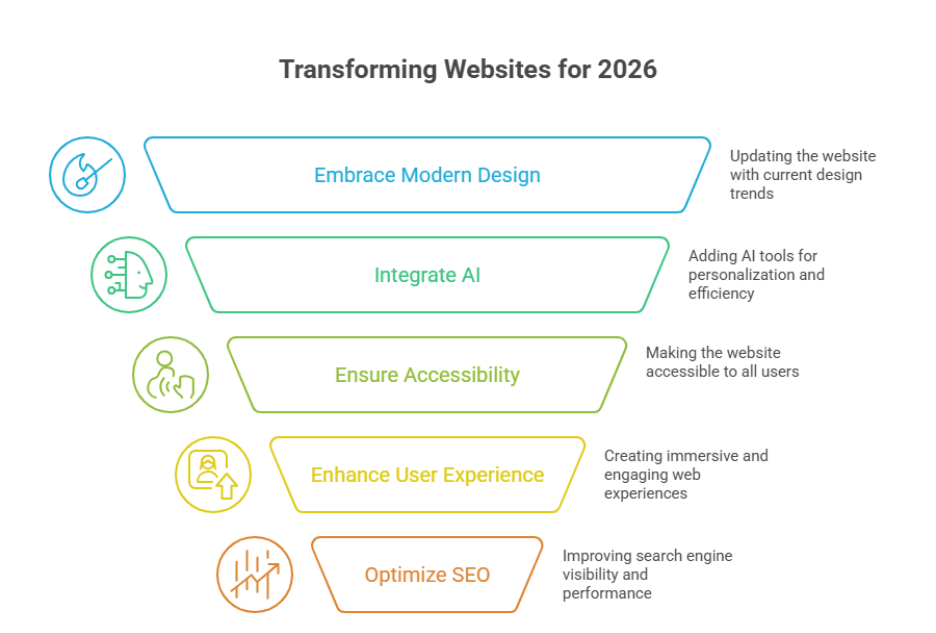
Preparing a website for 2026 means creating modern websites that are adaptive, engaging, and built for long-term performance. Follow these steps to make your site truly future-ready:
Step 1: Embrace Modern Web Design and Layouts
Start by updating your web design to match current design trends 2026. Focus on clear, immersive layouts, responsive typography, and micro-interactions. A well-structured 2026 website guides users intuitively, improving usability and overall digital experience.
Step 2: Prioritize Personalization and AI Integration
Implement personalization features and AI tools to tailor content to each visitor. Adding AI assistants or ai search functionality enhances navigation and boosts engagement, making your web experiences smarter and more user-focused.
Step 3: Focus on Inclusive Design and Accessibility
Incorporate inclusive design principles to make your website accessible to all users. This ensures compliance with accessibility standards, improves UX, and aligns with trends of 2026 where ethical, user-centered design is a priority.
Step 4: Enhance Web Experiences With Immersive Features
Add interactive visuals, animations, and immersive elements that captivate visitors. Thoughtful web experiences create a memorable site, keeping users engaged and encouraging return visits.
Step 5: Stay Ahead With SEO and Development Trends
Optimize for search engines and keep up with web development and trends for 2026. Fast-loading pages, structured data, and AI-driven analytics ensure your future of web design strategy maintains high performance and visibility.
Key Design Trends 2026 Shaping Modern Websites Today
Modern websites are evolving fast, and trends of 2026 are shaping the future of website design. To create modern websites that deliver exceptional digital experiences and remain future-ready, consider these key design trends:
Immersive Experiences and Micro-Interactions
- Web experiences are moving toward immersive, interactive designs that actively engage users.
- Micro-interactions, such as hover effects, animated buttons, and real-time feedback, guide users and enhance overall usability.
- These features make modern websites dynamic and memorable, improving user retention and encouraging exploration.
AI-Driven Personalization
- Personalization with ai tools allows websites to adapt content, recommendations, and offers to individual user behavior.
- Integrating ai assistants or ai search simplifies navigation, helping users find relevant content quickly.
- Personalized experiences not only improve engagement but also strengthen the user’s connection with your brand, enhancing the overall digital experience.
Inclusive Design and Accessibility
- Inclusive design ensures your website is accessible to users with different abilities, meeting accessibility standards.
- Enhancing UX for all visitors aligns with trends for 2026, where ethical and user-centered design is a priority.
- Accessibility improvements increase audience reach, build trust, and contribute to a future-ready website.
Typography and Visual Hierarchy
- Thoughtful typography improves readability and establishes a clear visual hierarchy for your content.
- Strong hierarchy and expressive fonts guide users intuitively, making navigation easier and boosting usability.
- Bold typefaces, dynamic font sizes, and clear spacing are integral design trends 2026 that enhance digital experiences.
Future-Ready Layouts
- Websites are shifting away from rigid grids toward flexible, immersive layouts that adapt to various devices.
- These layouts improve responsiveness, creating consistent web experiences across desktops, tablets, and mobile devices.
- Adopting such designs ensures websites in 2026 are visually appealing, functional, and adaptable to evolving user needs.
Optimized Performance and AI Integration
- Using ai tools can automate content delivery, enhance personalization, and optimize workflows for efficiency.
- Maintaining fast-loading pages and monitoring performance metrics ensures smoother digital experiences.
- AI-powered insights and automation help your future of website strategy remain competitive and future-ready.
Core Design Principles
- Every design choice should have a purpose, balancing aesthetics with functionality.
- Focus on good design and user-first principles to create intuitive, engaging modern websites.
- Following these principles ensures your site is immersive, usable, and positioned as a future-ready website for 2026.
Conclusion
Creating a future-ready website in 2026 goes beyond attractive visuals. It requires combining AI-driven personalization, immersive layouts, inclusive design, and SEO integration to deliver seamless digital experiences. By following modern web design trends, prioritizing usability, and investing in professional website development, your site can adapt to evolving user expectations while building trust and engagement. Thoughtful design choices, interactive micro-elements, and AI-powered tools ensure your website not only performs well today but remains relevant in the fast-changing digital landscape of 2026.
Ultimately, the key to a truly future-ready website is balancing aesthetics, functionality, and accessibility while keeping users at the center of every decision. Regular updates, maintenance, and integration of new technologies will keep your modern website competitive and impactful.
Are you ready to transform your website into a future-ready digital experience, or should you contact Integriti Studio to make it happen?
Frequently Asked Questions (What Makes a Website Future-Ready In 2026)
What is the trend in website 2026?
In 2026, website trends focus on AI-powered personalization, minimalist yet purposeful design, 3D/immersive visuals, voice-enabled navigation, and accessibility. Sites are faster, adaptive to users, mobile-first, and use bold typography and subtle interactions to boost engagement and clarity.
What is the scope of web development in 2026?
In 2026, web development has a vast scope with rising demand for AI-integrated websites, progressive web apps, voice and AR/VR interfaces, and advanced cybersecurity. Developers skilled in full-stack, cloud solutions, and accessibility-focused design will lead, as businesses prioritize seamless, personalized, and future-ready digital experiences.
What is the future of websites?
The future of websites is AI-driven, highly personalized, and immersive, combining voice, AR/VR, and interactive 3D elements. Websites will focus on speed, accessibility, and seamless mobile experiences, acting as smart platforms that adapt to user behavior, deliver real-time content, and enhance engagement and conversions.
What will technology look like in 2026?
In 2026, technology will be AI‑driven, highly interconnected, and immersive, with smart devices, augmented and virtual reality, advanced robotics, and quantum computing becoming mainstream. Emphasis will be on automation, personalized experiences, sustainability, and seamless integration across work, entertainment, and daily life, reshaping how people live and interact.