
Why Webflow Sites Started Competing With Custom Code in 2025
Why do some websites outperform others despite using similar platforms? The difference often comes down to factors influencing website performance, from coding quality and clean CSS to optimized content management and seamless third-party integrations. As a startup or growing business, you might assume that a custom website built for a few hundred dollars is enough but without professional development, ongoing support, and thoughtful maintenance, hidden costs often accumulate, affecting speed, SEO, and user experience.
Webflow sites started competing with custom code in 2025 because they combine no-code efficiency with advanced customization, AI-assisted tools, and scalable workflows. Businesses and developers realized that Webflow offered faster deployment, easier maintenance, and strong SEO performance, making it a cost-effective, professional alternative to fully coded custom websites.
Webflow sites in 2025 have emerged as a compelling alternative to custom code, offering a no-code, user-friendly builder that balances customization with efficiency. Developers now recognize that leveraging Webflow’s platform, coupled with AI-assisted tools and scalable workflows, can deliver sophisticated animations, integrations, and content management capabilities previously reserved for traditional coding. Good design, robust support, and adherence to best practices are no longer optional—they’re critical to long-term success.
This blog will explore why Webflow started competing with custom code in 2025, examining performance factors, the real value of professional development, and strategic use cases for startups. You’ll also see how making the right choice between Webflow and custom coding can impact scalability, SEO, and overall web development workflows.
Why Startups Choose Webflow in 2025 Strategically
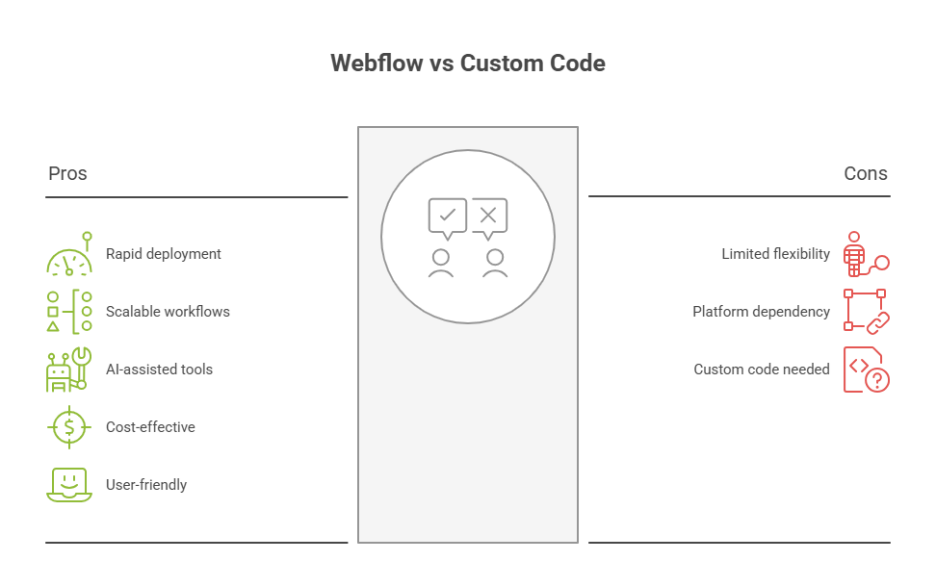
Startups in 2025 are increasingly turning to Webflow as a strategic alternative to fully custom development. The platform offers a unique combination of speed, scalability, and flexibility, allowing emerging businesses to launch professional websites without compromising on design, functionality, or long-term growth potential. Understanding why startups are making this shift requires a closer look at the benefits Webflow brings compared to traditional custom coding approaches.
Speed and Efficiency in Web Development
One of the primary reasons startups choose Webflow in 2025 is the speed at which websites can be launched. Unlike fully custom development, which may require extensive coding and debugging, Webflow’s visual interface allows teams to build functional, responsive sites quickly. Webflow generates clean code and semantic code automatically, reducing errors while ensuring compatibility with SEO best practices. For startups, this means faster time-to-market and the ability to iterate quickly based on user feedback.
Scalability Without Compromising Quality
Scalability is another critical factor. Webflow remains a strong choice for startups that anticipate rapid growth. Webflow’s platform allows for advanced features, complex functionalities, and integration with third-party tools without the need to rebuild the site from scratch. Startups can add custom code or implement custom business logic where necessary, ensuring the site grows alongside the business. Compared to platforms like Webflow vs custom code, Webflow often reduces long-term maintenance costs while maintaining flexibility.
Balance Between Design and Development
Webflow is great for bridging the gap between design and development. Startups can leverage Webflow University resources to train in webflow development or collaborate with webflow experts to create custom layouts. The platform gives startups the ability to maintain clean code while implementing advanced features, animations, and AI site builder tools without writing a line of code.
Strategic Decision: Webflow vs Custom
Choosing the right choice between Webflow and custom development comes down to balancing budget, timeline, and functionality. While fully custom sites offer ultimate flexibility, they are often resource-intensive. Webflow in 2025 gives startups the ability to build custom websites, add custom code selectively, and maintain semantic code all while avoiding platform limitations.
Long-Term Value and Maintenance
Startups also benefit from Webflow’s sustainable approach to web development. The platform provides ongoing updates, reliable hosting, and analytics tools to monitor site performance. Webflow gives teams insights to optimize workflows, maintain scalability, and future-proof their digital presence critical considerations for businesses planning long-term growth.
Webflow vs Custom Code: 2025 Developer Comparison Insights
As the web development landscape evolves in 2025, businesses and developers are increasingly evaluating whether to invest in fully custom code or switch to Webflow. Understanding the practical differences, benefits, and limitations of each approach is essential for making informed decisions that align with business needs, scalability, and long-term performance.
Speed and Efficiency for Designers and Developers
- Rapid Development: Webflow is a visual web development platform that allows designers and developers to build responsive sites faster than traditional coding.
- Clean Code Generation: Webflow generates clean, semantic code automatically, reducing errors and ensuring compatibility with SEO and performance optimization best practices.
- Visual Control: Webflow allows teams to manage layouts, animations, and styling visually while still providing the option to add custom code where necessary.
Integration and Third-Party Tools
- Seamless Connections: Webflow provides integration with third-party tools like CRMs, analytics, and marketing platforms, simplifying workflows for startups and enterprises.
- Custom Content Types: While fully custom development allows complete control over data structures, Webflow users can create custom content types and easily add dynamic content through its CMS features.
Cost, Maintenance, and Scalability
- Total Cost of Ownership: Deciding between Webflow and custom solutions often comes down to long-term costs. Custom development may require more technical resources, dedicated maintenance, and custom SLAs, which can lead to unexpected costs.
- Sustainable Scalability: Webflow pages are optimized to handle millions of users, with scalable hosting and reliable performance, making the platform helpful for startups building growth-focused digital products.
Flexibility vs Platform Limitations
- Custom Code Advantage: Fully custom sites offer complete flexibility for complex functionalities and unique business logic.
- Webflow Advantage: Webflow is a visual web development builder that simplifies most tasks, from the basics to advanced features, and allows designers and developers to focus on user experience and workflow optimization.
Best Fit for Your Business
- Startups and SMEs: For businesses seeking speed, reduced maintenance, and integrated tools like analytics, Webflow provides a practical solution without sacrificing scalability.
- Enterprises with Unique Needs: Companies requiring highly customized solutions may benefit from custom code, provided they have the technical resources to manage development and ongoing updates.
Conclusion
In 2025, Webflow sites proved they could compete with fully custom code by combining speed, scalability, and flexibility with professional-grade design and development capabilities. Startups and growing businesses found that leveraging Webflow’s visual platform, AI-assisted tools, and clean code generation enabled faster launches, easier maintenance, and optimized performance. Compared to traditional custom development, Webflow reduces long-term costs, simplifies integrations with third-party tools, and allows selective addition of custom code, making it a practical, scalable choice for businesses aiming for sustainable growth.
Deciding between Webflow and custom code ultimately depends on your business needs, technical resources, and long-term goals. For startups, Webflow provides a strategic, cost-effective solution that balances efficiency, design, and advanced functionality. Meanwhile, enterprises with highly specific requirements may still benefit from fully custom development, provided they can manage the associated complexity and costs.
Curious which approach Webflow or custom code would maximize your growth? Why not ask Integriti Studio?
Frequently Asked Questions (Why Webflow Sites Started Competing With Custom Code in 2025)
Is Webflow still relevant in 2025?
Yes Webflow remains highly relevant in 2025. Its no‑code visual development, responsive design, CMS capabilities, and AI-assisted features make it essential for designers, freelancers, and businesses. With growing adoption and continued updates, Webflow stays a strong tool for modern web design and development.
Does Webflow allow custom code?
Yes Webflow allows custom code. Designers can embed HTML, CSS, and JavaScript directly into pages or the site’s header/footer, enabling advanced functionality beyond the visual builder. This flexibility makes Webflow suitable for both no‑code users and developers needing custom, dynamic web solutions.
Who does Webflow compete with?
Webflow competes with platforms like Wix, Squarespace, WordPress, Shopify, and Bubble. It stands out for visual no‑code development and CMS flexibility, but these competitors offer alternative solutions for website building, e‑commerce, and app development, targeting both beginners and professional designers.
What is the difference between Webflow and custom website?
The difference between Webflow and a custom website is that Webflow uses a visual, no‑code platform with templates and built-in CMS, enabling faster development, while a custom website is coded from scratch, offering full control, unique features, and optimization, but requires more time, skill, and maintenance.