Category: Studioblogs

  • Why Your E-Commerce Business Needs WooCommerce Development Services Today

    Why Your E-Commerce Business Needs WooCommerce Development Services Today

    Why Your E-Commerce Business Needs WooCommerce Development Services Today

    E-commerce businesses must offer customers a very seamless shopping experience in the rapidly growing digital marketplace while also standing out in a totally crowded market. One product that has entirely transformed how businesses function is WooCommerce, a very dynamic and highly customizable platform built on top of WordPress (ecommerce platform). But why would your business wish to invest highly in WooCommerce website development services (woocommerce development services, ecommerce development)? Let’s explore the specifics.

    What is WooCommerce?

    WooCommerce is particularly an open-source e-commerce extension for WordPress that allows businesses to completely transform their websites into highly functional e-commerce sites (ecommerce website). Since its launch in 2011, WooCommerce, has become quite a popular e-commerce platform, that has ran millions of online stores worldwide (online store, ecommerce site). Because of its high scalability, flexibility, and an extensive range of customizable options, it has become quite a solution for companies of all sizes (businesses of all sizes, scalable, scalability).

    Whether you’re an enterprise looking for a very specialized solutions or a small business owner trying to expand your company online (online business), WooCommerce offers quite a range of WooCommerce development services (custom woocommerce development services, woocommerce solutions) to meet your needs.

    The Benefits of WooCommerce for E-Commerce Businesses
    The Benefits of WooCommerce for E-Commerce Businesses

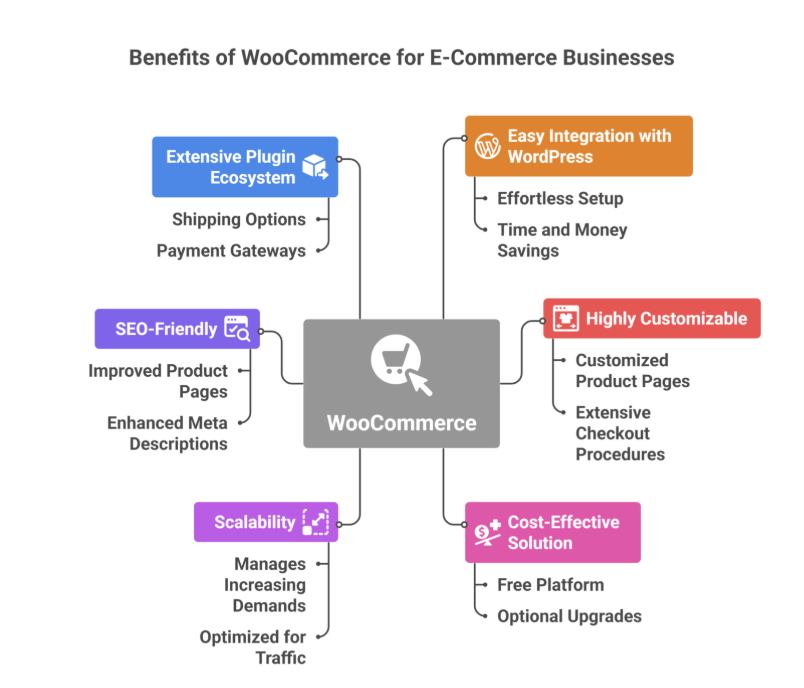
    1. Easy Integration with WordPress

    WordPress, quite a widely used content management system (CMS) worldwide, connects easily with WooCommerce (plugin for wordpress, wordpress plugin). Unlike building an e-commerce website from scratch, particularly adding WooCommerce to an already-existing WordPress website is effortless and saves a lot of time and money (wordpress site, built on wordpress).

    2. Highly Customizable

    Custom WooCommerce development services allow companies to customize their online stores to reflect their personal brand identity (customization, customized solutions, brand identity). With features like customized product pages and extensive checkout procedures, the platform provides you the freedom to design a shopping experience that caters to your target market (shopping experience, customer experience).

    3. Cost-Effective Solution

    WooCommerce is a free e-commerce platform (woocommerce is free), compared to some that require hefty subscription fees. It is still a cost-effective choice for enterprises, particularly those who are just getting started, even though quality upgrades or development services may incur additional fees (development needs).

    4. Scalability

    WooCommerce can grow alongside your business (business grows). The platform effectively manages increasing demands, regardless of how many products you have—ten or a thousand. You can make sure your store stays optimized regardless of traffic and merchandise grow with professional WooCommerce development (expert woocommerce development, optimize).

    5. SEO-Friendly

    For your online store to draw in organic traffic, search engine optimization, or SEO, is essential. You may improve product pages, meta descriptions, and URLs to rank higher in search results via WooCommerce’s integration with WordPress, which ensures access to a variety of SEO tools (website design, long-term success).

    6. Extensive Plugin and Extension Ecosystem

    With the help of WooCommerce’s comprehensive plugin and extension library (woocommerce plugins, plugin development), you can include features like shipping options, payment gateways (payment gateway), and advanced analytics. WooCommerce website development services can be used to further improve these plugins, guaranteeing smooth operation catered to your company’s requirements (functionality, best practices).

    Why Invest in WooCommerce Development Services?

    1. Enhanced User Experience

    A well-designed e-commerce store (e-commerce store) is essential for retaining clients. Expert WooCommerce development service providers (expert woocommerce developers, woocommerce experts) know how to maximize your store’s performance, guaranteeing smooth checkout, quick load times, and easy navigation (support and maintenance).

    2. Custom Features for Unique Needs

    Every company has different objectives. You can incorporate certain features like foreign support, complex search filters, or audience-specific recommendations with custom WooCommerce development services (custom solutions, tailor specific needs).

    3. Mobile Optimization

    Since a growing number of consumers are constantly shopping on mobile devices, it is essential to have a store that is properly optimized for mobile (mobile responsiveness). By ensuring that your store functions highly and looks attractive on all screen sizes, WooCommerce developers can highly enhance the user experience (woocommerce developers, skilled woocommerce).

    4. Integration with Third-Party Tools

    Third-party technologies are crucial for digital e-commerce for marketing, analytics, and customer service. Because WooCommerce is open-source, it integrates easily with programs like CRM systems, MailChimp, and Google Analytics (seamless integration with third-party). These integrations can be further tailored by skilled developers to fit your company operations (creating a plugin).

    Choosing the Right WooCommerce Development Partner

    The performance and success of your store can be greatly impacted by investing in professional development services. What to look for in a development partner for WooCommerce:

    1. Expertise and Experience

    Inspect the developers’ history of successfully finishing WooCommerce tasks (experienced woocommerce developers). Analyze portfolios, case studies, and customer recommendations to evaluate their experience level (development company).

    2. Understanding of Business Needs

    An ideal partner will take the time to understand the goals of your business (business needs) and tailor their solutions accordingly. Look for developers who respect communication and teamwork throughout the entire project (customer satisfaction).

    3. Post-Launch Support

    E-commerce websites need constant maintenance and updates. To handle technical problems and maintain the functionality of your business after launch, pick a development partner that provides post-launch support (support and maintenance).

    Real-World Applications of WooCommerce

    Businesses across industries have leveraged WooCommerce to create unique online stores:

    • Retail: WooCommerce enables small businesses to provide an extensive range of products at low setup costs (woocommerce store, ecommerce business).
    • Subscription Services: Companies can provide subscription-based business models for recurring income with the appropriate extensions.
    • Digital Products: Software and eBooks are among the digital products that WooCommerce makes easy to market.
    • Service-Based Enterprises: Companies may partially incorporate customer service tools and reservation systems straight into their WooCommerce websites (woocommerce plugin development).

    Is WooCommerce Right for Your Business?

    Despite its many advantages, WooCommerce might not be the very best option for every company. Here are a few considerations:

    • Budget: Although WooCommerce is totally free, you should factor in some extra costs for development services, plugins, and hosting (vps hosting).
    • Technical Expertise: Setting up and constantly maintaining a WooCommerce store requires a certain level of expertise in technology. This process can be made very simple with expert WooCommerce development (experienced woocommerce). 
    • Business Scale: WooCommerce is highly suited for small to medium-sized businesses, however it can also service large corporations with the right customization (choose woocommerce, reasons to choose).

    Businesses looking to establish a strong online presence in the competitive marketplace of e-commerce today would be wise to invest sufficiently in WooCommerce website development services (wordpress, ecommerce solutions). WooCommerce’s highly unmatched adaptability satisfies a variety of business goals, including scalability, customization, and mobile and SEO optimization (customize, tailor). You may fully utilize the platform and create an online store that attracts and engages a lot of clients by collaborating with highly knowledgeable developers (development company, woocommerce development company).

    Want your business to be seen and heard online? Explore our Services
     

    Frequently Asked Questions (Why Your E-Commerce Business Needs WooCommerce Development Services Today)

    What is the purpose of WooCommerce?

    WooCommerce is a powerful WordPress plugin designed to turn a website into a fully functional online store. It allows businesses to sell products and services, manage inventory, handle payments, and customize the shopping experience. Its flexibility makes it ideal for small to large e-commerce businesses.

    Do you need a developer for WooCommerce?

    You don’t always need a developer for WooCommerce, as it’s user-friendly and offers many ready-made themes and plugins. However, a developer is helpful for advanced customizations, integrating complex features, optimizing performance, or ensuring security, especially for larger stores or unique business requirements.

    Why is web development important for business?

    Web development is crucial for businesses because it establishes an online presence, builds credibility, and attracts customers. A well-designed website improves user experience, boosts sales, supports marketing efforts, and enables businesses to compete effectively. It also allows easy communication, engagement, and growth in the digital marketplace.

    What are the needs for successful eCommerce?

    Successful eCommerce requires a user-friendly website, secure payment systems, and reliable inventory management. Effective marketing, fast shipping, and excellent customer service are essential. Additionally, mobile optimization, analytics, and personalized experiences help attract and retain customers, driving growth and long-term business success.





  • WordPress Development: Custom vs. Off-the-Shelf Solutions

    WordPress Development: Custom vs. Off-the-Shelf Solutions

    WordPress Development: Custom vs. Off-the-Shelf Solutions

    When it comes to building your business related WordPress website using WordPress themes, one of the very major challenges you’ll face is to choose either between the custom development or the off-the-shelf solutions. Each option particularly has its own advantages and drawbacks, and the better choice will depend on your business needs, budget, and the long-term goals. This blog totally explores the major differences between the two approaches to help you make a very informed decision while using WordPress for website development and improving your online presence.

    Understanding Off-the-Shelf Solutions

    What Are Off-the-Shelf Solutions?

    Off-the-shelf solutions are specifically pre-built themes, templates and plugins, and third-party tools that are quite easily available or can be purchased. These options are designed to meet totally different variety of customer needs and are quite easy to install and setup, making them ideal for people building a website with minimal initial investment.

    Benefits of Off-the-Shelf Solutions

    Benefits of Off-the-Shelf Solutions

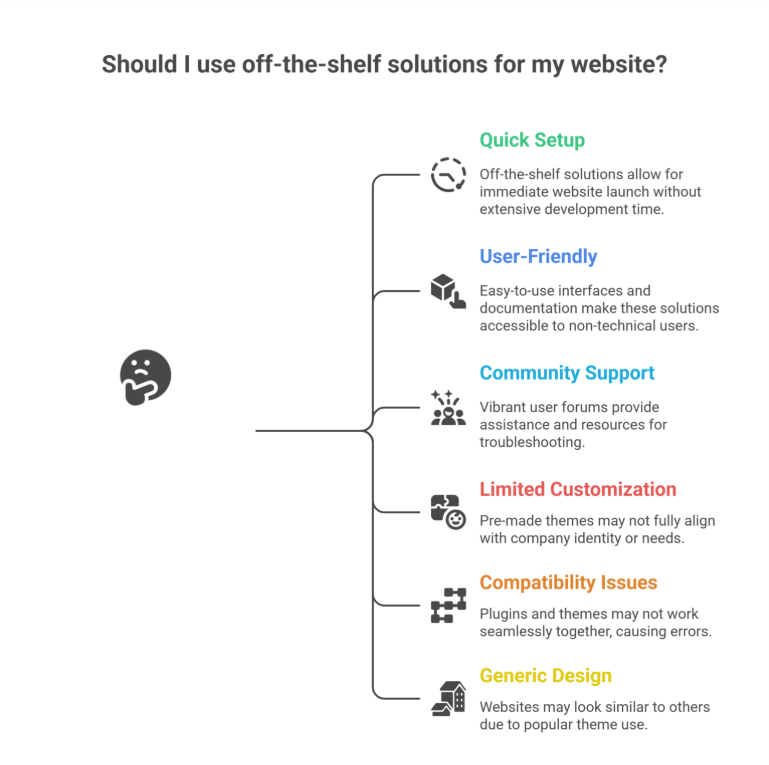
    • Quick Setup: Since all these pre-built WordPress solutions are quite easy to use instantly, you may launch your very own website right away without having to spend quite a lot of time and effort in developing it using custom code.
    • User-Friendly: Even a non-technical user can utilize a template or pre-built platforms because they frequently include easy drag-and-drop builders and comprehensive documentation, offering a user-friendly experience.
    • Large Community Support: The Well-known themes and plugins frequently have quite vibrant user forums and communities that offer helpful assistance and resources for troubleshooting, especially when dealing with performance issues, vulnerability, or integration problems.

    Drawbacks of Off-the-Shelf Solutions

    While off-the-shelf WordPress solutions are quite convenient, they come with some limitations:

    • Limited Customization: It’s quite possible that pre-made themes don’t always highly suit the identity or needs of your company or brand, especially when you need tailored solutions.
    • Compatibility Issues: Some plugins and themes might not always function highly together, causing errors in functionality.
    • Generic Design: Your website is more likely to seem like others if you use a very popular template or premium themes.

    Exploring Custom WordPress Development

    What Is Custom WordPress Development?

    Custom WordPress development basically means creating a website that is especially suited to your company’s personal requirements. Professionals providing Custom WordPress Development, custom web development, or working at a development company or WordPress web design agency, handle this particular procedure using unique code and custom solutions.

    Benefits of Custom Development

    • Unique Design: Since a customized website is created from the very scratch, it will accurately represent your brand identity and set you quite apart from the competition.
    • Tailored Functionality: You can incorporate particular unique features and functions that are quite essential to your company’s operations through the custom-built development that is fully tailored to your business.
    • Scalability: Because the custom-built websites are made to always grow with your business, adding new features or expanding your website as your business grows will be very simpler, ensuring long-term scalability and long-term growth.
    • Enhanced Performance: Custom websites frequently load quite faster and offer a much better user experience by removing the unnecessary code and focusing on your specific needs and requirements.
    • SEO Optimization: By including specific SEO guidelines directly into the website’s design, developers can highly increase the site’s exposure in the search engine results and help you optimize your content management system.

    Drawbacks of Custom Development

    Despite its advantages, custom development has some challenges:

    • Higher Initial Cost: Because the custom development takes much more time and experience than off-the-shelf options, it may require a higher initial investment.
    • Longer Development Time: If you need a new website launched very quickly, it might not be the very best option to build it from scratch.
    • Dependence on Developers: For immediate updates and frequent ongoing maintenance, you might require continuous assistance from a WordPress design or Shopify Services agency or developers.

    Key Factors to Consider While Choosing Between the Custom and Off-the-Shelf Solutions

    1. Budget

    It can be highly convenient to use off-the-shelf alternatives if you have limited budgets. Custom development, on the other hand, provides long-term advantages and greater alignment with your business objectives.

    2. Business Goals

    Custom development is best for companies who need special features, custom themes, or have certain branding needs. Simpler websites with conventional features are more suitable for off-the-shelf themes.

    3. Timeline

    Off-the-shelf options are more practical if you need to start your website rapidly. Although custom development takes longer, the end product is a website that is precisely customized to meet your unique requirements.

    4. Scalability

    Consider your future growth and success plans. Custom websites are more scalable, while off-the-shelf systems might require extensive modification or rebuilding.

    How Professional Services Can Help

    Working with experienced professionals helps guarantee an effortless process, regardless of whether you decide to use off-the-shelf solutions or custom creation. Experts in both strategies are available through WordPress Development, Shopify Development, Shopify Design, Webflow Services, and other web solutions, enabling you to maximize the benefits of your selected solution. A WordPress web design agency can also offer assistance, support, and improvements.

    Conclusion

    Your specific business needs, financial limitations, and goals will determine whether you choose custom vs off-the-shelf WordPress solutions. Custom development provides more flexibility, scalability, and a customized user experience, even while off-the-shelf alternatives are quicker to adopt and less expensive. You can make a highly informed choice that supports your business goals by being aware of the benefits and drawbacks of each strategy. To achieve an optimal outcome, think about collaborating with a Custom WordPress Development Services Company to ensure your website meets your expectations and delivers long-term value in a competitive digital landscape.

    Frequently Asked Questions (WordPress Development: Custom vs. Off-the-Shelf Solutions) 

    What is the difference between custom software and off-the-shelf solutions?

    Custom software is built specifically for your business needs, offering unique features, full control, and scalability. Off-the-shelf solutions are pre-made, affordable, and quick to deploy but come with limited customization and may not fit every requirement perfectly. The choice depends on budget, goals, and flexibility needs.

    What is the difference between custom and WordPress?

    Custom development creates a fully tailored website built from scratch to match unique business needs, design, and functionality. WordPress uses pre-built themes, plugins, and templates, making it faster and more affordable but less specialized. Custom sites offer flexibility, while WordPress offers convenience and ease of use.

    What is the advantage of developing your own software over using custom of the shelf software cots?

    Developing your own software offers complete control, tailored features, stronger scalability, and better integration with your workflows. Unlike off-the-shelf COTS software, it avoids unnecessary features, reduces long-term limitations, and supports unique business processes. Though costlier upfront, it delivers higher efficiency and competitive advantage over time.

    Do nearly 75% of all websites use WordPress?

    No, nearly 75% of all websites do not use WordPress. Currently, WordPress powers around 43–45% of all websites. It remains the most popular content management system, but other platforms like Shopify, Wix, and custom-built sites also hold significant market share.


  • WordPress Users Beware – These Popular Theme Plugins Have Some Major Security Issues

    WordPress Users Beware – These Popular Theme Plugins Have Some Major Security Issues

    WordPress Users Beware – These Popular Theme Plugins Have Some Major Security Issues

    Introduction

    WordPress powers more than 40% of websites worldwide, making it one of the very most widely used content management systems. While it offers high flexibility and ease of use, WordPress security remains a very major concern, especially when it comes to WordPress plugins and themes. Many popular WordPress plugins contain high security vulnerabilities that hackers or cybercriminals exploit to gain unauthorized access, inject malicious code, or totally compromise website security.

    If you highly rely on WordPress custom development to enhance your WordPress website, understanding these security risks is crucial. In this blog, we’ll discuss the major security issues highly associated with some very popular WordPress themes and plugins, and how you can protect your site effectively.

    Why WordPress Theme Plugins Are Vulnerable

    1. Open-Source Nature

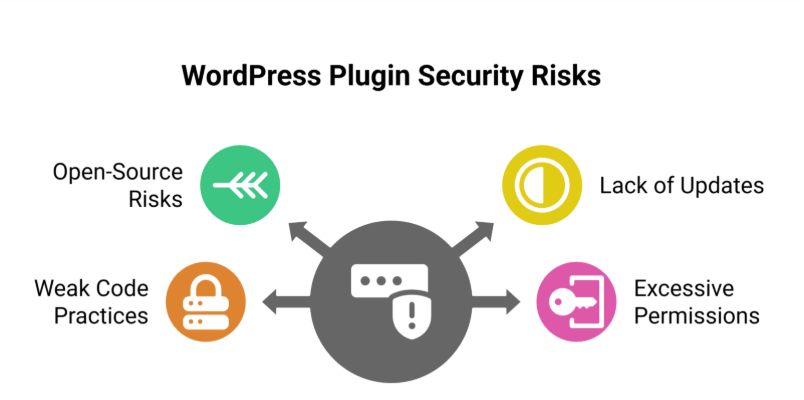
    WordPress is a totally open-source platform. This means anyone can develop and distribute WordPress plugins. While this encourages high innovation, it also highly increases the risk of very poorly coded or unmaintained plugins introducing security vulnerabilities that can be exploited by threat actors.

    2. Lack of Regular Updates

    Some WordPress plugins and themes are quite abandoned by their developers, leaving them highly vulnerable to common security threats. If a plugin is not updated regularly, security researchers warn that hackers can exploit outdated plugins to gain full control of the site.

    3. Weak Code Practices

    Not all plugin developers follow critical security practices. Very poorly written code can create many backdoors for malicious scripts, exposing sensitive data or allowing unauthorized access.

    4. Excessive Permissions

    Some popular plugin or WordPress themes request unnecessary permissions, giving them more access to your WordPress dashboard or admin accounts than required. This can be exploited by attackers to manipulate your site’s security or escalate login credentials privileges.

    Popular WordPress Theme Plugins with Security Issues

    Popular WordPress Theme Plugins with Security Issues

    1. Elementor

    Risk: Cross-Site Scripting (XSS) or SQL Injection

    Elementor is one of the very highly used WordPress plugins. However, it has faced multiple security vulnerabilities in the past. Hackers have used XSS and SQL injection tactics to exploit weaknesses in outdated versions of the plugin, leading to highly compromised WordPress websites.

    2. WPBakery Page Builder

    Risk: Remote Code Execution

    WPBakery is another popular WordPress plugin that has had plugin vulnerabilities, particularly involving remote code execution. Attackers have used this flaw to upload malicious code and take full control of the site.

    3. Revolution Slider

    Risk: File Upload Exploits

    Revolution Slider has been associated with major security breaches due to improper file upload validation. Unauthorized access via malicious scripts has been reported on many WordPress sites.

    4. Essential Addons for Elementor

    Risk: Arbitrary File Upload

    This plugin extends Elementor’s functionality but has vulnerabilities allowing unauthorized file uploads, posing a high risk to WordPress site security.

    5. Ultimate Addons for WPBakery

    Risk: SQL Injection Privilege Escalation

    This plugin enhances WPBakery but has been targeted by SQL injection attacks, compromising database integrity and allowing attackers to escalate privileges on WordPress websites.

    How to Protect Your WordPress Website

    1. Keep Plugins Updated

    Always update your WordPress plugins and themes to their latest versions. Developers often release security patches to fix exploited vulnerabilities. Ignoring updates leaves your WordPress site exposed to site takeover risks.

    2. Use Only Trusted Plugins

    Download plugins and themes from reputable sources like the official WordPress repository. Avoid third-party plugins or nulled versions, which often contain malware or other critical security flaws.

    3. Monitor Plugin Permissions

    Review the permissions requested by each plugin before installing it. If a plugin requests access to sensitive data or critical files, reconsider its use to keep your site secure.

    4. Implement Web Application Firewalls (WAFs)

    A WAF helps detect and block malicious code and attacks before they reach your WordPress website. Services like Cloudflare or Sucuri provide protection against common security threats.

    5. Regularly Back Up Your Website

    In case of a security breach, recent backups ensure you can restore your WordPress site without losing sensitive data. Use plugins like UpdraftPlus or BackupBuddy for automated backups.

    6. Remove Unused or Inactive Plugins

    Inactive WordPress plugins can increase your attack surface. Delete plugins that are not actively used to reduce potential security risks.

    7. Use Security Plugins

    Install security plugins like Wordfence or Sucuri to monitor malicious scripts, block attacks, and enforce critical security measures.

    8. Enable Two-Factor Authentication (2FA)

    Adding 2FA to your WordPress admin login provides an extra layer of protection, making it harder for hackers to gain unauthorized access.

    Conclusion

    While WordPress plugins and themes offer high functionality and design flexibility, they can introduce major security issues if not managed properly. By keeping plugins updated, using trusted sources, and implementing proactive security measures, you can protect your site from potential threats.

    If you rely on WordPress custom development, working with experienced security experts who follow best practices is essential. Prioritizing website security safeguards sensitive data and ensures a seamless experience for your visitors.

    Want your business to be seen and heard online? Explore our WordPress services and protect your WordPress website effectively.

    Want your business to be seen and heard online? Explore our Services
     

    Frequently Asked Questions (WordPress Users Beware These Popular Theme Plugins Have Some Major Security Issues)

    What are the security issues with WordPress?

    WordPress faces security risks due to outdated plugins, themes, and core files, weak passwords, and improper user permissions. Vulnerabilities like SQL injection, cross-site scripting (XSS), and malware attacks are common. Regular updates, strong passwords, secure hosting, and reliable security plugins are essential to protect WordPress sites effectively.

    Are WordPress plugins safe?

    WordPress plugins can be safe if sourced from trusted developers and regularly updated. However, poorly coded or outdated plugins may contain vulnerabilities, malware, or backdoors that hackers exploit. Always use reputable plugins, keep them updated, and limit unnecessary additions to ensure your WordPress site remains secure.

    Why are people moving away from WordPress?

    People are moving away from WordPress due to security vulnerabilities, frequent updates, and performance issues on large or complex sites. Many prefer simpler, faster, or more secure platforms with better scalability, built-in hosting, and easier maintenance, reducing the need for constant plugin management and technical troubleshooting.

    Which is the best security plugin for WordPress?

    The best WordPress security plugin is Wordfence Security, offering a firewall, malware scanning, login protection, and real-time traffic monitoring. Other strong options include Sucuri Security for cloud-based protection and iThemes/Solid Security for comprehensive site hardening, 2FA, and file-change detection. Choose based on site size and risk.


  • WordPress vs. Shopify: Which Platform is Right for You?

    WordPress vs. Shopify: Which Platform is Right for You?

    WordPress vs. Shopify: Which Platform is Right for You?

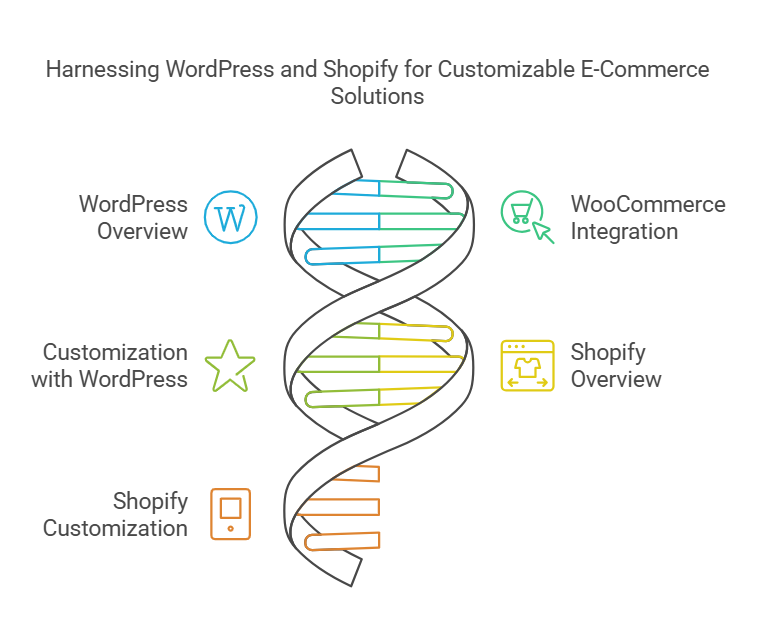
    Choosing the right e-commerce platform is crucial for online success. WordPress with WooCommerce and Shopify are two of the most popular website builders globally. Understanding their features, SEO capabilities, customization options, and custom vs off-the-shelf solutions will help you select the best platform to maximize online store growth and efficiency.

    What is WordPress?

    Over 40% of websites worldwide are powered by WordPress, an open source content management system. When paired with WooCommerce, it enables businesses to build fully customizable WordPress sites.

    Through custom WordPress development, companies can create a custom-built online store using custom themes, plugins and themes, third-party integration, and unique code. WordPress website development services help businesses tailor functionality, design, and branding to meet business objectives while improving online presence.

    What is Shopify?

    Shopify is a comprehensive e-commerce platform designed for small businesses. Its user-friendly drag-and-drop interface and pre-built templates simplify building a website, management, and scaling as your business grows.

    With Shopify app development, stores can expand features without dealing with custom code or complex maintenance, making it ideal for limited budgets.

    Key Differences Between WordPress and Shopify
    1. Ease of Use

    WordPress

    Offers unmatched customization but requires technical knowledge of hosting, design, and WooCommerce. Using WordPress also requires maintenance to avoid vulnerability and performance issues, especially when using templates and plugins.

    Shopify

    Extremely user-friendly and handles hosting, security, and updates automatically. An ideal off-the-shelf solution for beginners.

    2. Customization Options

    WordPress

    Provides almost unlimited customization through plugins, third-party tools, WordPress themes, and custom WordPress development. A fully custom WordPress website allows tailored solutions, advanced SEO, improved user experience, and designs tailored to your business.

    Shopify

    Uses pre-built platforms, themes, and apps. Experienced developers can add custom solutions, but customization is still limited compared to WordPress.

    3. Cost

    WordPress

    The CMS is free. Costs depend on hosting, pre-built WordPress themes, plugins, or custom web development. It’s flexible for different budgets but may require a higher initial investment if opting for fully custom development.

    Shopify

    Subscription-based (starting at $29/month). Costs increase with premium apps and transaction fees. Works best for those who prefer off-the-shelf solutions without complexity.

    4. SEO and Marketing Tools

    WordPress

    Excellent SEO through tools like Yoast and Rank Math. Ideal for content marketing, optimize performance, and long-term growth and success.

    Shopify

    Offers built-in SEO features and marketing tools. Good for beginners but less powerful than WordPress in terms of content management and deep customization.

    5. Scalability

    WordPress

    Highly scalable with proper hosting and professional support. Fully custom development can help you create websites that grow with your business.

    Shopify

    Built for scalability without worrying about servers or security. A great pre-built platform that ensures faster load times and smooth performance.

    When to Choose WordPress

    WordPress is ideal for businesses that:

    • Require extensive customization through WordPress website development services.
    • Want a store tailored to your business needs

    • Require strong blogging and content management

    • Prefer deep integration options and custom WordPress themes

    When to Choose Shopify

    Shopify is best for businesses that:

    • Prefer off-the-shelf themes and ready-made tools

    • Want a simple, user-friendly setup

    • Need built-in payments, shipping, and marketing

    • Plan to rely on Shopify app development for enhanced functionality.

    Real-World Examples

    WordPress Use Case

    A niche retailer wanting unique branding may choose WordPress with WooCommerce. Using custom WordPress development and custom code, they can build a store fully aligned with their brand identity and unique requirements.

    Shopify Use Case

    A beginner launching their first store may prefer Shopify. With pre-built themes, apps, and simple setup, they can focus on customers rather than technical tasks.

    Conclusion

    Both platforms are powerful. WordPress offers deep customization, custom-built solutions, and long-term scalability, while Shopify excels as a pre-built, off-the-shelf, easy-to-manage solution.

    To make an informed decision , carefully analyze your needs and think about engaging with expert Shopify developers or WordPress.

    Your choice depends on your business needs, budget, and technical skill level.Ready to launch a high-performing online store? Explore our custom WordPress development, Shopify services, and web solutions to build the best website for your business!

    Want your business to be seen and heard online? Explore our Services
     

    Frequently Asked Questions (WordPress vs. Shopify: Which Platform is Right for You?)

    WordPress vs. Shopify: Which Platform is Right for You?

    WordPress offers unmatched customization and flexibility, ideal for businesses wanting full control over design and functionality. Shopify excels in simplicity and eCommerce-focused features, perfect for those seeking a quick, secure, and scalable online store. Your choice depends on technical comfort, business needs, and growth plans.

    Which platform is better than Shopify?

    WooCommerce (with WordPress) is often better than Shopify if you want full control, lower long‑term costs, and customisation. It’s free to use, supports almost unlimited plugins and payment gateways, and gives you complete ownership of your data ideal for flexible, scalable and SEO‑focused stores.

    Can I switch from WordPress to Shopify?

    Yes, you can switch from WordPress to Shopify. The process involves migrating your products, content, and customer data, often using migration tools or expert services. Shopify simplifies store management, offers built-in hosting, and provides secure eCommerce features, making the transition smooth for growing online businesses.

    Is Shopify still a thing in 2025?

    Yes, Shopify is absolutely still a thing in 2025. Millions of businesses continue using it, its revenue and merchant base keep growing, and it’s still one of the most reliable, scalable eCommerce platforms. Brands choose it for ease of use, strong apps, and powerful sales features.

  • 10 Must-Have Features for a Successful WordPress Website

    10 Must-Have Features for a Successful WordPress Website

    10 Must-Have Features for a Successful WordPress Website

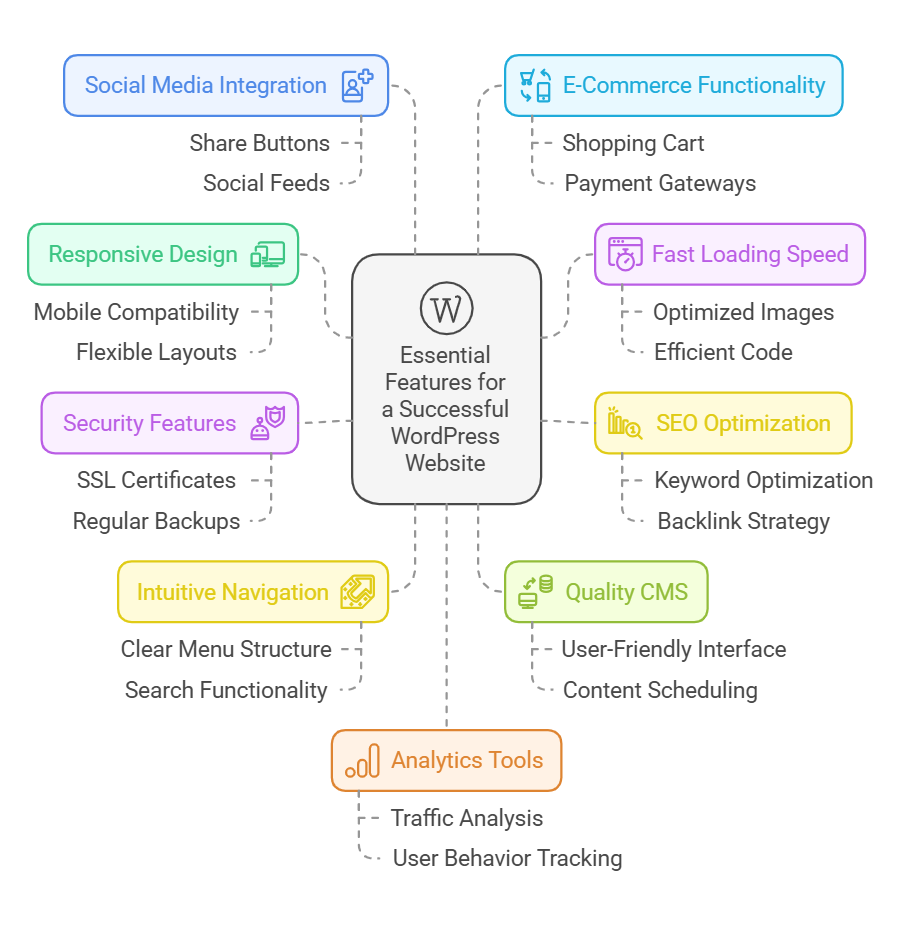
    More than just a very visually appealing layout is needed to create a successful WordPress website. Certain features are very necessary to make sure that your WordPress site is quite unique, operates effectively, and offers a great user experience. Some of these essential characteristics will set up your business website for high success whether you’re working with a WordPress web design agency or doing it all by yourself.

    1. Responsive Design

    It is essential to have a very responsive website in the mobile-first world today. A highly responsive design guarantees that your WordPress website works very well and looks great across all platforms, including most importantly smartphones, mobile apps, tablets, and PCs. By ensuring that your WordPress site adjusts very smoothly to various screen sizes, professional WordPress design services can enhance user experience highly and raise search engine rankings. Mobile-friendly websites are also given preference by search engines, so this feature is very crucial for both visibility and usability.

    2. Fast Loading Speed

    Website speed is quite critical for user satisfaction, core web vitals, and SEO optimization. Slow websites might lower your site speed results and drive away visitors. Reducing unnecessary plugins, cache optimization, optimizing pictures, and utilizing lightweight WordPress themes like Astra are all ways to improve the speed of your website. A Custom WordPress Development Services Company can help you make sure your WordPress website functions very properly without sacrificing any usability. Because WordPress users are highly inclined to stay on a website that loads within a matter of seconds, quicker loading times highly increase user retention.

    3. SEO Optimization

    In order to highly increase the organic traffic to your website, SEO is very essential. For the purpose of optimizing meta titles, meta descriptions, and keywords, WordPress provides unique plugins such as Yoast SEO, Rank Math, and other popular plugins. Better search engine visibility is also a result of features like XML sitemaps, permalinks, and clear URL structures. Working with WordPress development services guarantees that SEO best practices are taken into consideration when designing your website. Your SEO efforts will be further enhanced by producing high-quality content that is in line with user intent, in addition to plugins.

    4. Security Features

    Any website must prioritize cybersecurity. Strong security measures like SSL certificates, two-factor authentication, frequent software upgrades, and secure login credentials are necessary to defend your WordPress site against attacks. A WordPress web design company that uses advanced security methods can protect your data and increase user confidence. Additional safeguards like firewalls provide an extra degree of security, guaranteeing that your WordPress website is safe from constantly changing threats.

    5. Intuitive Navigation

    Maintaining viewers on your website requires an easy-to-navigate system. Clear calls to action, a well-organized menu, and a WordPress dashboard make it easier for consumers to locate information. In addition to improving user experience, intuitive navigation boosts engagement. Services for WordPress development and design can improve the readability of your website by streamlining its navigation. A logical structure and simple features like breadcrumb trails can have a big impact on how consumers engage with your WordPress site.

    6. Quality Content Management System (CMS)

    One of WordPress’ very best features is its open-source content management system, which provides tools for creating and managing content effectively. While custom post types allow for specific material, categories and tags can help organize your pages and posts. Adding new content to your blog on a regular basis guarantees that your website stays updated. The CMS can be customized according to your company’s requirements by a custom WordPress development services company. Furthermore, even people with no technical expertise may update content thanks to user-friendly editing tools, allowing teams to maintain original content.

    7. Social Media Integration

    Increasing the reach and engagement of your website requires social media connection. Visibility and traffic can be increased by including social sharing buttons, showing live social media feeds, and including links to your profiles. Professional development services can easily be integrated using these interfaces, which facilitate cross-platform connections between you and your visitors. In addition to expanding your audience, encouraging users to share your information on social media promotes community involvement.

    8. E-Commerce Functionality

    Having e-commerce capabilities is essential for companies that offer goods or services. The top e-commerce plugin for WordPress, WooCommerce, offers functions like inventory control, safe payment methods, and product pages that may be customized. Your online store will be successful if you work with a WordPress web design agency. Beyond functionality, product filtering options and an easy-to-use checkout process improve the shopping experience and raise conversion rates. WordPress also allows you to easily integrate an online store and other built-in features.

    9. Analytics and Reporting Tools

    Making informed choices requires knowing how well your WordPress website functions. Analytics tools like Google Analytics and Site Kit can be used to monitor traffic sources, conversion rates, and visitor behavior.

    Incorporating these tools generates insightful information about your audience, which may be further improved with WordPress development services to maximize the functionality of your website. You can test fresh approaches to increase user engagement and pinpoint areas for improvement with the use of real-time analytics data.

    10. Regular Updates and Maintenance

    Regular updates are very necessary to keep a WordPress website up to date and quite compatible with the newest plugins, themes, and built-in features. Updates also enhance overall performance and guard against vulnerabilities on your website. WordPress development services can help you very much in keeping your website safe and up to date so you can concentrate more on running your company. Monitoring uptime, repairing broken links, and quickly resolving any technical issues that arise are further examples of preventive maintenance.

    Conclusion

    Selecting a WordPress theme and adding content are only two steps in creating a successful WordPress website. Every element is essential to building a useful and interesting website, from SEO and security features to adaptable design and quick loading times. Implementing these essential features and building a website that satisfies your business objectives can be facilitated by working with a WordPress web design agency or a custom WordPress development services company. By giving these components top priority, you can make sure that your WordPress website draws in and keeps visitors, which will help it succeed in the long run.

    Want your business to be seen and heard online? Explore our Services

    Frequently Asked Questions (10 Must-Have Features for a Successful WordPress Website)

    What are the essential features of WordPress?

    Essential WordPress features include easy customization, a wide range of themes and plugins, an SEO-friendly structure, mobile responsiveness, strong security options, and a user-friendly dashboard. These features make it simple to manage content, scale your site, and build any type of website efficiently.

    What are the 7 C’s of a website?

    The 7 C’s of a website include Content, Context, Convenience, Customization, Communication, Connection, and Commerce. These elements ensure a site is clear, user-friendly, engaging, and optimized for conversions. Focusing on these areas helps improve user experience, trust, and overall website performance.

    Do nearly 75% of all websites use WordPress?

    No nearly 75% of all websites do not use WordPress. As of 2025, about 43–44% of all websites worldwide are built with WordPress, making it the most popular platform but far below 75%.

    What are the key features of a good website?

    A good website includes clear navigation, fast loading speed, mobile responsiveness, quality content, strong security, and an attractive, user-friendly design. It should also offer easy accessibility, SEO optimization, and consistent branding to ensure a seamless user experience and better engagement for visitors.

  • 15+ Key Benefits of WordPress for All Businesses

    15+ Key Benefits of WordPress for All Businesses

    15+ Key Benefits of WordPress for All Businesses

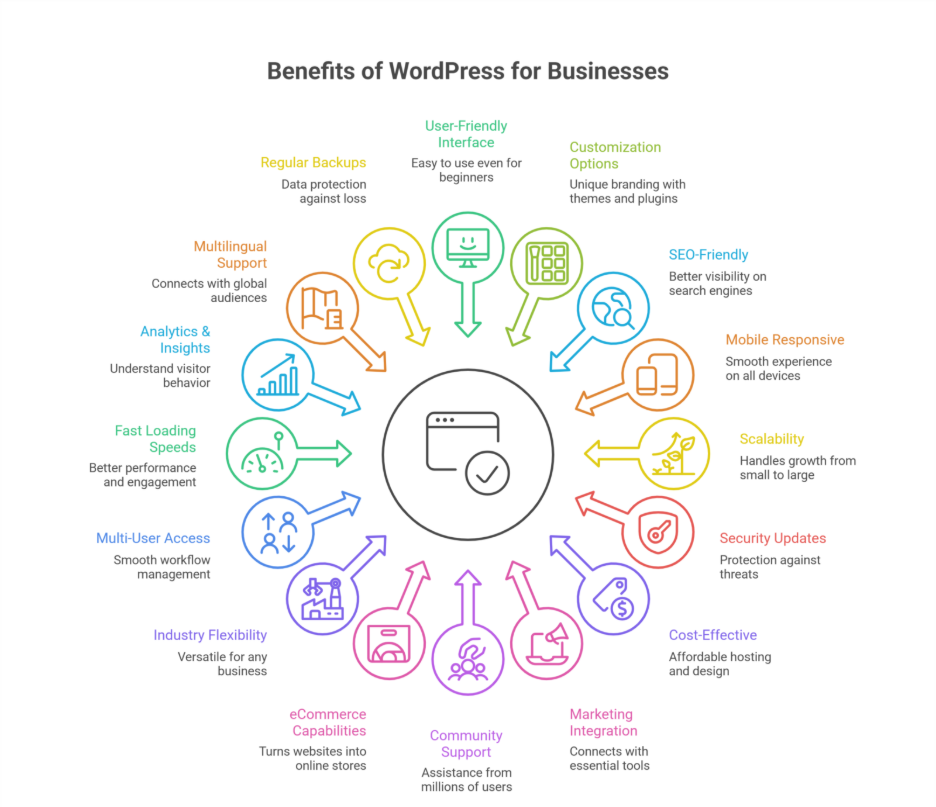
    Why WordPress is the Go-To Choice for Businesses
    Whether you’re running a very small startup, a well established huge business, or a global big brand, having a strong online presence is highly crucial. WordPress has become the top most choice for businesses worldwide, and for some very good reasons. It’s not just a website builder—it’s a highly powerful and flexible content management system that caters to all your possible business needs. Let’s explore why WordPress quite stands out and how it can highly benefit your business.

    15+ Key Benefits of WordPress for All Businesses

    1: Easy to Use, Even for Beginners

    One of the highly important reasons businesses love WordPress a lot is its very user-friendly interface. You don’t need to specifically be a coding expert to set up and even manage your wordpress site. The dashboard is very intuitive, making it quite easy to create pages, publish blog posts, and even completely customize your site. WordPress makes creating a website simple even for beginners who need a website quickly.

    2:Highly Customizable for Unique Branding

    With thousands of different WordPress themes and plugins, WordPress design options practically have no limit. Businesses can choose from ready-made templates or work with an entirely custom WordPress development services company to create a very unique website that highly reflects their brand identity. Custom WordPress websites allow companies to fully customize their website design and optimize it for their business needs.

    3:SEO-Friendly for Better Visibility

    A website is useful only if people can easily find it. Thankfully, WordPress development services come with unique built-in SEO tools. Plus, plugins like Yoast SEO help highly optimize content, ensuring your website ranks very high on Google and other search engines. WordPress is optimized for search engine performance, making it easier to grow your online presence.

    4: Mobile Responsive by Default

    Particularly more than half of website traffic comes from mobile devices. With WordPress development and design services, your website will automatically adjust to many different screen sizes, providing a very smooth user experience on desktops, tablets, and phones. WordPress themes are designed to be responsive, ensuring your site works on all devices.

    5: Scalable for Business Growth

    As your business expands a lot, your website needs to keep up. WordPress can handle everything from a very simple blog to quite a large eCommerce store. With the right development services, your website can highly grow without any limitations. WordPress offers scalability that supports growing businesses of all sizes.

    6: Secure & Regularly Updated

    Security is the top priority for any business. WordPress is very regularly updated with security patches to protect against threats. Plus, using secure themes and plugins ensures your site remains safe. WordPress updates and expert WordPress maintenance help businesses stay protected from online threats.

    7: Cost-Effective Solution

    Hiring a WordPress web design agency can be much more affordable than a custom-built website from the very scratch. The platform itself is totally free, and businesses can choose very budget-friendly WordPress hosting plans to keep costs very low. WordPress is a free platform that helps small businesses save on website development costs.

    8: Seamless Integration with Marketing Tools

    From email marketing platforms to social media plugins, WordPress design services allow businesses to connect with essential marketing tools effortlessly. This helps with lead generation and customer engagement. Integration with WordPress plugins ensures smooth workflow with all marketing tools.

    9: Strong Community Support

    With millions of users worldwide, WordPress has a very vast support community. Whether it’s forums, tutorials, or direct help from developers, immediate assistance is always available when needed. Many WordPress users contribute to a strong community that helps businesses optimize their websites.

    10: eCommerce Capabilities with WooCommerce

    If you’re planning to sell your products online, WordPress highly integrates seamlessly with WooCommerce, turning your website into a full-fledged online store. This makes it very ideal for businesses looking to expand into eCommerce. WordPress also supports online store management through its extensive plugins.

    11: Flexibility for Any Industry

    Whether you’re in real estate, healthcare, fashion, or tech, WordPress is quite versatile enough to cater to any possible industry. With entirely tailored custom WordPress development services, businesses can get their industry-specific features that meet the requirements. WordPress offers flexibility for businesses of all types.

    12: Multi-User Access for Teams

    For businesses with multiple team members managing the website, WordPress offers user roles with different permission levels. This ensures smooth workflow management without compromising security. WordPress makes team collaboration easy while maintaining control over access.

    13: Fast Loading Speeds for Better Performance

    Speed matters for user experience and SEO. With optimized hosting and performance-enhancing plugins, WordPress ensures your website loads quickly, keeping visitors engaged. WordPress also ensures optimization for fast loading times.

    14: Analytics & Insights for Business Growth

    Tracking website performance is easy with WordPress. Integrations with Google Analytics and other tracking tools help businesses understand visitor behavior and improve their strategies. WordPress development services help businesses leverage analytics to optimize their site performance.

    15: Multilingual Support for Global Reach

    Expanding globally? WordPress completely supports multiple languages, making it much easier for businesses to oftenly connect with international audiences through multilingual websites. Using WordPress for your business allows you to reach global markets effortlessly.

    16: Regular Backups for Data Protection

    Accidents happen very often, but with WordPress, businesses can set up totally automatic backups to prevent data loss. This usually ensures peace of mind in case of some unexpected issues. WordPress offers backup solutions that protect critical business data.

    Final Thoughts

    For businesses of all sizes, WordPress remains one of the very most powerful and highly flexible platforms available. Its high ease of use, SEO capabilities, scalability, and customization options make it a top choice for building a very strong online presence. Whether you’re starting a blog from scratch, launching a new eCommerce store, or creating a corporate website, investing in WordPress development and design services can set your business up for high success.

    Want your business to be seen and heard online? Explore our Services
     

    Frequently Asked Questions (15+ Key Benefits of WordPress for All Businesses)

    What are the benefits of WordPress?

    WordPress offers flexibility, easy customization, and thousands of themes and plugins to build any type of website. It’s user-friendly, SEO-friendly, and supports strong security features. With a large community, regular updates, and full content control, it’s ideal for businesses of all sizes.

    How much does WordPress pay for 1000 views?

    On WordPress, earnings for 1,000 views vary widely by monetization method and traffic quality. Typical ad revenue (like Google AdSense) is about $0.2 – $2.5 per 1,000 views, though optimized sites or high-value niches can earn more. Real earnings depend on niche, audience location, ad placement, and engagement.

    What are the key features of WordPress?

    WordPress offers powerful features like easy content management, thousands of themes and plugins, SEO-friendly structure, strong security options, and full customization. It supports blogging, ecommerce, and scalable websites, making it suitable for beginners and advanced users. Regular updates and a large community ensure flexibility and long-term reliability.

    Why do companies use WordPress?

    Companies use WordPress because it’s flexible, affordable, and easy to manage without coding. It supports custom designs, SEO optimization, ecommerce, and integrations with marketing tools. Its large plugin ecosystem and strong community make it ideal for building secure, scalable, and high-performing business websites.

  • 20 Best Shopify Plugins & Apps to Grow Your eCommerce Store

    20 Best Shopify Plugins & Apps to Grow Your eCommerce Store

    20 Best Shopify Plugins & Apps to Grow Your eCommerce Store

    One of the most widely used eCommerce platforms for companies wishing highly to launch and grow their online presence highly is Shopify. Shopify’s quite extensive network of apps and plugins that highly improve the platform’s capabilities is what gives it even more power. There can be a Shopify plugin to suit any of your particular requirements, whether its marketing, customer involvement, inventory management, or even analytics. This makes Shopify the ideal ecommerce platform for store owners looking to grow your Shopify store and optimize user experience.

    We’ll look at the top 20 extensive Shopify apps and plugins in this blog post to help you totally expand your online business and provide your consumers a very amazing shopping experience, boosting your ecommerce business and increasing sales.

    Why Are Shopify Plugins Important?

    Why Are Shopify Plugins Important?

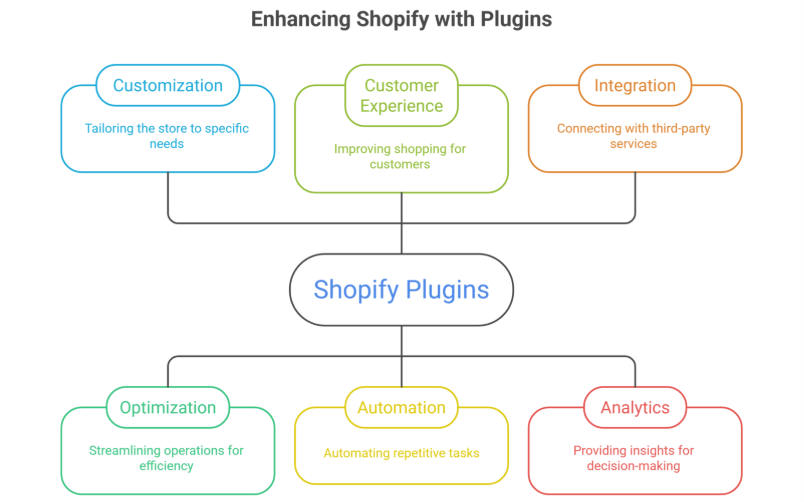
    Shopify plugins and apps always allow you to highly customize your store, optimize operations, and improve your customers’ shopping experience very much. These tools can be highly automated for repetitive tasks, integrate third-party services, and provide very valuable insights to help you make very informed decisions. With the very right combination of plugins, you can scale your business very effectively without compromising on efficiency or performance. Shopify plugins are a must-have for store owners who want to increase customer retention and boost conversions while maintaining a smooth shopping online experience.

    Factors to Consider When Choosing Shopify Plugins

    When choosing Shopify plugins for your store, it’s highly important to take into account some factors before going into the list:

    1. Compatibility: Make sure the app works with the theme of your store and any current integrations.
    1. User Reviews: Look for plugins with positive reviews and ratings.
    1. Features: Choose plugins that address your specific pain points or objectives.
    1. Pricing: Many apps offer free plans, but some advanced features might require a paid subscription.
    1. Support: Opt for plugins with reliable customer support in case you encounter any issues.

    20 Best Shopify Plugins & Apps for Your Store

    1. Shopify Email

    You can design and send email campaigns right from your Shopify dashboard with this highly integrated tool. It’s ideal for using very personalized communication to create lasting connections with customers and supports email templates and marketing automation for higher engagement.

    2. Klaviyo

    Klaviyo is an excellent option for advanced email and SMS marketing. It facilitates audience segmentation, campaign performance analysis, and the creation of automated workflows, supporting both SMS marketing and email marketing campaigns for your ecommerce business. 

    3. ReConvert Upsell & Cross-Sell

    Use this software to increase your revenue by providing cross-sells and upsells after a purchase. It enables you to make personalized thank-you pages that increase client interaction and sales, boosting your Shopify store conversions and order value.

    4. SEO Manager

    Search engine optimization is essential for increasing organic traffic to your store. To rank quite higher in search results, SEO Manager highly assists you in improving your site’s structure, alt texts, meta tags, and search engine visibility.

    5. Oberlo

    Oberlo makes it much easier for drop shippers to locate and add products to their Shopify store. It automates order fulfillment and integrates easily, allowing store owners to expand product offerings without inventory hassle.

    6. Yotpo Reviews

    Customer reviews are a vital trust factor. You can gather, display, and control user reviews, images, and Q&A sections on your product pages using Yotpo, including photo and video reviews to enhance social proof.

    7. Gorgias

    By combining social media, live chat, and email in one location, this helpdesk tool centralizes client support. It is essential for delivering outstanding customer support, increasing retention, and improving overall user experience.

    8. Shopify Flow

    Shopify Flow is perfect for larger companies since it saves you time and effort by automating repetitive operations like customer segmentation, inventory updates, and marketing automation. 

    9. Privy

    Privy provides capabilities for cart abandonment campaigns, exit-intent pop-ups, and email gathering. It’s a great app for increasing email list growth, boosting conversion rates, and executing all-in-one marketing strategies.

    10. Shogun Page Builder

    You don’t need to know how to code specifically to design unique landing pages, product pages, and blog articles with Shogun, a drag-and-drop page builder, supporting your content marketing and design tools.

    11. Loox

    This app combines customer reviews with visual content. Users can include images with their evaluations, which increases the credibility, engagement, and conversion rates of your store.

    12. PushOwl

    You can keep your consumers interested and informed by using PushOwl to deliver online push alerts for product announcements, flash sales, and abandoned carts, helping with cart recovery and customer retention.

    13. Spocket

    Another drop shipping tool that links you with vendors selling premium goods is called Spocket. It also supports local shipping for faster delivery and better shopping online experiences.

    14. Tidio Live Chat

    Provide real-time support to your customers with Tidio. To enhance customer support, this tool combines email message, chatbots, and live chat, improving customer retention and satisfaction.

    15. PageSpeed Optimizer Pro

    A slow website can harm your conversions. PageSpeed Optimizer Pro enhances your store’s loading speed, ensuring a smooth user experience and improving conversion rates.

    16. Recharge Subscriptions

    Recharge Subscriptions makes it simple to handle recurring payments and personalize subscription choices if you wish to sell subscription-based goods, allowing store owners to increase order value and customer loyalty.

    17. Easyship

    Easyship makes shipping easier for businesses who ship abroad by comparing prices, calculating customs and taxes, and providing real-time tracking for better customer experience.

    18. Better Reports

    Use Better Reports to make data-driven decisions. This tool helps you monitor important performance indicators by offering comprehensive data on inventory, sales, and consumer behavior, helping store owners optimize operations.

    19. Hurrify – Countdown Timer

    Create urgency on your product pages with Hurrify. This plugin lets you add countdown timers to highlight limited-time offers and boost conversions, helping increase sales and average order value.

    20. Bundler – Product Bundles

    Bundler assists you in creating discounted product bundles that will boost your average order value and entice customers to buy more, supporting upsell strategies and increasing conversions.

    How Shopify Plugins Enhance Business Growth

    1. Streamline Operations

    Plugins like Shopify Flow and Gorgias reduce manual tasks and improve operational efficiency, allowing you to focus on scaling your business while maintaining ease of use.

    2. Boost Customer Engagement

    You can increase client loyalty and repeat business by using apps like Yotpo and PushOwl, which help you establish trust, keep your consumers interested, and increase customer retention.

    3. Improve Website Performance

    Tools like PageSpeed Optimizer Pro ensure your store performs well, providing an excellent shopping experience for visitors and helping improve your store’s search results ranking.

    4. Expand Product Offerings

    You may test new products with drop shipping apps like Oberlo and Spocket without having to worry about keeping inventory, allowing you flexibility in expanding your catalog and promoting your store online.

    Conclusion

    Optimizing your store’s functionality, enhancing client satisfaction, and promoting business expansion all depend on using the appropriate Shopify plugins and apps. These 20 plugins cover everything from marketing to customer care and performance optimization, regardless of whether you’re just getting started with eCommerce or want to grow your current store.

    You may succeed on Shopify over the long run by selecting the ideal set of tools for your company’s requirements. Maintaining your store’s competitiveness in the ever-changing eCommerce market requires regular software updates, experimentation, and exploring the best Shopify apps available, including free plan offers, free trial options, and paid plan features.

    Want your business to be seen and heard online? Explore our Services
     

    Frequently Asked Questions (20 Best Shopify Plugins & Apps to Grow Your eCommerce Store)

    Why should I use Shopify apps?

    Shopify apps help you add advanced features, automate tasks, improve marketing, boost conversions, and enhance the customer experience without custom coding.

    How do I choose the best Shopify apps?

    Pick apps based on your goals speed, marketing, SEO, conversions, design. Check ratings, reviews, features, pricing, and compatibility with your theme.

    Are Shopify apps free?

    Some apps are free, some offer free plans, and others require monthly payments. Many premium apps start around $10–$50 per month depending on features.

    Can too many apps slow down my store?

    Yes. Too many apps can add scripts that slow your speed. Install only essential apps and remove unused ones to keep your store fast.

  • AI & SEO Strategies: What Even Big Brands Must Consider In 2025

    AI & SEO Strategies: What Even Big Brands Must Consider In 2025

    AI & SEO Strategies: What Even Big Brands Must Consider In 2025

    The field of search engine optimization (SEO) is always changing on and off, and as artificial intelligence (AI) becomes highly popular in search engines, brands need to start reconsidering their approaches. Businesses of all sizes must use AI-driven SEO as we move toward 2025 in order to preserve visibility, raise rankings, and highly improve user experience. Unlike traditional SEOAI SEO can help brands enhance their brand visibility and optimize search results efficiently.

    We’ll look at the most important AI-powered SEO tactics in this blog, as well as what even the largest firms need to think about in order to remain highly competitive and maintain brand authority in the AI search landscape.

    AI & SEO Strategies: What Even Big Brands Must Consider In 2025

    The Role of AI in SEO

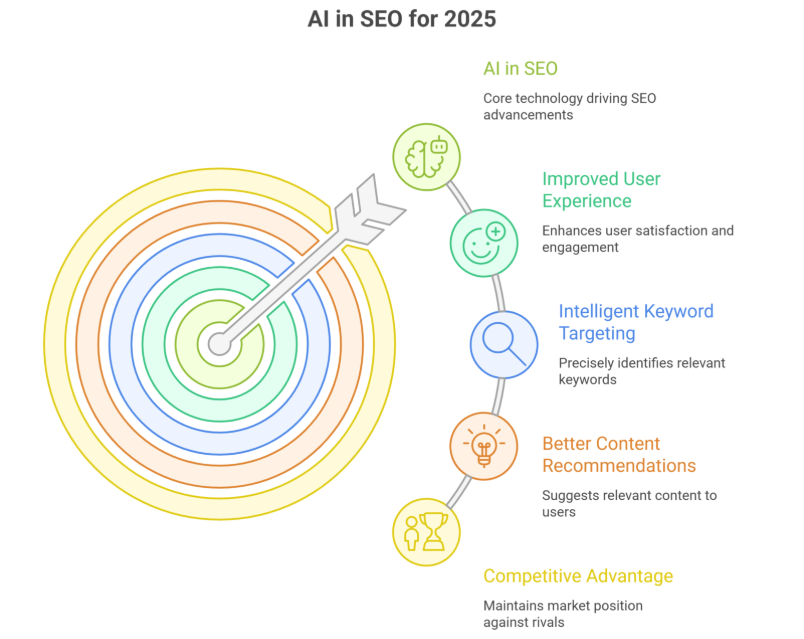
    AI has highly transformed how search engines rank contentSearch engines are now much better able to interpret user intent due to machine learning algorithms very quickly like Google’s RankBrain and BERT. AI facilitates the automation of high optimization strategies, the analysis of huge volumes of data, and the early and accurate prediction of search trends, helping improve search visibility.

    Businesses can highly benefit from improved user experience, much more intelligent keyword research, and much better content marketing recommendations by leveraging AI for SEO. Mostly ignoring AI-powered SEO tactics could cause you to lag behind rivals who are already using these highly advanced AI tools.

    AI-Powered SEO Strategies for 2025

    1. AI-Generated Content Optimization

    Content creation is becoming much quicker and more effective due to easy-to-access AI platforms like ChatGPT, Jasper, and Copy.ai. But depending only on content produced by AI models can be dangerous. Original, superior content that offers users genuine value is given priority by search engines.

    How Brands Can Adapt:

    • When creating content, use AI as a tool, not a substitute.

    • Make very certain that information produced by AI is always fact-checked and tweaked to add quite a human touch.

    • Focus on EEAT (Experience, Expertise, Authoritativeness, Trustworthiness) to highly improve credibility and brand-specific authority.

    1. Voice Search Optimization

    Voice search’s rise with millions of people utilizing smart assistants like Google Assistant, Alexa, and Siri every day makes AI-driven search crucial. Voice queries are typically longer-tail and more conversational.

    How Brands Can Adapt:

    • Optimize content for natural language queries.

    • Focus on long-tail keywords and question-based phrases.

    • Ensure websites are mobile-friendly and load quickly for seamless AI search results.

    1. AI and Predictive Search Analytics

    Predictive analytics using AI help brands understand future search trends. Predictive SEO uses AI-driven insights to suggest keywords before they become popular.

    How Brands Can Adapt:

    • Utilize AI SEO tools like Clearscope and SurferSEO for keyword insights.

    • Monitor emerging trends and optimize content proactively to maximize organic reach.

    • Focus on semantic search to align with how audiences are asking queries.

    1. Enhanced User Experience with AI

    User experience (UX) is becoming quite a higher priority in Google’s algorithm. Rankings are highly impacted by metrics such as mobile usability, Core Web Vitals, and page speed.

    How Brands Can Adapt:

    • Improve relationship with customers by highly utilizing AI-powered chatbots.

    • Websites should be optimized for quick loading times and easy navigation to enhance brand awareness.

    • Highly personalize content based on user behavior with frequent AI recommendations.

    1. AI-Powered Image & Video SEO

    Visual content plays a critical role in search engine resultsAI-powered image and video recognition help search engines understand and categorize media better.

    How Brands Can Adapt:

    • Optimize images with structured data and alt text.

    • Use AI-generated captions and transcriptions for videos.

    • Leverage AI tools like Google Vision API to enhance AI search visibility.

    1. Automation in SEO Strategies

    High AI-driven automation saves a lot of time by handling repetitive SEO tasks like keyword tracking, backlink analysis, and frequent site audits.

    How Brands Can Adapt:

    • Implement AI-powered SEO tools like SEMrush, Ahrefs, and Moz.

    • Automate technical SEO audits to fix site errors quickly.

    • Set up AI-based A/B testing to improve website performance.

    1. Local SEO and AI-Driven Personalization

    Local SEO is essential for companies that have physical locations. AI assists in highly customized local search results according to user behavior, location, and previous searches.

    How Brands Can Adapt:

    • Make sure your website is optimized for local search phrases and Google My Business (GMB).

    • Utilize geotargeting driven by AI to customize user experiences.

    • Ensure NAP (Name, Address, Phone) consistency across all platforms to reinforce brand’s AI presence.

    1. AI and Mobile-First Indexing

    Google now highly prioritizes mobile-friendly sites in search engine resultsAI tools help businesses optimize their mobile experience effectively.

    How Brands Can Adapt:

    • Assure uniformity of NAP (Name, Address, Phone) on all platforms.

    • Make good use of mobile testing solutions powered by AI, such as Google’s Mobile-Friendly Test.

    • Improve mobile site speed with AI-based caching and unique compression techniques.

    1. AI-Powered Backlink Analysis

    Backlinks remain a crucial ranking factor, and AI makes backlink efforts more efficient by identifying high-quality opportunities.

    How Brands Can Adapt:

    • Use AI backlink analysis tools to track and disavow toxic links.

    • Leverage AI for content outreach and automated backlink suggestions.

    • Prioritize quality over quantity in link-building efforts to boost brand authority.

    1. Evolving Search Algorithms and AI

    Google is increasingly using AI to update its algorithms. Brands need to stay ahead of the curve by staying very up-to-date with AI-powered search innovations.

    How Brands Can Adapt:

    • Stay updated with Google’s latest AI-driven changes.

    • Adapt content strategies based on AI-generated insights.

    • Continuously refine on-page and technical SEO practices.

    The Future of AI in SEO

    AI will drive SEO in the future. Artificial intelligence will continue to influence search engine results through automation, content customization, and real-time analytics. Companies may find it very difficult to stay competitive if they don’t incorporate AI into their SEO plans.

    Key Takeaways:

    • The way search engines interpret and rank material is changing due to AI.

    • To remain relevant, businesses need to use AI-driven SEO tools and strategies.

    • It’s crucial to give user experience, technical SEO, and excellent content top priority.

    • In 2025, staying way ahead of algorithm upgrades driven by AI will be crucial.

    • Brands can highly raise their search engine ranks, increase organic search traffic, and improve user experience by highly utilizing AI SEO tactics. To produce content that genuinely connects with people, it is very crucial to strike a balance between AI automation and human creativity.

    Meta Description:

    Find out the best AI-powered SEO tactics that all major firms need to implement by 2025. Learn how AI is improving digital marketing, influencing search rankings, and boosting brand visibility.

    Frequently Asked Questions (AI & SEO Strategies: What Even Big Brands Must Consider In 2025)

    How is AI changing SEO in 2025?

    AI is making SEO more personalized, predictive, and intent-driven. Search engines analyze user behavior, context, and real-time data to deliver smarter results. Brands must use AI tools, automation, and advanced content optimization to stay competitive and maintain strong search visibility.

    Why should big brands adopt AI-driven SEO?

    AI-driven SEO helps big brands gain faster insights, improve keyword targeting, and deliver personalized content at scale. It enhances rankings, boosts efficiency, and reduces competitive pressure. AI also streamlines large-content management, making overall SEO performance stronger and more consistent.

    What role does machine learning play in modern SEO?

    Machine learning predicts user intent, identifies search patterns, and evaluates content quality. In 2025, ML-driven algorithms prioritize relevance, engagement, and behavior signals. This helps brands make data-informed SEO decisions and optimize content for better visibility across multiple search environments.

    How can AI improve content quality for SEO?

    AI tools identify content gaps, enhance readability, and recommend topic clusters. Real-time editors improve tone, structure, and keyword optimization while reducing plagiarism. This results in higher-quality, search-friendly content that aligns with user intent and improves overall ranking potential.

  • AI-Powered Social Strategies: Using Machine Learning to Optimize Campaigns

    AI-Powered Social Strategies: Using Machine Learning to Optimize Campaigns

    AI-POWERED SOCIAL STRATEGIES: USING MACHINE LEARNING TO OPTIMIZE CAMPAIGNS

    In the ever-evolving landscape of digital marketing, harnessing the power of artificial intelligence (AI) and machine learning (ML) is not just a competitive advantage it’s a game-changer. Imagine having a marketing assistant that learns from data, predicts trends, and optimizes campaigns in real-time. This is the promise of AI-powered social strategies, where advanced ai algorithms transform data into actionable insights, driving unparalleled results and ROI. By leveraging ai tools and ai content creation tools, marketers can refine their marketing campaigns and social media campaigns for maximum efficiency.

    The Rise of AI in Social Marketing: Where Data Meets Creativity

    The Rise of AI in Social Marketing: Where Data Meets Creativity

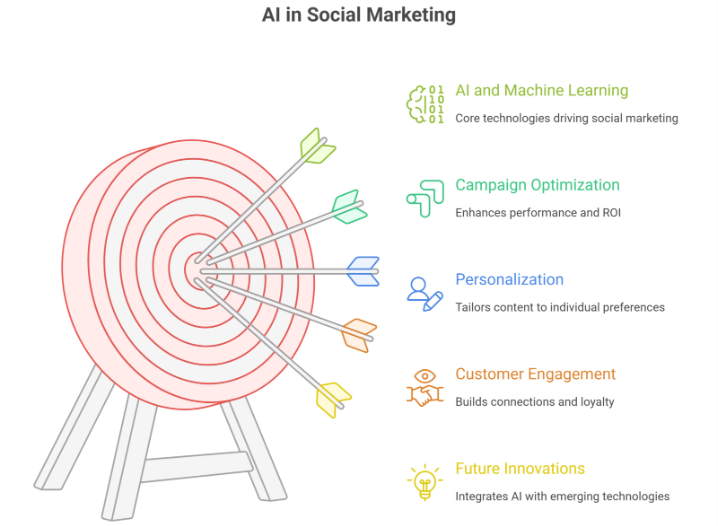
    AI isn’t just a buzzword it’s a catalyst for innovation. Picture this: a brand leveraging ai in social media marketing to analyze vast amounts of social media content and social data, from audience demographics to content engagement patterns. By understanding user behavior and social media trends, marketers can craft hyper-personalized campaigns that speak directly to individual preferences. Marketing teams can now integrate ai and machine learning to create personalized campaigns that enhance engagement and conversion rates.

    Imagine using ai to predict emerging trends and consumer behaviors. By staying ahead of the curve, brands can adapt their marketing strategies proactively, ensuring relevance and maximizing impact. Advanced ai allows marketers to optimize campaigns by analyzing ad campaigns, social media advertising, and social media platforms for performance improvement.

    Personalization at Scale: From Segments to Individuals

    Gone are the days of generic messaging. AI enables hyper-personalization, where every interaction feels tailored to the individual. By leveraging ai-driven content, social media content, and ai writing tools, marketers can personalize content strategies and email campaigns at scale. Picture a dynamic content strategy that adapts in real-time based on user preferences, powered by ai. By analyzing historical data and behavioral signals, AI can deliver targeted content that speaks directly to each customer’s interests and needs.

    Imagine an e-commerce site that recommends products based on past purchases, browsing history, and even sentiment analysis of social media posts. By leveraging AI-powered personalization, brands can create seamless, intuitive experiences that foster customer loyalty and drive conversions. Marketers can use ai to automate marketing efforts and social media management, improving user experience and creating personalized campaigns.

    Optimizing Campaign Performance: From Insights to Action

    One of AI’s most significant contributions is its ability to optimize campaign performance. Imagine automating routine tasks like A/B testing, content generation, and ad placement optimization. AI-powered algorithms can analyze analytics, marketing content, and marketing campaigns in real-time, identifying patterns and making data-driven decisions to improve outcomes.

    Consider a scenario where AI predicts the optimal times to post social media posts based on audience behavior. By leveraging machine learning algorithms analyze audience insights, marketers can allocate budget effectively, ensuring maximum ROI across various channels. AI allows marketers to optimize campaigns, enhance engagement strategies, and integrate ai into their marketing platform for better results.

    Enhancing Customer Engagement: Where Automation Meets Authenticity

    AI doesn’t replace human creativity it amplifies it. Picture chatbots powered by ai that provide instant customer support, resolving queries and guiding purchase decisions 24/7. By automating repetitive tasks, brands free up resources to focus on creating social media content and building genuine connections with their audience.

    Imagine using AI to analyze customer feedback and sentiment across social media platforms. By listening to the voice of the customer, brands can respond proactively, addressing concerns and celebrating successes in real-time. AI in social media marketing enables marketing teams to create personalized campaigns, optimize email marketing, and leverage ai tools for social listening and content creation.

    The Future of AI in Social Marketing: Innovations on the Horizon

    As AI continues to evolve, the possibilities are limitless. Imagine integrating AI with augmented reality (AR), allowing customers to visualize products in their own space before making a purchase. Picture predictive analytics that anticipate market shifts and consumer preferences, empowering brands to pivot with agility. AI adoption in marketing ensures marketers can harness ai technologies, ai features, and ai algorithms to stay ahead in trends in marketing.

    In the realm of influencer marketing, AI can match brands with the most relevant influencers based on audience demographics and engagement metrics. By leveraging ai and machine learning, brands can forge authentic partnerships that resonate with their target audience. AI and machine learning are transforming social media strategy, social media advertising, and programmatic advertising, enabling marketing innovation and engagement strategies.

    Embracing AI-Powered Social Strategies: From Concept to Execution

    Embracing AI in social marketing isn’t just about technology—it’s a mindset shift. Picture a future where data fuels creativity, where algorithms optimize performance, and where customer relationships are cultivated at scale. AI can help marketers refine their campaigns, use ai responsibly, and learn how ai offers insights to improve marketing efforts across social media channels.

    As brands navigate this transformative landscape, the key lies in collaboration bringing together data scientists, marketers, and creatives to harness the full potential of ai. By embracing experimentation and continuous learning, brands can unlock new possibilities, driving innovation, engagement, and growth in the age of ai-powered social marketing and the future of social media marketing.

    Frequently Asked Questions (AI-Powered Social Strategies: Using Machine Learning to Optimize Campaigns)

    What is an example of AI optimization?

    An example of AI optimization is using machine learning algorithms to improve supply chain efficiency. AI can analyze historical data, predict demand, and optimize inventory levels, reducing costs and delivery times. This allows businesses to make smarter decisions and streamline operations for better overall performance.

    How do social networks use AI to improve advertising?

    Social networks use AI to analyze user behavior, preferences, and engagement patterns. This enables them to target ads more precisely, predict which content will resonate, and optimize ad placement and timing. As a result, advertisers reach the right audience, increasing conversion rates and overall campaign effectiveness.

    What role does artificial intelligence (AI) play in improving the efficiency of social media marketing campaigns?

    AI enhances social media marketing efficiency by analyzing user data, predicting trends, and personalizing content. It automates tasks like scheduling, audience targeting, and ad optimization, ensuring campaigns reach the right users at the right time, increasing engagement, conversions, and overall return on investment.

    What are 7 types of AI?

    The seven types of AI are: Narrow AI, General AI, Superintelligent AI, Reactive Machines, Limited Memory AI, Theory of Mind AI, and Self-Aware AI. These categories range from task-specific intelligence to advanced systems capable of understanding, learning, and potentially surpassing human cognitive abilities.

  • Beyond Vanity Metrics: Unveiling the Real ROI of Social Media Marketing

    Beyond Vanity Metrics: Unveiling the Real ROI of Social Media Marketing

    BEYOND VANITY METRICS: UNVEILING THE REAL ROI OF SOCIAL MEDIA MARKETING

    In the world of social media marketing, it’s easy to get caught up in the allure of vanity metrics likes, shares, and follower counts. However, true social media roi and social media success isn’t just about visibility; it’s about tangible, measurable returns on investment (ROI). Today, we’ll delve into the real roi of social media, exploring how brands are leveraging marketing strategies, social media analytics, and data-driven tracking metrics that matter to drive meaningful business outcomes and connect social media efforts to real business growth.

    Imagine a clothing brand that meticulously tracks their social media campaigns using google analytics and advanced analytics tools. By analyzing conversion rates, customer acquisition cost, and new customer acquisition alongside metrics like click-through rate, they discover that their Instagram ads targeting a specific audience segment generated a 20% increase in online sales compared to traditional print advertising. This actionable insight enables them to allocate resources more effectively, maximizing marketing roi and revenue generated.

    Consider a tech startup that uses social listening tools to monitor online conversations about their products. By identifying pain points, addressing customer concerns in real-time, and tracking meaningful engagement, they strengthen customer relationships and improve brand perception. As a result, customer retention rates soar, translating into measurable lifetime value and long-term ROI, reflecting real growth.

    Now, let’s explore how brands are moving beyond vanity metrics to unlock the real ROI of social media marketing and measuring social media roi:

    BEYOND VANITY METRICS: UNVEILING THE REAL ROI OF SOCIAL MEDIA MARKETING

    1. Driving Direct Conversions

    Gone are the days when social media was solely a brand awareness tool. Today, platforms like Instagram and Facebook offer robust e-commerce functionalities, allowing users to discover, explore, and purchase products without leaving the app. Brands are leveraging these direct purchasing features to drive conversions and measure social media roi more effectively, making sure metrics like impression, click-through, and acquisition cost contribute to positive ROI.

    Imagine a beauty brand that integrates Instagram Shopping into their social media strategy. By tagging products in posts and stories, they create a seamless shopping experience for their followers. As a result, they see a significant uptick in online sales directly attributed to their social media efforts, demonstrating clear roi metrics and measurable business results.

    2. Fostering Customer Relationships

    Social media isn’t just a broadcast channel; it’s a two-way conversation. Brands that prioritize engagement rate, meaningful metrics, and relationship-building see tangible returns in customer loyalty and advocacy, contributing to the real impact and actual business growth.

    Take the example of a restaurant that actively engages with customers on Twitter. By responding to reviews, sharing user-generated content, and running interactive polls, they foster a sense of community and loyalty among their followers. This investment in relationships translates into repeat business, positive word-of-mouth referrals, and measurable roi data—key indicators of social media roi and business outcomes.

    3. Harnessing Data for Optimization

    Data is the cornerstone of effective social media marketing. Brands that leverage analytics tools, track metrics such as likes, and experiment with marketing campaigns to optimize social media analytics can improve metrics that reveal meaningful ROI.

    Consider a fitness app that uses A/B testing to refine their ad copy and visuals on Facebook. By experimenting with different messaging strategies, they identify the most compelling approach that resonates with their target audience. This iterative optimization process leads to improved click-through rates, app downloads, and new customer acquisition, directly impacting roi calculation and marketing roi.

    4. Integrating Social into the Sales Funnel

    Successful brands understand that social platforms play a crucial role at every stage of the customer journey. By integrating social into the sales funnel from awareness to consideration to conversion and tracking social media, brands can attribute specific metrics to each stage and measure overall ROI more accurately, connecting your social activity to real business results.

    Imagine a travel agency that runs a Facebook campaign targeting users who have expressed interest in vacation destinations. By retargeting these users with personalized offers, testimonials, and email marketing follow-ups, they drive qualified leads through the sales funnel, resulting in bookings, revenue generated, and positive marketing ROI directly attributable to their social media’s real roi.

    Conclusion: Unlocking the True Value of Social Media Marketing

    In conclusion, the real ROI of social media marketing extends beyond surface-level metrics like follower count, vanity metrics like likes, and metrics such as likes. Brands that focus on driving direct conversions, fostering customer relationships, harnessing data for optimization, and integrating social into the sales funnel see meaningful metrics, truly meaningful ROI, and tangible returns on their investment.

    As we navigate the evolving landscape of digital marketing, let’s shift our focus from vanity metrics to metrics that actually matter, marketing activities that drive real business, and actionable metrics that reveal the true social media ROI. By adopting data-driven strategies, tracking metrics that matter, prioritizing engagement and conversion, and discovering how to measure social effectively, brands can unveil the real roi of social media marketing and maximize the impact of their digital presence, moving beyond vanity metrics to actual business growth.

    Frequently Asked Questions (Beyond Vanity Metrics Unveiling the Real ROI of Social Media Marketing)

    What are vanity metrics in social media?

    Vanity metrics in social media are superficial measurements like likes, followers, or shares that appear impressive but don’t reflect real business impact. They don’t indicate engagement quality, conversions, or ROI, making them less useful for assessing the true effectiveness of marketing campaigns.

    What is the ROI on social media marketing?

    ROI on social media marketing measures the return generated from social media efforts compared to the investment made. It evaluates campaign effectiveness by tracking metrics like conversions, sales, lead generation, and engagement, helping businesses determine the financial impact and optimize strategies for better results.

    How to prove ROI on social media?

    To prove ROI on social media, track key metrics such as conversions, sales, leads, and website traffic generated from campaigns. Compare these results to the cost of advertising, tools, and resources used. Using analytics and attribution models helps demonstrate the tangible financial impact of social media efforts.

    What is the 50 30 20 rule for social media marketing?

    The 50-30-20 rule for social media marketing suggests allocating content strategy as follows: 50% valuable, educational, or informative content; 30% engaging or entertaining posts to build community; and 20% promotional content to drive sales or conversions, ensuring a balanced and effective social media presence.