Category: Studioblogs

  • How to make the most of your Google Business Profile for online advertising?

    How to make the most of your Google Business Profile for online advertising?

    A Google Business Profile (GBP) aka Google My Business (GMB) is an essential tool for any company, especially those targeting local markets. Few firms make the most of their profiles, despite the fact that many develop them. Having a well-maintained business listing can significantly improve your online visibility and search rankings in Google search results.

    According to Google’s GBP statistics, if your profile is complete, users are 50% more likely to think about making a purchase and 70% more likely to visit your shop. Optimizing your Google business profile helps customers find your business in local searches and boosts your local SEO strategies.

    In this blog, we’ll explore how optimizing your Google Business Profile can enhance visibility, attract local customers, boost engagement, and improve your business’s online presence.

    Why does Google Business Profile matter?

    Customers can find your company immediately through Google Maps and Search with a Google Business Profile, which is more than simply a digital listing. Regardless of the size of your business, having a well-optimized GBP helps you reach a wider audience, be more visible in search engines, interact with potential clients, and gain their confidence. Your business pin ensures your listing is trusted across directories.

    Many potential buyers search Google to start their buying journey, often looking for products or services by the label “near me.” Your company can more easily show up in local searches if your profile is completely optimized, giving you an advantage over the competition. A GBP serves as an instant point of contact for customers to phone, message, or locate your company, making it an essential component of your customer service and engagement plan.

    Knowing how to make the most out of it:

    Now that Google has made it possible for companies to include social media accounts in their Google Business Profile, this is a fantastic chance to improve your SEO efforts and digital marketing approach. By displaying your services, contact details, business description, landing page, and photographs, GBP aims to make it simple for consumers to learn about your business’s offerings without them having to visit your website. Having your business’s GBP optimized is crucial for visibility since paid advertisements are driving organic results lower on the search results page.

    You may greatly expand the reach of Google My Business, interact with clients, and stand out in the congested search results of today by preserving your GBP with genuine material, adding photos and videos, connecting it to social media accounts, and maintaining consistent information across all directories.

    Steps to take for your Google Business Profile/ Google My Business improvement:

    Optimizing your Google Business Profile (GBP) is important for improving your online presence and connecting with potential customers. Here’s how to do it efficiently:
    __wf_reserved_inherit
    Steps to take for your Google Business Profile/ Google My Business improvement:

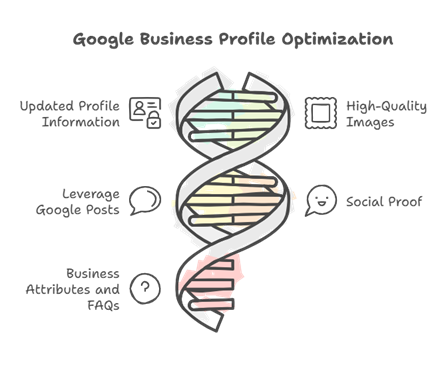
    1. Updated Profile Information:

    Make sure that all of your company’s information, including your name of your business, address, phone number (NAP), and operating hours (keep in mind to adjust your hours in accordance with special occasions or holidays) is correct and up to date. Moreover, a well-written business description that includes relevant keywords and search terms draws attention, making it easier for clients to find you, boosting your SEO efforts, and improving your search rankings.

    2. High-Quality Images:

    Keep clear of stock photos and upload real shots to offer customers a sense of authenticity. Include pictures of your shopfront, staff, merchandise, and service-specific landing pages to give prospective buyers an idea of who you are. Businesses with high-quality photos get a lot more interaction and traction in local search results.

    3. Leverage Google Posts:

    By using this function, you can keep your profile interesting and up to date by sharing events, promotions, updates about your business, newsletters, and special offers right on it. Frequent postings can draw attention to new services, significant occasions, or special deals, making it simple for clients to discover what’s going on, increasing website traffic, and helping improve your business’s online visibility.

    4. Social proof:

    Good customer reviews and positive reviews increase credibility and trust. By responding to negative reviews and customer reviews, you show your concern for the client experience. Although most customers are not avid commenters, a rating of one or a rating between 0 and 5 stars is a little suspect.

    5. Add Business Attributes and FAQs:

    Use terms like “accessible,” “women-led,” or other business attributes to make a statement. By answering commonly asked questions (FAQs) immediately on your profile, you can reduce the volume of queries you have to answer, help improve customer understanding, and provide prospective clients clarity.

    Key message to take away:

    The first step to engaging local customers is creating a Google Business Profile. Optimizing it on a regular basis increases traffic, visibility, and customer attraction without incurring additional expenses. You will experience an increase in customer engagement and trust if you take the effort to update and maintain your profile on a regular basis.

    ‍Want your business to be seen and heard online? Explore our Services

    Frequently Asked Questions (How to make the most of your Google Business Profile for online advertising?)

    How do I advertise my Google Business Profile?

    To advertise your Google Business Profile, optimize your listing with accurate info, high-quality photos, and engaging posts. Use Google Ads Local campaigns to target nearby customers, encourage reviews, and share promotions. Consistently update your profile to improve visibility and attract more local traffic.

    Is $10 a day enough for Google Ads?

    A $10 daily budget for Google Ads can work for small campaigns or local businesses, but results may be limited. It’s enough to test keywords, ads, and targeting, but scaling or competing in high-demand markets usually requires higher budgets to achieve meaningful traffic and conversions.

    Is $500 a month enough for Google Ads?

    A $500 monthly budget for Google Ads can be enough for small to medium local businesses or niche campaigns. It allows testing multiple keywords, optimizing ads, and driving some conversions. However, highly competitive industries may need larger budgets to achieve significant traffic and measurable ROI.

    How to maximize your Google Business Profile?

    To maximize your Google Business Profile, ensure complete and accurate information, add high-quality photos, and regularly post updates or offers. Encourage customer reviews and respond promptly. Use relevant keywords, enable messaging, and track insights to optimize visibility, engagement, and local search performance effectively.


  • Lost Sales Due to Poor UX? Custom Shopify Development Can Help

    Lost Sales Due to Poor UX? Custom Shopify Development Can Help

    Lost Sales Due to Poor UX? Custom Shopify Development Can Help

    Introduction

    Have you ever visited an online store. Struggled a lot to find what you were looking for, and left very frustrated? If so, you’re not the only one in this. A very poor user experience (UX) can turn away many potential customers in the matter seconds, costing businesses thousands in lost sales. When a Shopify store isn’t fully intuitive, fast, or very visually appealing, shoppers are more likely to abandon their carts and never ever return. The very good news? Investing highly in Shopify design services can make a huge difference by ensuring a very smooth and seamless shopping journey.

    Why UX Matters in eCommerce

    Think about the very last time you made a purchase online. What made it easy? What made it frustrating? The user experience plays quite a huge role in whether a visitor converts into a highly  paying customer. If a website is very slow, difficult to navigate, or has a highly complicated checkout process. Shoppers won’t think twice before heading to a fellow competitor. Research shows that even a one second delay in page load time can decrease conversions very significantly. This is where Shopify development services always come in. Helping businesses highly optimize their stores for high speed, accessibility, and ease of use.

    Common UX Issues That Lead to Lost Sales

    1. Slow Loading Speeds

    Online shoppers have very little patience for slow websites. If your store takes even longer than three seconds to load. There’s a pretty good chance visitors will leave before even seeing your site’s products. Slow speeds are often caused by very large images, excessive code, or a possible third party app running in the background. With Shopify development services, you can highly optimize images, streamline code, and implement caching strategies to highly improve site speed, ultimately leading to a totally different shopping experience.

    2. Complicated Checkout Process

    How many times have you completely abandoned a cart because the checkout process was very long or confusing? It happens quite often than you think. Customers want a much quicker, completely hassle-free way to complete their purchases. Simplifying checkout by offering auto filled fields, guest checkout options, and quite multiple payment methods can make a very big difference. Custom Shopify development services in the USA can highly tailor the checkout experience to reduce cart abandonment and totally boost conversions.

    3. Poor Mobile Responsiveness

    With particularly more than half of online shoppers using mobile devices. A store that isn’t very mobile friendly is pretty much bound to lose sales. If visitors struggle alot with tiny buttons, highly unresponsive pages, or text that’s very small to read, they won’t hesitate a bit to leave. Shopify Plus development highly ensures your store looks and works very flawlessly on any of the screen sizes. Providing mobile users with the same amazing experience as desktop shoppers.

    4. Difficult Navigation

    Customers should be quite able to find what they need within the matter of seconds. If they have to dig deeply through multiple menus, very unclear categories, or a confusing layout, the frustration will set in fast. A well-organized site with easy-to-use menus, search filters, and category structures can keep shoppers engaged. Shopify design services can help refine navigation to make product discovery effortless.

    5. Lack of Personalization

    Today’s shoppers expect a highly personalized experience. If your store isn’t offering pretty tailored recommendations, highly dynamic content, or even customized user journeys, you may be missing out on many potential sales. Custom Shopify development services in the USA can highly integrate AI-driven tools to display very relevant products, send highly personalized email campaigns, and create a very unique shopping experience for each visitor.

    6. Weak Branding & Visual Appeal

    First impressions always matter so much. A very cluttered or completely outdated design can turn visitors totally away before they even start their browsing. A very strong, cohesive brand presence builds so much trust and keeps shoppers highly engaged. Investing highly in Shopify design services allows businesses to create a highly visually appealing, modern store that aligns with their brand identity a lot and totally attracts customers.

    How Custom Shopify Development Can Improve UX

    Personalized Store Design

    Using a pretty default Shopify theme might work initially, but as your business grows. A custom design can set you quite apart. With custom Shopify development services in the USA, businesses can create very unique and engaging store completely tailored to their specific audience. Helping them stand out in a competitive market.

    Enhanced Features & Functionality

    Standard Shopify themes have limitations, but custom development unlocks a wide range of possibilities. From AI-powered product recommendations to interactive elements and loyalty programs, advanced features keep customers engaged. Smart search, chatbots, and automated customer support can also improve the overall shopping experience.

    Better Site Performance

    A very slow website doesn’t just annoy customers. It also highly affects search engine rankings. Optimizing performance highly through custom coding, pretty faster loading times, and backend improvements can reduce the bounce rates and keep visitors on your site much longer. Shopify development services ensure that your store runs efficiently without unnecessary delays.

    Seamless Third-Party Integrations

    From payment gateways and CRM systems to marketing automation tools. Integrating third-party services can totally enhance customer interactions and pretty much streamline business operations. Custom Shopify development services in the USA allow for very seamless integrations that help a lot in businesses automate processes, manage inventory, and totally boost sales effortlessly.

    Security & Reliability

    A secure store is a trustworthy store. Customers want to always know their data is completely safe when making a purchase. Custom Shopify development also includes security features like SSL certificates, very secure payment gateways, and quite regular software updates to keep your store highly protected from cyber threats.

    Scalability for Future Growth

    As your business grows a lot, so should your online store. A very scalable Shopify store always allows you to add new products, easily handle increased traffic, and highly integrate additional features without any major disruptions. Custom development totally ensures that your store is quite future-proof and very adaptable to changing market demands.

    Conclusion

    A very poor UX silently drives many potential customers away. Leading to much lost revenue and missed opportunities. Investing in Shopify development services can help a lot in optimizing your store for a much better shopping experience. Ensuring quite smooth navigation, fast loading times, and a very seamless checkout process. Custom Shopify development services in the USA provide much tailored solutions to make your store highly efficient, user-friendly, and highly conversion-focused. In a very competitive eCommerce landscape, quite prioritizing UX is not just a luxury it’s a necessity.

    Want your business to be seen and heard online? Explore our Services
  • Make your Store a Must-Visit with these 13 Tried and Tested Strategies for 2025

    Make your Store a Must-Visit with these 13 Tried and Tested Strategies for 2025

    Make your Store a Must-Visit with these 13 Tried and Tested Strategies for 2025

    With their lightning-fast checkout processes and personalized offerings, online retailers have set a new standard for traditional stores. People now demand the same degree of customization and ease when they visit physical stores, just as they did when they shopped online before the pandemic. Shops in brick-and-mortar locations must therefore do more than meet consumers’ fundamental necessities; they must also entice them to leave the comfort of their homes. This is essential for any retail store looking to grow and implement effective retail marketing strategies in 2025.

    Secure Your Store with Shopify Support and Maintenance (CTA Button)

    Retailers need to make in-store visits more appealing by providing customers with reasons to visit in person. People can easily shop online with only a few clicks, thus providing the basics is no longer enough. Implementing retail strategies and using digital tools can help increase foot traffic and overall retail growth.

    Let’s be real, businesses have physical locations; the question is, how can they increase sales and foot traffic there while keeping customers coming back and boosting retail sales?

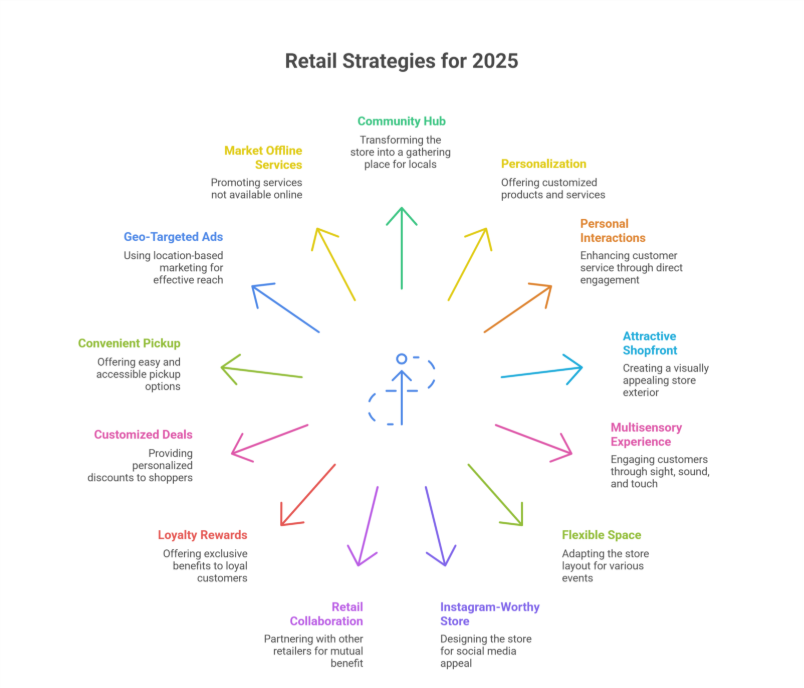
    1.Turn your store into a community hub

    2. Add a personal touch with customization

    3.Make the most of personal interactions

    4. Create a more attractive shopfront  

    5. Engage customers in a multisensory journey  

    6.  Make your store a flexible space

    7. Create an Instagram-Worthy store

    8.Collaborate with fellow retailers

    9. Reward loyalty with exclusive perks

    10. Offer customized deals to shoppers

    11. Provide convenient pickup choices

    12. Run Geo- Targeted Ads for effective Digital Marketing

    13.Market services not offered online

    1.Turn your store into a community hub

    Turn your store into a community hub

    Customers want more than just goods; they want a connection. Make your store a gathering spot by sponsoring in-store events, offering workshops, or simply creating an area for people to engage. Gym+Coffee’s running groups are an excellent example of retail-based community engagement and experiential retail.

    2. Add a personal touch with customization

    Personalized products can be quite appealing. Providing unique gifts or experiences, such as Sequoia Soaps’ build-your-own gift baskets, helps customers feel more connected to the products they purchase. This enhances the customer experience and builds a loyal customer base.

    3.Make the most of personal interactions

    In-store purchasing offers several benefits, one of which is personalized service. Shopify POS allows employees to support customers from anywhere in the store, moving away from the counter to offer individualized assistance. They can easily verify item availability at different locations, retrieve a customer’s past purchases, or complete an earlier-in-the-day online shopping cart.

    Casual browsers become purchasers thanks to these tools. Businesses that integrate their online and in-store systems with Shopify POS receive an average 8.9% boost in revenues. This frees up employees’ time to help clients instead of juggling many systems or looking for information, streamlining the point of sale process.

    Click here to learn more about Shopify App Development (CTA Button)

    4. Create a more attractive shopfront  

    Customers are more inclined to set foot in your store and prolong their visit if it exudes a welcoming atmosphere. By incorporating a well-organized design scheme, chic furniture, and refined lighting, any space can be entirely transformed. Along with fostering a more comfortable environment for your customers, this will also motivate them to spend additional time browsing with you. This is something that companies like July have perfected, employing cozy, warm lighting to entice clients to stay and interact, enhancing dwell time and the in-store experience.

    5. Engage customers in a multisensory journey

    Making an effort to engage all five senses when shopping enhances the store experience. Think about how your store can improve its ambiance, greeting, music, aromas, and even little snacks just like Chicago French Press does with its welcoming, fragrant feel. This improves the overall shopping experience and helps attract new customers.

    6.  Make Your store a flexible space

    Combine retail with additional activities, such as cafes or workshops, to keep customers in-store for longer. Forth & Nomad accomplishes this by offering coffee and classes alongside its lifestyle products, enticing customers to remain and browse. This flexible approach supports strategies for retail growth and encourages foot traffic.

    7. Create an Instagram-Worthy store

    Customers are more inclined to take pictures and discuss their experiences at a store that is visually appealing. Wish’s Atlanta location, with its art-gallery-inspired exhibits, is an excellent example of how to create a social media-worthy environment, generating buzz and increasing brand awareness.

    8.Collaborate with fellow retailers

    Collaborating with other retailers is one strategy to increase client reach. With the finest of both brands available to customers in one convenient location, the cooperation between Leesa and West Elm has increased foot traffic and revenue. These partnerships act as complementary retail marketing strategies that work effectively in 2025.

    9. Reward loyalty with exclusive perks

    A fantastic strategy to retain consumers is to implement a loyalty program. Customers are more likely to return and form stronger ties with businesses that offer incentives for in-store visits and purchases, such as Kenny Flower’s Island Society program. Loyalty programs directly impact conversion and keep customers coming back.

    10. Offer customized deals to shoppers

    Imagine a more meaningful connection with your clients through personalized adverts that cater to their individual preferences. With a mobile POS system, this becomes a piece of cake. You can provide customers with more relevant recommendations and promotions if you keep tabs on what they buy. Ultimately, your relationship with your clients will be strengthened and they will feel valued. This technique builds customer loyalty by making them feel appreciated and understood.

    In addition, you can create personalized promos and campaigns by analyzing your audience’s previous encounters with your brand. 

    If you own a swimwear business, for instance, and you introduce a new print to an existing model, you might contact all of your customers who have bought that suit style in the past to offer them a discount.

    Shopify POS makes it easy to create and maintain client profiles. With this function, you can keep tabs on what your consumers buy and what they like, which opens the door to targeted advertising.

    11. Provide convenient pickup choices

    Stores see an increase in foot traffic when customers have more flexible pickup alternatives, such as Buy Online, Pick Up In-Store (BOPIS). Offbeat Bikes had a notable surge in sales when they introduced this option, streamlining the purchasing process for their clients and creating a seamless omnichannel experience.

    12. Run Geo- Targeted Ads for effective Digital Marketing

    Google searches for “near me” and similar terms are common among consumers looking for local businesses and products. The phrase “shoe store near me” is one example of a possible search query. Traditional retailers should significantly spend on local SEO to entice these clients.

    Traditional retailers should significantly spend on local SEO to entice these clients.

    Want to boost your local visibility? Start with the basics:

    -Put your shop’s name, address, and phone number front and center on your website. Make it impossible to miss!

    -Then, claim your spot on Google My Business. It’s like giving your store a megaphone in the digital world.

    Pro tip: Keep your information consistent across both platforms. It’s the secret sauce for helping customers find you easily!

    Additionally, it’s important to encourage clients to post pictures and write reviews. To further improve your position in local search engine results, you should also develop “citations” in other internet business directories.  

    13.Market services not offered online

    Do something that your online competitors can’t if you want to bring in more customers to your physical store. Offering professional recommendations is equally important because it gets people to talk to you before they make a purchase, instead of blindly buying things online. 

    A hybrid business model that combines online and in-store shopping is something to think about. Ensure that buying in person is as painless as it may be. Nowadays, customers are accustomed to receiving mediocre service; therefore, going above and beyond to guarantee their happiness would distinguish you from the competition.

    For the majority of companies, providing services exclusively in person can yield enormous benefits. More people will visit your store because of this novel strategy, which boosts consumer satisfaction and retail business growth.

    In a nutshell,

    Bring the Buzz back with these Proven Tactics

    Shops have been and will continue to be vital to the retail industry. Nevertheless, their strategic significance has changed over time. These days, drawing in customers is all about making their in-store experiences memorable, using data-driven strategies, digital marketing, and AI-powered tools. 

    Frequently Asked Questions (Make your Store a Must-Visit with these 13 Tried and Tested Strategies for 2025)

    What are the in store shopping trends in 2025?

    In‑store shopping trends in 2025 include hyper‑personalised experiences using AI and data, seamless omnichannel integration, immersive phygital tech like AR/VR, automated self‑service and checkout, and sustainability‑focused products and layouts that appeal to eco‑conscious consumers.

    How to create a complete marketing strategy in 2025?

    To create a complete marketing strategy in 2025, start with data‑driven audience insights, define clear goals, and integrate AI-powered personalization. Combine omnichannel campaigns, immersive content, influencer collaborations, and sustainable messaging. Continuously track KPIs, optimize using real-time analytics, and adapt to emerging technologies and consumer behaviors.

    What are the challenges in retail in 2025?

    Retail challenges in 2025 include adapting to rapidly evolving consumer expectations, integrating seamless omnichannel experiences, managing supply chain disruptions, ensuring data privacy and security, adopting AI and automation effectively, and meeting sustainability demands. Rising competition and economic uncertainties further pressure retailers to innovate and stay agile.

    How do I attract customers to my store?

    To attract customers to your store, offer personalized experiences using AI insights, create engaging in-store events, leverage social media and local marketing, provide exclusive promotions or loyalty rewards, ensure a seamless omnichannel experience, and focus on a welcoming, visually appealing, and sustainable store environment.

  • Migrating From Magento to Shopify Successfully

    Migrating From Magento to Shopify Successfully

    Migrating From Magento to Shopify Successfully

    Introduction

    Migrating completely from Magento to Shopify is a very decisive move. Only for businesses seeking a very user friendly, highly scalable, and cost effective eCommerce solution. While Magento is known for its high flexibility and customization. It often requires quite extensive technical expertise to manage properly. On the other hand, Shopify offers a highly intuitive platform with built in tools. Making it ideal for merchants looking for high efficiency and growth.

    A successful migration requires careful planning to highly ensure data integrity, SEO rankings, and very smooth functionality. In this blog, we will walk you through the very essential steps to migrate from Magento to Shopify. That too without disrupting even a fraction of your online business.

    Why Migrate from Magento to Shopify?

    Before jumping into the migration process, it is highly crucial to understand why businesses choose to switch from Magento to Shopify:

    • Ease of Use : Shopify has a highly intuitive and beginner friendly interface as compared to Magento.
    • Lower Maintenance Costs:  Shopify pretty much eliminates the need for highly extensive development and hosting management.
    • Scalability:  Shopify’s cloud based infrastructure quite supports businesses of all sizes without the need for any additional servers or maintenance.
    • App Ecosystem: Shopify has a vast app store for extending functionality without custom development.
    • Security & Reliability: Shopify handles security, updates, and hosting, reducing the burden on store owners.

    Pre-Migration Considerations

    1. Analyze Your Current Magento Store

    Before migrating, audit your current Magento store to understand what needs to be transferred. Key elements include:

    • Products & Categories
    • Customer Data
    • Order History
    • Website Content (pages, blogs, policies, etc.)
    • SEO Elements (meta titles, descriptions, URLs)
    2. Choose the Right Shopify Plan

    Shopify offers multiple plans. Including Basic Shopify and Advanced Shopify. If you run a large scale store, Shopify Plus can also be an option. Select a plan based on your business needs and budget.

    3. Backup Your Magento Store

    Before proceeding with migration, always create a full backup of your Magento database to prevent data loss. Export the entire important data including products, customers, orders, and CSV file imports for a smooth data migration.

    Step by Step Complete Guide to Migrating from Magento to Shopify

    1. Set Up Your Shopify Store

    Once you’ve chosen your plan, set up your Shopify store by:

    • Registering a domain (or connecting your existing one)
    • Selecting a theme that quite perfectly aligns with your brand
    • Configuring general settings such as currency, tax rules, and payment gateways
    2. Use an Automated Migration Tool

    Manual data migration can be highly time consuming and prone to errors. Consider using helpful tools like Cart2Cart, LitExtension, or Matrixify. This will completely automate the process. These tools help transfer:

    • Products and categories
    • Customers and orders
    • CMS pages and blog posts
    3. Manually Review & Clean Up Data

    Once the migration is complete, review your data in Shopify to ensure everything has transferred correctly. Look for:

    • Missing product descriptions or images
    • Incorrect pricing or stock levels
    • SEO settings like URLs and metadata
    4. Redesign Your Store for Shopify

    Since Magento themes cannot be directly transferred, you’ll need to choose a Shopify theme or build a custom design. A Shopify website designer or Shopify design agency can help create a visually appealing and optimized store.

    5. Reconfigure Essential Apps & Integrations

    Shopify offers various apps to replace Magento’s extensions. Ensure that your Shopify store has the necessary apps for:

    • Email marketing
    • Inventory management
    • Analytics and reporting
    • Customer support (Live chat, Helpdesk)
    6. Test Your Store Thoroughly

    Before making your Shopify store live, conduct thorough testing:

    • Check product pages and categories
    • Verify payment and checkout processes
    • Test website speed and mobile responsiveness
    • Ensure customer accounts and order history are intact
    7. Set Up 301 Redirects

    To prevent broken links and maintain SEO rankings, set up 301 redirects for all important URLs. Shopify allows you to redirect old Magento URLs to new ones, ensuring a smooth transition without losing search engine rankings.

    8. Launch Your Shopify Store

    Once everything is in place it will be time to go live! Before officially launching:

    • Announce the migration to customers via email and social media
    • Monitor performance and fix any post-launch issues
    • Keep an eye on analytics to track sales and traffic

    Post-Migration Tips

    1. Monitor Website Performance

    Use tools like Google Analytics and Shopify’s built-in reports to track performance post-migration. Pay attention to traffic fluctuations, conversion rates, and new store functionality.

    2. Optimize SEO & Content

    To maintain and improve SEO rankings:

    • Update meta descriptions and page titles
    • Submit a completely new sitemap to Google Search Console
    • Optimize product pages with relevant keywords
    3. Train Your Team on Shopify

    If your team is used to Magento, they might need some time to get quite familiar with Shopify’s admin interface. Provide training and resources to ensure a very smooth transition.

    4. Engage with Customers

    Keep customers informed about the changes and offer assistance if they face issues. Ensure smooth communication through:

    • FAQs about the new store
    • Live chat support
    • Promotional offers to welcome them to the new platform

    Conclusion

    Migrating from Magento to Shopify can be a total game changer for your entire business. Making store management easier while highly improving user experience. With proper planning, the right migration tools, and thorough testing, you can transition quite smoothly without losing data or customers.

    Following this Magento to Shopify migration checklist and step-by-step guide will help ensure a very successful and hassle free migration process.

    Want your business to be seen and heard online? Explore our Services
     

    Frequently Asked Questions (Migrating From Magento to Shopify Successfully)

    Why should I migrate from Magento to Shopify?

    Shopify offers a highly user-friendly, scalable, and cost-effective eCommerce solution. Unlike Magento, which requires extensive technical knowledge, Shopify simplifies store management with built-in tools, making it ideal for businesses aiming for growth with less complexity.

    Will I lose my SEO rankings during migration?

    Not necessarily. By carefully redirecting old Magento URLs to Shopify URLs and preserving meta titles, descriptions, and alt tags, you can maintain most of your SEO value. Proper planning is crucial.

    How long does the migration take?

    The timeline depends on store size and complexity. Small stores may migrate in 1–2 weeks, while larger stores with thousands of products and custom functionalities could take 4–8 weeks.

    Can I migrate all my data automatically?

    Many tools and apps can automate migration of products, customers, and orders. However, some custom data or extensions may require manual adjustments.