Category: Studioblogs

  • Is Your WordPress Site Ready For 2026? A Simple Readiness Checklist

    Is Your WordPress Site Ready For 2026? A Simple Readiness Checklist

    Is Your WordPress Site Ready For 2026? A Simple Readiness Checklist

    Why do some WordPress websites perform flawlessly while others struggle with speed, security, and conversions? The difference is rarely the platform itself. It lies in how well your WordPress site is built, managed, and maintained as expectations rise in 2026. For business growth, relying on an outdated setup is no longer sustainable in 2026.

    A WordPress site ready for 2026 follows a clear checklist covering performance, SEO, security, hosting, mobile experience, backups, and AI-driven optimization. Regular updates, reliable support, and professional maintenance ensure faster loading, better rankings, higher conversions, and long-term stability for growing businesses.

    Website performance is influenced by multiple factors, including hosting quality, code standards, design decisions, and ongoing support. A professionally developed WordPress site integrates SEO, reliable host infrastructure, regular backup systems, and smart use of AI to maintain efficiency and scalability in 2026. Without a clear checklist, even strong brands risk slow performance, weak trust, and missed opportunities.

    Many business owners underestimate the real value of professional design, proactive maintenance, and technical support. While basic development may cost a few hundred dollars, long-term stability, security, and performance require a strategic investment backed by expertise and planning.

    This blog presents a practical checklist to assess whether your WordPress website is truly ready for 2026, outlining key areas to review, risks to address, and improvements that support sustainable business success.

    2026 WordPress SEO Checklist For Business Owners Platform
    2026 WordPress SEO Checklist For Business Owners Platform

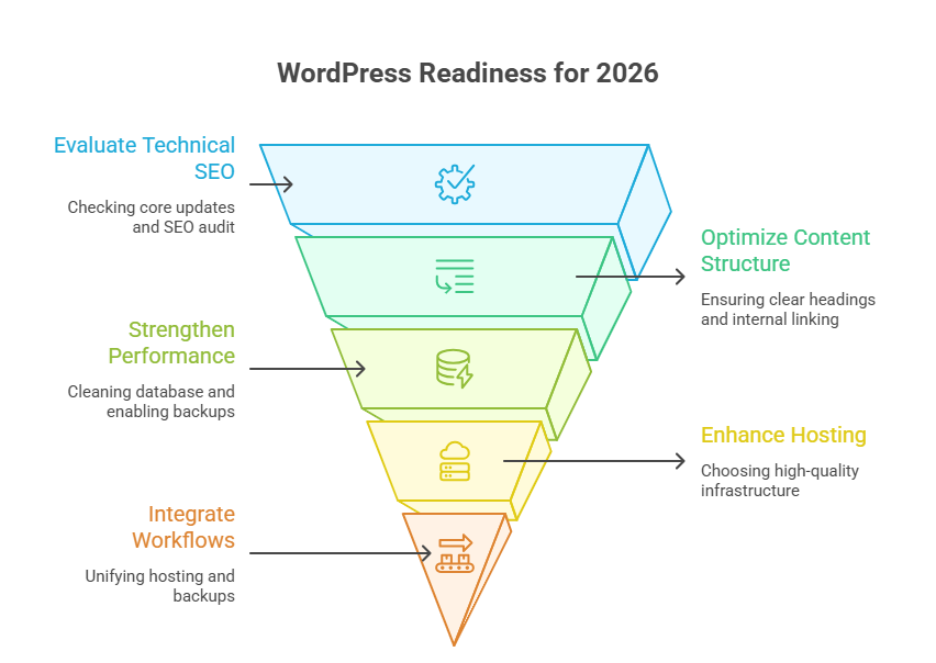
    Step 1: Evaluate Technical SEO Foundations

    website ready for search growth in 2026 and beyond starts with strong technical foundations. Begin by reviewing wordpress core updates to ensure no outdated software is exposing security vulnerabilities. Perform a full SEO audit covering ssl configuration, core web vitals, and proper cdn integration to reduce downtime. This step protects your site from hacker risks while improving visibility and crawl efficiency for search engines.

    Why it matters

    For business owners, technical gaps directly affect trust, rankings, and long-term stability. Ignoring these basics often leads to performance drops and hidden risks.

    Step 2: Optimize Content Structure And User Flow

    Search engines reward clarity and relevance. Review your service pages, blog posts, and faqs to ensure consistent format, clear headings, and strong internal linking. Strategic calls to action should guide users toward booking or inquiries without disrupting the user experience. Clean css, readable font, and logical page hierarchy strengthen accessibility and engagement.

    Step 3: Strengthen Performance, Data, And Reliability

    Effective performance optimization includes database cleanup, malware scanning, and enabling daily backups. Properly configure your hosting plan to support peak traffic and smooth mobile experience. A reliable workflow for updates and monitoring ensures stable functionality and protects revenue during traffic surges.

    2026 WordPress Host Backup Advantage Reducing Downtime Workflow

    A strong hosting setup is the first advantage in reducing website downtime and protecting business continuity. In 2026, hosting is no longer just about server space; it is about performance, security, and seamless integration across your WordPress workflow.

    Key hosting advantages

    • Use a latest stable server environment to prevent unexpected crashes
    • Choose high-quality infrastructure that supports traffic spikes during any marketing campaign
    • Enable automated monitoring to protect real user experience
    • Maintain secure admin accounts to limit unauthorized access
    • Build user trust through consistent uptime and fast response times

    Backup Systems That Minimize Risk And Recovery Time

    Backups are your safety net when technical failures occur. A structured backup strategy ensures fast recovery without data loss or reputational damage.

    Backup workflow best practices

    • Store backups in secure cloud storage for off-server protection
    • Schedule backups using automation to eliminate manual errors
    • Ensure compatibility with third-party tools and services
    • Regularly test restore points to avoid failed recovery scenarios

    Integrated Workflow For Downtime Reduction

    Hosting and backups should not operate in isolation. When you integrate them into a single workflow, recovery becomes faster and more predictable.

    Why integration matters

    • Simplifies technical operations through unified control
    • Reduces dependency on manual fixes during failures
    • Supports search visibility across platforms like Bing
    • Improves long-term reliability through seamless system alignment

    Conclusion

    Preparing yourWordPress website for 2026 is no longer a technical luxury it is a business necessity. From SEO foundations and content structure to hosting stability and backup workflows, every element discussed above directly impacts performance, security, user trust, and long-term growth. A clear readiness checklist helps you identify gaps before they turn into downtime, ranking loss, or missed conversions.

    For business owners, the real advantage lies in proactive decisions: keeping systems updated, integrating hosting and backups into a reliable workflow, and investing in professional oversight rather than reactive fixes. When these elements work together, your WordPress platform becomes scalable, resilient, and aligned with future expectations instead of struggling to catch up.

    Isn’t it time to see how Integriti Studio can strengthen your WordPress site for 2026?

    Frequently Asked Questions (Is Your WordPress Site Ready For 2026? A Simple Readiness Checklist)

    How to build a website checklist?

    To build a website, start with a clear purpose and target audience. Choose a domain and reliable hosting, plan your site structure, and design a responsive layout. Add quality content, optimize for SEO, ensure fast loading, implement security, and test across devices before launch.

    What are the 7 steps to building a good website?

    The 7 steps to building a good website are: 1) Define purpose and audience, 2) Choose domain and hosting, 3) Plan site structure, 4) Design responsive layout, 5) Create quality content, 6) Optimize for SEO and speed, 7) Test, secure, and launch.

    What is the basic information of WordPress?

    WordPress is a popular open-source content management system (CMS) used to create websites and blogs. It offers customizable themes, plugins for added functionality, and a user-friendly interface. WordPress supports SEO, responsive design, and content management, making it suitable for beginners and professionals alike.

    What are the requirements for a website?

    The requirements for a website include a clear purpose, target audience, and domain name. You need reliable web hosting, a responsive design, quality content, and user-friendly navigation. Additionally, SEO optimization, fast loading speed, security measures, and regular updates are essential for a successful website.

  • What Makes a Website Future-Ready In 2026

    What Makes a Website Future-Ready In 2026

    Why do some websites struggle to engage visitors despite sleek layouts and flashy visuals? The difference often lies in a combination of factors influencing website performance from page speed and accessibility to AI-driven personalization and SEO integration. A future-ready website in 2026 isn’t just about how it looks; it’s about how it functions, converts, and adapts to evolving user expectations.

    A website becomes future-ready in 2026 by combining AI-driven personalization, fast and accessible layouts, SEO integration, and seamless user experience. Prioritizing professional development, regular maintenance, and modern design trends ensures your site transforms web experiences, builds trust signals, and stays adaptable to evolving technologies and user expectations.

    Professional development plays a crucial role in this transformation. Investing in expert web design, maintenance, and support ensures your site remains secure, fast, and compatible with modern tools. Good design goes beyond aesthetics it builds trust signals, guides users efficiently, and enhances the overall user experience. For businesses, this often means allocating budgets that reflect quality development, with typical professional website projects ranging from moderate to higher-end pricing depending on complexity and features.

    This blog will explore what makes a website truly future-ready in 2026. You’ll discover emerging design trends, AI-powered tools, accessibility standards, layout strategies, and techniques to transform web experiences. We’ll also highlight practical ways to ensure your new website attracts search engines, engages users, and stays ahead of the trends of 2026.

    How To Make Your Website Future-Ready In 2026

    How To Make Your Website Future-Ready In 2026

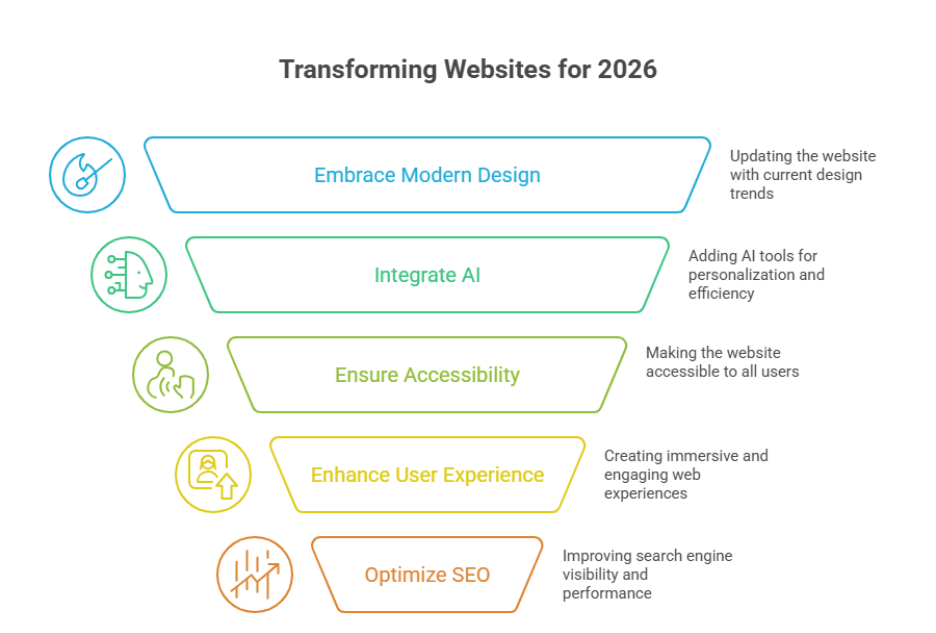
    Preparing a website for 2026 means creating modern websites that are adaptive, engaging, and built for long-term performance. Follow these steps to make your site truly future-ready:

    Step 1: Embrace Modern Web Design and Layouts

    Start by updating your web design to match current design trends 2026. Focus on clear, immersive layouts, responsive typography, and micro-interactions. A well-structured 2026 website guides users intuitively, improving usability and overall digital experience.

    Step 2: Prioritize Personalization and AI Integration

    Implement personalization features and AI tools to tailor content to each visitor. Adding AI assistants or ai search functionality enhances navigation and boosts engagement, making your web experiences smarter and more user-focused.

    Step 3: Focus on Inclusive Design and Accessibility

    Incorporate inclusive design principles to make your website accessible to all users. This ensures compliance with accessibility standards, improves UX, and aligns with trends of 2026 where ethical, user-centered design is a priority.

    Step 4: Enhance Web Experiences With Immersive Features

    Add interactive visuals, animations, and immersive elements that captivate visitors. Thoughtful web experiences create a memorable site, keeping users engaged and encouraging return visits.

    Step 5: Stay Ahead With SEO and Development Trends

    Optimize for search engines and keep up with web development and trends for 2026. Fast-loading pages, structured data, and AI-driven analytics ensure your future of web design strategy maintains high performance and visibility.

    Key Design Trends 2026 Shaping Modern Websites Today

    Modern websites are evolving fast, and trends of 2026 are shaping the future of website design. To create modern websites that deliver exceptional digital experiences and remain future-ready, consider these key design trends:

    Immersive Experiences and Micro-Interactions

    • Web experiences are moving toward immersive, interactive designs that actively engage users.
    • Micro-interactions, such as hover effects, animated buttons, and real-time feedback, guide users and enhance overall usability.
    • These features make modern websites dynamic and memorable, improving user retention and encouraging exploration.

    AI-Driven Personalization

    • Personalization with ai tools allows websites to adapt content, recommendations, and offers to individual user behavior.
    • Integrating ai assistants or ai search simplifies navigation, helping users find relevant content quickly.
    • Personalized experiences not only improve engagement but also strengthen the user’s connection with your brand, enhancing the overall digital experience.

    Inclusive Design and Accessibility

    • Inclusive design ensures your website is accessible to users with different abilities, meeting accessibility standards.
    • Enhancing UX for all visitors aligns with trends for 2026, where ethical and user-centered design is a priority.
    • Accessibility improvements increase audience reach, build trust, and contribute to a future-ready website.

    Typography and Visual Hierarchy

    • Thoughtful typography improves readability and establishes a clear visual hierarchy for your content.
    • Strong hierarchy and expressive fonts guide users intuitively, making navigation easier and boosting usability.
    • Bold typefaces, dynamic font sizes, and clear spacing are integral design trends 2026 that enhance digital experiences.

    Future-Ready Layouts

    • Websites are shifting away from rigid grids toward flexible, immersive layouts that adapt to various devices.
    • These layouts improve responsiveness, creating consistent web experiences across desktops, tablets, and mobile devices.
    • Adopting such designs ensures websites in 2026 are visually appealing, functional, and adaptable to evolving user needs.

    Optimized Performance and AI Integration

    • Using ai tools can automate content delivery, enhance personalization, and optimize workflows for efficiency.
    • Maintaining fast-loading pages and monitoring performance metrics ensures smoother digital experiences.
    • AI-powered insights and automation help your future of website strategy remain competitive and future-ready.

    Core Design Principles

    • Every design choice should have a purpose, balancing aesthetics with functionality.
    • Focus on good design and user-first principles to create intuitive, engaging modern websites.
    • Following these principles ensures your site is immersive, usable, and positioned as a future-ready website for 2026.

    Conclusion

    Creating a future-ready website in 2026 goes beyond attractive visuals. It requires combining AI-driven personalization, immersive layouts, inclusive design, and SEO integration to deliver seamless digital experiences. By following modern web design trends, prioritizing usability, and investing in professional website development, your site can adapt to evolving user expectations while building trust and engagement. Thoughtful design choices, interactive micro-elements, and AI-powered tools ensure your website not only performs well today but remains relevant in the fast-changing digital landscape of 2026.

    Ultimately, the key to a truly future-ready website is balancing aesthetics, functionality, and accessibility while keeping users at the center of every decision. Regular updates, maintenance, and integration of new technologies will keep your modern website competitive and impactful.

    Are you ready to transform your website into a future-ready digital experience, or should you contact Integriti Studio to make it happen?

    Frequently Asked Questions (What Makes a Website Future-Ready In 2026)

    What is the trend in website 2026?

    In 2026, website trends focus on AI-powered personalization, minimalist yet purposeful design, 3D/immersive visuals, voice-enabled navigation, and accessibility. Sites are faster, adaptive to users, mobile-first, and use bold typography and subtle interactions to boost engagement and clarity.

    What is the scope of web development in 2026?

    In 2026, web development has a vast scope with rising demand for AI-integrated websites, progressive web apps, voice and AR/VR interfaces, and advanced cybersecurity. Developers skilled in full-stack, cloud solutions, and accessibility-focused design will lead, as businesses prioritize seamless, personalized, and future-ready digital experiences.

    What is the future of websites?

    The future of websites is AI-driven, highly personalized, and immersive, combining voice, AR/VR, and interactive 3D elements. Websites will focus on speed, accessibility, and seamless mobile experiences, acting as smart platforms that adapt to user behavior, deliver real-time content, and enhance engagement and conversions.

    What will technology look like in 2026?

    In 2026, technology will be AI‑driven, highly interconnected, and immersive, with smart devices, augmented and virtual reality, advanced robotics, and quantum computing becoming mainstream. Emphasis will be on automation, personalized experiences, sustainability, and seamless integration across work, entertainment, and daily life, reshaping how people live and interact.

  • What Will No Longer Work On Websites In 2026

    What Will No Longer Work On Websites In 2026

    What Will No Longer Work On Websites In 2026

    Why do some websites stop performing even though they looked “modern” just a year ago? The answer often lies in outdated assumptions carried over from 2025. As 2026 approaches, what once worked on the web is quickly becoming a liability. Your website performance is now shaped by speed, clarity, accessibility, privacy expectations, and how intelligently ai is integrated into real user journeys.

    In 2026, websites will no longer succeed with slow load times, cluttered layouts, confusing navigation, or copied design trends. Overused AI features, poor accessibility, outdated updates from 2025, and unsupported web builds will reduce trust, harm user experience, and limit long-term business growth.

    Many businesses still rely on heavy layouts, confusing navigation, slow load behavior, and borrowed trends that no longer match mobile-first usage. Simply embedding a youtube video, copying an app-style interface, or forcing endless scroll does not guarantee engagement. In 2026, ai must support decision-making, personalization, and efficiency not distract users or compromise trust. Without proper support and ongoing updates, even expensive builds lose value fast.

    Professional development protects your investment. A typical website project may range between $1,500 and $6,000, but without maintenance, optimization, and strategic upgrades, performance declines quickly. Good design is not visual polish alone it is structure, compliance, and long-term reliability.

    This blog breaks down what will no longer work on websites in 2026, from outdated web trends and poor navigation to misuse of ai, helping you identify risks, rethink priorities, and make smarter choices for sustainable growth.

    Web Design Trends Failing Websites In 2026 After 2025

    Step 1: Relying on Outdate Design Decisions

    Many businesses enter 2026 still using outdate layouts, outdate components, and outdate thinking carried over from earlier years. While these choices once aligned with popular web trends, they now create a clear risk to performance. Search behavior, user expectations, and search engines have evolved, and web design that fails to adapt quickly loses relevance.

    Step 2: Broken Layouts and Poor Scrolling Logic

    A rigid or overloaded layout is one of the fastest ways to lose a visitor. Endless scroll without visual hierarchy, poorly placed visual cues, or unbalanced spacing harms readability and engagement. These issues directly conflict with modern web design trends and make it harder for sites to perform well across devices.

    Step 3: Overusing Trends Without Purpose

    Blindly copying a popular design trend is no longer effective. Trends that ignore context, usability, or personalization feel disconnected and reduce trust. In 2026, trends must support clarity and outcomes, not experimentation alone. What worked in 2025 often needs a strategic update, not repetition.

    Step 4: Ignoring Performance and Embedded Bloat

    Heavy media choices such as unnecessary embed elements slow sites and impact SEO expectations shaped by Google’s Core Web Vitals. Without regular update cycles and a clear upgrade plan, even well-built sites struggle to keep pace with design trend shifts.

    Step 5: Failing to Plan for Continuous Improvement

    Successful websites are reviewed, refined, and measured. Teams that overlook structured improvement miss opportunities to align with emerging expectations and trends for 2026. The goal is not to chase every change, but to apply web design choices that scale, support growth, and remain future-ready.

    Conclusion

    Websites that fail to evolve with user expectations and technological shifts quickly lose relevance in 2026. Outdated layouts, confusing navigation, overused AI, and heavy media not only frustrate users but also harm engagement, trust, and search visibility. Simply copying design trends from 2025 or neglecting performance upgrades is no longer sufficient.

    To stay competitive, you must invest in professional development, continuous updates, and strategic web design decisions that prioritize usability, personalization, and future-ready layout structures. Modern websites succeed when every element from scrolling logic and visual hierarchy to embedded media and AI features is thoughtfully optimized for speed, clarity, and user experience.

    The key takeaway is that good design extends beyond aesthetics: it is structured, compliant, and focused on measurable results. If you want your business website to thrive and avoid the common pitfalls of outdated trends, continuous improvement is essential.

    So, ask yourself can your website truly perform at its best, or is it time to explore a smarter upgrade with Integrity Studio?

    Frequently Asked Questions (What Will No Longer Work On Websites In 2026)

    What will happen to technology in 2026?

    In 2026, technology will become more intelligent and human-centric. AI will power everyday tools, automation will increase efficiency, and digital experiences will be highly personalized. Strong focus on cybersecurity, accessibility, and sustainable technology will shape long-term business growth and user trust.

    What is replacing websites?

    Websites are not disappearing, but they are being complemented by AI-driven platforms. In 2026, super apps, AI chatbots, voice assistants, social commerce, and no-code tools are handling quick interactions, while websites remain the central hub for trust, conversions, content, and long-term digital presence.

    What is the trend in website 2026?

    The website trend in 2026 focuses on AI-powered personalization, fast-loading performance, and clean, modular layouts. Accessibility-first design, voice and chatbot integration, and privacy-focused experiences are becoming standard. Websites are built to guide users quickly, build trust, and support long-term business scalability.

    Do you still need a website in 2025?

    Yes, a website is still essential in 2025. Social platforms and apps support visibility, but a website builds credibility, ownership, and trust. It acts as a central hub for branding, SEO, conversions, and data control, helping businesses grow independently and sustainably.

  • Website Trends Businesses Need To Prepare For In 2026

    Website Trends Businesses Need To Prepare For In 2026

    Website Trends Businesses Need To Prepare For In 2026

    Why do some business websites generate consistent leads while others struggle to justify their cost? The difference is rarely the platform alone. Performance is shaped by strategic web design decisions, the right design trend adoption, and how professionally a site is built, supported, and maintained over time. As 2026 approaches, expectations around speed, trust, and usability are rising fast.

    Businesses preparing for 2026 must focus on AI-powered web design, accessibility, personalization, and performance-driven layouts. Modern websites will prioritize UX, fast loading, micro-interactions, and scalable architecture. Strategic design trends, ongoing maintenance, and professional development choices will directly impact trust, conversions, and long-term digital growth.

    Businesses that relied on shortcuts in 2025 are now facing limitations in scalability, accessibility, and personalization. Elements like layout structure, typography, color palette, and even how a logo is layered or displayed can directly affect credibility and conversion. Modern websites demand creative thinking, oversized visuals, refined overlays, micro-level polish, and increasingly ai-powered enhancements that improve user experience without overwhelming it.

    Professional development also protects your investment. A new website may cost anywhere between $1,500 to $6,000 depending on scope, but without ongoing support and updates, even strong designs lose value quickly. Smart planning ensures your site evolves with user behavior, not against it.

    This blog explores the most impactful web design trend shifts, design trends for 2026, accessibility standards, personalization strategies, and how ai fits into the future of digital growth—helping you prepare with clarity, confidence, and long-term results.

    Web Design Trends 2026 Shaping Modern Business Websites Success

    Web Design Trends 2026 Shaping Modern Business Websites Success

    The Strategic Shift Behind Website Performance

    In 2026 web expectations are no longer driven by aesthetics alone. Website trends now focus on measurable performance, long-term scalability, and user trust. For small businesses, competing in a crowded digital landscape means aligning design with core web vitals, accessibility standards like WCAG, and clear business outcomes. This shift defines the most impactful design trends 2026 has introduced.

    UX, Usability, and Structured Layouts

    Designing for How Users Actually Behave

    Modern success begins with ux and usability. Clean structured layouts, a consistent grid, and logical navigation reduce friction across all web pages. Visitors expect fast page load speeds, intuitive clickable elements, and focused calls-to-action especially on landing pages. Ignoring these fundamentals often results in slow load times, lost trust, and missed conversions.

    Visual Direction: From Minimalism to Maximalist Confidence

    Making a Strong Visual Identity

    The web design trends for 2026 reflect confidence and clarity. Some brands lean into minimalism, while others adopt maximalist expressions inspired by ’90s nostalgia and futurism. Oversized images, bold shape usage, and expressive design elements are paired with soft gradients, subtle gradient overlays, and even experimental accents like neon pinks, pastel color, or controlled glitter effects. The key is consistency with your visual identity, not decoration for its own sake.

    Typography, Fonts, and Content Hierarchy

    Content-Led Digital Design

    Strong font choices and readable typography guide attention and support content based storytelling. In modern websites, typography is no longer secondary it defines hierarchy, tone, and clarity in a noisy digital world. When paired with neutral color foundations or textured surfaces, it creates balance without overwhelming the user.

    AI-Driven Personalization and Commerce

    Smarter Experiences, Not Louder Ones

    AI-driven interfaces are reshaping digital experiences, particularly for e-commerce. Thoughtful ai-driven logic enables dynamic product recommendations, adaptive layouts, and smarter personalization without sacrificing speed. These capabilities are now part of the top web design trends, especially for business websites seeking scalable growth.

    Tools, Platforms, and Practical Execution

    Beyond Templates

    Relying solely on a rigid template limits flexibility. Modern design tools, platforms like Wix Studio, and experienced collaboration with a professional web designer allow brands to move faster while maintaining quality. Whether launching a new website or refining existing business websites, execution matters more than trends alone.

    Preparing for What Comes Next

    The future of web design is not about chasing every trend. It is about understanding how the year’s trends connect performance, accessibility, and creativity. Brands that shape 2026 and learn from evolving expectations will build modern websites that perform reliable far removed from the limitations of dial-up thinking while staying relevant to audiences like Gen Z and beyond.

    Conclusion

    Preparing for website success in 2026 is no longer about following trends blindly it is about making informed, strategic decisions that balance performance, usability, accessibility, and long-term growth. As expectations evolve, businesses that invest in professional web design, structured layouts, thoughtful UX, and scalable, AI-driven personalization will consistently outperform those relying on shortcuts or outdated approaches. From visual identity and typography to page speed, maintenance, and platform choice, every detail contributes to trust, conversions, and measurable business outcomes. The brands that act early will not only adapt to change but shape it, building digital experiences that remain relevant, reliable, and competitive well beyond 2026.

    If your website needs to be future-ready, isn’t it time to ask why not discuss your next move with Integrity Studio?

    Frequently Asked Questions (Website Trends Businesses Need To Prepare For In 2026)

    What are the web trends in 2026?

    In 2026 web trends, AI-powered personalization, Progressive Web Apps (PWAs), immersive AR/3D experiences, Web3/blockchain, voice and conversational interfaces, strong cybersecurity, low-code/no-code tools, and sustainable, performance-first web design will dominate online experiences.

    What are the 7 C’s of website design?

    The 7 C’s of website design are Context, Content, Community, Customization, Communication, Connection, and Commerce. Together, they ensure a website looks appealing, delivers valuable information, engages users, supports interaction, integrates external links, and effectively drives business goals and conversions.

    What is the future of digital marketing in 2026?

    The future of digital marketing in 2026 focuses on AI-driven personalization, immersive AR/VR experiences, voice and conversational commerce, data privacy-centric targeting, short-form video dominance, influencer credibility, and sustainable, value-based content strategies to deepen engagement and boost conversions across platforms.

    Is website design still a good business in 2025?

    Yes website design is still a good business in 2025 because companies always need professional, user-friendly, SEO-optimized, and mobile-responsive websites to compete online. Demand for custom design, UX expertise, and scalable sites remains strong despite AI tools and builders.

  • The Website Features Users Will Expect By 2026 

    The Website Features Users Will Expect By 2026 

    The Website Features Users Will Expect By 2026

    Why do some websites feel effortless to use while others frustrate visitors at every click? The difference lies in how carefully you plan for 2026 web design from layout and navigation to accessibility and AI-driven personalization. Websites that excel are not just visually appealing; they deliver seamless user experience, optimized performance, and real value through thoughtful digital experiences. 

    By 2026, users will expect websites with minimalist layouts, AI-powered personalization, accessible and inclusive design, fast load times, and seamless navigation. Engaging interfaces, immersive digital experiences, and responsive, SEO-friendly web design trends will be essential for building trust, enhancing user experience, and driving conversions. 

    Several factors influence website performance, including clean layout, intuitive navigation, accessibility standards, minimalism, and integration of AI tools for personalization and optimization. Professional development ensures your site scales effectively, stays SEO-friendly, and maintains fast load times. Good design, ongoing support, and regular maintenance are investments that pay off in higher conversion, stronger brand credibility, and better search engine performance. Even modest budgets for a new website can deliver measurable returns when structured with long-term strategy in mind. 

    This blog will explore the website features users will expect by 2026, including emerging design trends, immersive interfaces, AI-powered personalization, minimalist layouts, accessibility-first approaches, and how smart development decisions enhance digital marketing efforts and guide users toward meaningful engagement. 

    Future of web design and website features 2026 

    As you step into 2026, the future of web design will continue to evolve, shaped by user expectations, emerging 2026 web design trends, and advancements in technology. Businesses must adopt modern, inclusive design practices and AI-powered tools to create new website experiences that are fast, intuitive, and visually appealing. Below are actionable steps to align your site with the top web design trends and features users will expect in 2026. 

    Step 1: Embrace Minimalist and Clean Layouts 

    Minimalist design will dominate 2026 web design trends, focusing on simplicity, white space, and clean typography. Reducing clutter enhances load times and ensures your content and design elements guide users naturally, improving user experience while maintaining a professional appearance. 

    Step 2: Implement AI-Powered Personalization 

    Incorporate AI tools to provide product recommendations, personalized content, and interactive elements. AI-driven automation allows your company’s website to adapt in real-time to user behavior, creating highly relevant experiences that build trust and increase conversions. 

    Step 3: Prioritize Inclusive and Accessible Design 

    Inclusive design ensures your website is usable for all visitors, including people with disabilities. Accessibility considerations, mobile responsiveness, and optimized website speed are crucial for reaching broader audiences while maintaining compliance and good design standards. 

    Step 4: Enhance Interactivity and Visual Engagement 

    Interactive features like motion effects, hover animations, and data visualization improve engagement and guide users toward key actions. A thoughtfully designed website hero section paired with interactive elements reinforces brand identity and encourages users to explore further. 

    Step 5: Optimize Performance and Scalability 

    Fast load times, responsive layouts, and scalable infrastructure ensure your website in 2026 supports both mobile users and desktop visitors. Using modern design tools and website builder platforms allows continuous optimization, ensuring your site remains competitive in the evolving digital world. 

    Step 6: Monitor Trends and Adapt Continuously 

    Keep an eye on design trends to watch and trends to expect in 2026. Regularly updating your design strategy with emerging web design trends for 2026 ensures your online presence remains relevant, efficient, and capable of delivering interactive, AI-powered digital experiences. 

    2026 web design trends reveal minimalist AI-powered inclusive layouts 

    The evolving digital landscape means web design continues to evolve rapidly, and businesses must adapt to meet rising user expectations. Trends reveal that minimalist, AI-powered, and inclusive layouts are shaping the future of web design in 2026. Below are key insights explained in bullet points: 

    • Minimalist Layouts for Clarity and Focus: 
      A trend toward simplicity helps reduce clutter, improves internet users’ experience, and allows content and key messages to stand out. Minimalist design also helps users feel comfortable navigating your site, enhancing engagement. 
    • AI-Powered Personalization: 
      Integrating AI allows your website to adapt in real-time, offering personalized content, product recommendations, and dynamic interfaces. AI helps create an emotional connection with users by delivering experiences tailored to their preferences. 
    • Inclusive Design for Accessibility: 
      Websites must be inclusive, ensuring all users, including those with disabilities, can navigate and interact with your content. This approach signals professionalism and builds trust while expanding audience reach. 
    • Interactive and Engaging Interfaces: 
      Motion effects, micro-animations, and interactive features help users feel more engaged and guide them through key actions effectively. These elements support digital marketers in enhancing conversions and retention. 
    • Alignment with Evolving Marketing Trends: 
      Understanding the 2025 state of marketing helps anticipate what users expect in 2026. Websites that combine minimalist layouts, AI-driven personalization, and inclusivity position businesses ahead in the evolving digital space. 
    • Future-Ready Strategy: 
      Applying these trends can help your website stay relevant, improve user experience, and maintain a competitive edge as web design goes through continuous innovation. 

    Conclusion 

    As we approach 2026, the expectations for websites are higher than ever. Users demand minimalist layouts, AI-powered personalization, inclusive and accessible design, and fast, responsive navigation. Businesses that embrace these web design trends for 2026 create future-ready websites that build trust, improve user experience, and drive meaningful conversion and engagement. 

    A well-designed website is no longer just a digital presence—it’s a strategic asset. Integrating interactive features, optimizing load times, and leveraging AI for personalization ensures your site stays relevant in the evolving digital landscape. Regularly monitoring trends, adapting your website design, and prioritizing accessibility are essential steps for maintaining competitiveness and supporting long-term growth. 

    If your company’s website isn’t fully optimized for 2026, wouldn’t it make sense to see how Integriti Studio can help you stay ahead and create a future-ready website? Could your website really wait while your competitors embrace these trends? 

    Frequently Asked Questions (The Website Features Users Will Expect By 2026)

    What are the web development trends for 2026?

    Web development in 2026 will focus on AI‑driven tools, Progressive Web Apps (PWAs), no‑code/low‑code platforms, Web3 & blockchain, serverless/edge computing, WebAssembly for speed, headless CMS, and stronger cybersecurity & privacy‑first design.

    What is the scope of web development in 2026?

    The scope of web development in 2026 is vast, driven by AI integration, immersive web experiences, and faster, secure platforms. Developers skilled in PWAs, headless CMS, Web3, and no‑code/low‑code tools will be in high demand as businesses prioritize scalability, accessibility, and personalized user experiences.

    What are good features of a website?

    Good website features include fast loading speed, mobile responsiveness, clear navigation, strong security, and accessibility. Other key elements are engaging content, intuitive layout, SEO optimization, contact options, AI-powered personalization, and trust signals that build credibility and encourage users to interact and convert.

    What is the future of websites?

    The future of websites focuses on AI-driven personalization, immersive experiences, and faster, more secure platforms. Websites will prioritize accessibility, seamless mobile performance, voice and visual search, and integration with Web3 technologies, enabling businesses to offer interactive, user-centric, and data-informed online experiences.

  • What Businesses Should Rethink About Their Website In 2026 

    What Businesses Should Rethink About Their Website In 2026 

    What Businesses Should Rethink About Their Website In 2026

    Why do some business websites look polished yet fail to perform, while others quietly drive consistent growth? The difference is rarely the platform alone. It comes from how seriously you rethink website strategy as you move from 2025 into 2026, where expectations around speed, clarity, and trust have changed. 

    Businesses should rethink their website in 2026 by focusing on AI-driven optimization, mobile-first responsive layouts, accessible and intuitive navigation, and conversion-focused web design. Prioritizing user experience, personalization, SEO, and real-time performance updates ensures a future-focused website that drives engagement, trust, and long-term growth. 

    Website performance today is influenced by multiple factors: web design quality, clean layout, intuitive navigation, accessibility standards, and a mobile-first, responsive structure that supports real user experience. Professional development goes beyond visuals—it includes scalability, usability, strong typography, and the ability to optimize for search engines and long-term search visibility. Businesses that use AI for personalization, real-time improvements, and smarter optimization are already gaining an edge in conversion and engagement. 

    Many companies hesitate over costs, yet a basic business website often starts around a few hundred dollars, while a professionally planned, conversion-ready build with support and maintenance reflects real business value not just a template. 

    This blog explores what to rethink about website design in 2026, key design trends, how to use AI effectively, and how future-focused decisions improve SEO, usability, and sustainable growth. 

    Rethink website design UX accessibility and navigation 2026 

    As businesses move into 2026 and beyond, the way users interact with websites is evolving rapidly. A modern website must combine good design, intuitive navigation, and inclusive accessibility features to remain competitive. Below are actionable steps to help you rethink your website design and UX strategy for 2026. 

    Step 1: Evaluate Your Current Website Design 

    Start by reviewing your essential website elements. Check layout, typography, color schemes, and template choices. Ask yourself if your current design aligns with web design trends and design trends 2026, and whether it communicates a trust signal to users. If your website isn’t visually appealing or the design feels outdated, it may negatively impact user behavior and long-term growth. 

    Step 2: Prioritize UX and Navigation 

    Next, analyze the UX and navigation structure. Simplify menus, ensure intuitive pathways, and implement clear call-to-actions. Consider mobile-first design and responsive design to accommodate users on any device. Streamlined navigation not only improves usability but also enhances core web vitals and load times, which are essential for SEO and success in 2026. 

    Step 3: Implement Accessibility and Inclusive Design 

    Incorporate inclusive design practices so your website is accessible to all users, including those with disabilities. This includes text alternatives for images, proper heading structures, and color contrast adjustments. Accessibility improves user satisfaction, expands reach for small businesses, and signals professionalism a top website characteristic in any future-ready website strategy. 

    Step 4: Integrate Content and Multimedia Strategically 

    A solid content strategy paired with video or interactive elements enhances engagement. Use video strategy and optimized content placement to guide users naturally through your site. Ensure your template supports this integration without slowing load times, so your website remains both functional and visually appealing. 

    Step 5: Monitor, Test, and Optimize Continuously 

    Finally, a strategy for 2026 must include ongoing monitoring. Track user behavior, test new layouts, and optimize based on performance data. Incorporate AI tools for real-time adjustments to enhance UX, conversion, and long-term growth. Remember, a website isn’t just a digital presence it’s a dynamic asset that must evolve to stay competitive. 

    Mobile-first responsive layout shaping future of web design 

    Adopting a mobile-first responsive layout is no longer optional—it’s essential for businesses looking to stay competitive in 2026. Websites are no longer static, and design is no longer just about aesthetics. Here’s how mobile-first principles are shaping the future of web design: 

    • Built from the ground for mobile users: 
      Websites are built prioritizing mobile devices first, ensuring content is clear, layouts are intuitive, and essential features remain accessible on small screens. This future-focused website approach allows businesses to stay ahead in both UX and digital marketing strategies. 
    • Conversion-focused design: 
      Mobile-first layouts improve usability, load quickly, and streamline user journeys, increasing user trust and driving better business outcomes. By using AI tools and design assistant solutions, businesses can optimize forms, CTAs, and navigation for higher conversion rates. 
    • Core web vitals and SEO-friendly: 
      Optimized mobile layouts enhance core web vitals and SEO-friendly practices, reducing slow load issues and improving search visibility. Proper web hosting and format choices ensure pages perform efficiently across devices. 
    • Accessibility-first design: 
      Prioritizing accessibility ensures your website reaches all users. Features like scalable typography, clear contrast, and intuitive navigation make the site usable for everyone, signaling professionalism and user trust. 
    • Data-driven real-time optimization: 
      Websites must integrate real-time data insights and AI tools to continuously improve performance. Mobile-first responsive designs allow businesses to monitor engagement, test layouts, and adapt quickly to changing user behavior. 
    • Future-ready and scalable: 
      Mobile-first layouts support scalability, allowing websites to evolve alongside new web development trends. Businesses that embrace this approach ensure their sites are conversion-focused, future-focused websites, and prepared for trends to watch in 2026 and beyond. 

    Conclusion 

    As businesses move into 2026 and beyond, rethinking your website is no longer optional it’s a strategic necessity. Prioritizing AI-driven optimization, mobile-first responsive layouts, accessible navigation, and conversion-focused web design ensures your site not only performs but also builds user trust and drives long-term growth. Regularly monitoring core web vitals, optimizing content, and integrating inclusive design practices will keep your website competitive, scalable, and aligned with evolving web design trends. 

    A future-focused website is dynamic, adapting in real-time to user behavior while staying SEO-friendly and supporting your digital marketing strategies. By combining smart design, professional development, and AI-powered enhancements, you can transform your website from a static presence into a core business asset that delivers measurable results. 

    If your website isn’t performing as expected or your design is no longer engaging users effectively, it may be time to rethink your approach for 2026 and beyond. 

    Curious why struggle with an outdated layout when Integriti Studio could help your website stay ahead? Wouldn’t you want to see how your business can fully leverage a future-ready website? 

    Frequently Asked Questions (What Businesses Should Rethink About Their Website In 2026 )

    What are the web trends in 2026?

    Web trends in 2026 include AI-powered personalization, Progressive Web Apps (PWAs), low-code/no-code development, headless CMS, immersive experiences with AR/VR, voice and gesture interfaces, stronger cybersecurity, faster load times, and accessibility-focused design. Websites will be more interactive, adaptive, and optimized for seamless multi-device experiences.

    What three immediate changes would you recommend to improve our website?

    To improve your website immediately, I recommend: 1) optimizing page speed for faster loading and better user experience, 2) enhancing mobile responsiveness and accessibility to reach all users, and 3) updating content with clear CTAs and AI-powered personalization to boost engagement and conversions.

    What is the future of websites?

    The future of websites is AI-driven, interactive, and highly personalized, focusing on seamless user experiences across devices. They will integrate immersive technologies like AR/VR, prioritize accessibility and privacy, use faster, serverless architectures, and leverage automation and data insights to deliver smarter, more adaptive digital experiences.

    What to consider when redesigning a website?

    When redesigning a website, consider user experience, mobile responsiveness, accessibility, and fast load times. Update content for clarity and SEO, simplify navigation, incorporate modern design trends, ensure security, and use analytics to guide decisions. Focus on conversions, brand consistency, and future scalability for long-term impact.

  • How Website Expectations Are Changing Going Into 2026 

    How Website Expectations Are Changing Going Into 2026 

    How Website Expectations Are Changing Going Into 2026 

    Why do some business websites perform flawlessly while others struggle to load, rank, or convert even when built on similar platforms like WordPress? The answer lies in how expectations are evolving from 2025 into 2026. As 2026 approaches, web design is no longer judged only by appearance. In 2026, performance, accessibility, and long-term scalability define success. Businesses entering 2026 must rethink layout decisions, usability standards, and how ai supports smarter automation and optimization. 

    Website expectations going into 2026 focus on speed, accessibility, and intelligent design. Businesses now expect AI-supported web design, inclusive UX, strong Core Web Vitals, and scalable layouts. Performance, usability, and long-term optimization matter more than visuals alone for growth and trust. 

    Professional development matters more in 2026 because search visibility, seo stability, and conversion rates now depend on core web vitals, clean navigation, and a consistent user experience. A new website in 2026 often costs more than in 2025, with typical professional builds ranging from structured entry packages to higher-tier solutions that include ongoing support, workflow refinement, and third-party integrations. That investment reflects real value: inclusive interfaces, assistive technologies, readable font choices, and accessible ux built for every user. 

    This blog explores trends for 2026, future-ready web design choices, accessibility standards, interface planning, and how to optimize performance. You will learn how 2026 web strategies, inclusive design, and assistive considerations shape sustainable digital growth in 2026 and beyond. 

    Web Design Expectations Shifting From 2025 To 2026 

    Step 1: Performance And Purpose Now Drive Design 

    In 2025, visual appeal often led decisions. In 2026 web expectations are different. Websites in 2026 must balance clarity, performance, and intent. Website speed, scalability, and structured layouts are no longer optional they directly impact how search engines evaluate value. These web design trends show that trends aren’t about decoration; they are about results. Every business now expects a new website to support measurable business outcomes, not just look modern. 

    Step 2: Accessibility And Consistency Are Built In 

    2026 web design prioritizes inclusive access as a standard, not an upgrade. Compliance with WCAG influences layout logic, navigation clarity, and readable interfaces across web and mobile. Design systems ensure consistency as websites grow, helping web designers make smarter design choices without sacrificing usability. Accessibility-first thinking is shaping web experiences that work for all users, devices, and assistive needs. 

    Why This Matters Long Term 

    The future of web design focuses on personalization, motion design, and subtle animation supported by ai-powered workflows and ai tools. These digital experiences reflect user behavior and rising user expectations. Development services now emphasize scalability, automation, and personalization to support growth. 

    Step 3: Strategy Over Trends 

    Expect in 2026 a shift toward high-performing platforms built for 2026 and beyond. The design process integrates web design and digital strategy, ensuring websites evolve with upcoming trends rather than chasing the latest trends. This approach defines great web design and keeps website owners competitive in 2026 web environments. 

    2026 Web Design Trends Speed Layout Motion WCAG 

    Speed As A Baseline, Not A Feature 

    In the digital world, speed directly shapes perception. Fast-loading websites are no longer competitive advantages; they are minimum expectations. Performance optimization reduces cognitive load, improves focus, and ensures every interaction feels intentional. When delays occur, accessibility barriers increase and user trust declines. For every visitor, speed is the first signal of quality and credibility. 

    Layout Decisions That Reduce Friction 

    Modern layouts focus on clarity, hierarchy, and flow. Poor structure creates accessibility issues, while thoughtful spacing, text size, and visual balance improve readability across devices. These practical shifts reflect how users scan content in real time, especially on web and mobile. Intelligent systems now adapt layouts using real-time data, creating experiences that feel responsive rather than rigid. 

    Motion With Purpose, Not Distraction 

    Motion supports understanding when used responsibly. Subtle transitions and guided animation can reduce confusion without increasing cognitive load. However, excessive movement creates accessibility barriers and risks legal exposure, especially under european accessibility standards. 

    WCAG As A Business Requirement 

    Designing to WCAG helps future-proof digital products and protect business outcomes. Smarter tools, including ai-assisted workflows and platforms like chatgpt, support compliance testing and continuous improvement. Learning from 2026 and learn cycles ensures inclusive, fast, and reliable experiences built for long-term growth. 

    Conclusion 

    Website expectations going into 2026 are no longer driven by visuals alone. Speed, accessibility, scalability, and intelligent systems now define whether a website succeeds or silently fails. As seen throughout this blog, performance optimization, WCAG compliance, thoughtful layout, and purposeful motion directly influence user trust, search visibility, and long-term business outcomes. Businesses that treat web design as a strategic asset—rather than a one-time project—are better prepared for evolving user behavior, stricter accessibility standards, and rising competition. 

    Moving into 2026 and beyond, sustainable growth depends on future-proof decisions, professional development, and continuous optimization. A high-performing website is built through informed strategy, not shortcuts, and reflects a clear understanding of both users and technology. 

    if your website is expected to do all this in 2026, shouldn’t you be talking to Integriti Studio already? 

    Frequently Asked Questions (How Website Expectations Are Changing Going Into 2026)

    What are the web development trends for 2026?

    AI‑powered dev tools, Progressive Web Apps (PWAs), low‑code/no‑code platforms, Web3 & blockchain, serverless/edge architecture, WebAssembly for high performance, headless CMS, stronger cybersecurity & privacy‑first design will shape web development in 2026.

    What is the future of websites?

    The future of websites is AI-driven, highly personalized, and mobile-first, focusing on seamless user experiences, faster load times, and accessibility. Websites will integrate immersive technologies like AR/VR, leverage headless architecture, and prioritize privacy and security, making them smarter, more interactive, and adaptable to user needs.

    How have websites changed over the years?

    Websites have evolved from simple, static pages to dynamic, interactive platforms. Early designs focused on basic information, while modern sites emphasize user experience, mobile responsiveness, AI personalization, accessibility, and fast performance. Today, websites serve as powerful tools for engagement, conversion, and brand storytelling.

    What are the UI trends in 2026?

    UI trends in 2026 focus on immersive experiences, AI-powered personalization, and minimalistic yet dynamic designs. Expect dark mode, neumorphism, micro-interactions, voice and gesture navigation, advanced animations, and accessibility-first layouts. Designers will prioritize intuitive interfaces that adapt seamlessly across devices while enhancing user engagement and satisfaction.

  • Is Your Website Ready for 2026? Here’s How to Tell

    Is Your Website Ready for 2026? Here’s How to Tell

    Is Your Website Ready for 2026? Here’s How to Tell

    Why do some websites convert better than others, even when built on the same platform? The answer often lies in subtle performance factors page speed, navigation, responsive layout, accessibility, and how well the site interacts with search engines. Without careful attention to these details, your website might fail to capture leads or deliver a meaningful booking experience.

    Your website is ready for 2026 if it delivers fast, mobile-first navigation, optimized SEO, accessible layout, clear CTAs, and integrates AI tools to enhance conversion. Regular refreshes, professional development, and analytics monitoring ensure your site stays competitive, engaging, and capable of meeting evolving business and user needs.

    Professional development, ongoing support, and smart design choices provide real value beyond aesthetics. A well-planned homepage, clear headings, and strategically placed CTAs guide visitors toward action, while robust analytics help measure success and optimize performance. Integrating AI tools can further enhance personalization and conversion, ensuring your site adapts to user behavior and emerging trends. Even small upgrades or a targeted refresh can dramatically improve engagement, often with costs that fit typical small business budgets for redesign or optimization.

    This blog will show you how to assess whether your website is truly ready for 2026, explore practical ways to boost SEO, mobile experience, and conversion, and guide you through improvements to plugins, layout, and design elements. By the end, you’ll understand exactly what it takes to get your website performing at its peak next year.

    How to Know if Your Website Ready for 2026

    To determine if your website is truly website ready for 2026, it’s essential to evaluate performance, user experience, and adaptability to emerging trends like AI tools. A proper assessment ensures your site meets user expectations, maintains strong search rankings, and supports business growth in a rapidly evolving digital landscape.

    Conduct a Comprehensive Website Audit

    A website audit is the foundation of understanding whether your site isn’t ready or needs improvements. Key checks include core web vitals, pages load speed, and mobile experience. This step also verifies your site secure protocols and plugin efficiency to maintain reliability.

    Evaluate User Experience and Conversion Elements

    Assess how visitors interact with your homepage, landing pages, and service pages. Clear calls to action (CTAs), intuitive navigation, and streamlined mobile layout improve UX and conversion. Leveraging AI-driven personalization further enhances engagement and ensures your site can adapt to changing visitor behavior.

    Assess SEO, Content, and Structured Data

    Optimizing content for search engines, refreshing outdated pages, and implementing structured data improves visibility. Using search and AI tools or AI-powered search helps users find information faster and boosts your 2026 website’s performance in search results.

    Decide if a Refresh or Full Redesign is Needed

    Based on your audit, determine whether a minor refresh your website for 2026 is sufficient or a full redesign is required. Following a practical checklist ensures your site is optimized for the year ahead, delivering seamless mobile-first experiences, improved usability, and measurable business growth 2026 and beyond.

    Refresh Mobile-First Design and SEO for Website 2026

    With the digital landscape evolving faster than ever, ensuring your website is optimized for mobile and search is no longer optional. Users increasingly browse on mobile devices, and a slow or cluttered site can reduce web traffic, engagement, and conversion rates. A mobile-first design paired with updated SEO ensures your site is future-proof, fast, and aligned with modern user expectations.

    Step 1: Evaluate Mobile-First Performance

    The first step is to assess how your website performs on mobile. Your site is often judged by mobile users first, so the mobile layout must provide a smooth, intuitive experience. Check how quickly your content loads on different devices and ensure the site feel is consistent across screens. If your site is slow, consider optimizing images, reducing heavy plugins, or refining navigation. Analyzing how users interact on mobile helps you identify friction points and reduce risk of visitors leaving before engaging with your calls to action (CTAs).

    Step 2: Refresh SEO for 2026

    Next, review your site’s SEO to make sure it helps search engines understand your content and rank your pages effectively. Update site content, headings, and metadata to reflect current trends and integrate structured data to improve visibility in search results. Using AI tools or ai-generated insights can further optimize content for relevancy and search and AI performance. Regular SEO updates, even without a full redesign every few years, ensure your 2026 website remains competitive and discoverable.

    Step 3: Align Mobile-First Design and SEO

    Finally, ensure that your mobile-first layout and SEO work together. A modern design that adapts to mobile devices while maintaining strong SEO improves the site feel, enhances user experience, and supports higher conversion rates. Continuously monitor analytics, page speed, and usability to adapt as trends evolve. Even small adjustments to your site content or layout can make a big difference, helping your business today stay competitive and future-proof your website for 2026 and beyond.

    Conclusion

    Ensuring your website is truly ready for 2026 requires a careful balance of performance, design, and strategy. From conducting a thorough website audit to optimizing mobile-first navigation, refreshing SEO, and leveraging AI tools, every step helps enhance user experience, boost conversion, and maintain strong search rankings. Regular refreshes, professional development, and continuous monitoring ensure your site adapts to changing trends, stays competitive, and delivers measurable results for your business today and in the future.

    A thoughtful approach to layout, site content, and calls to action (CTAs) can make a big difference, turning casual visitors into engaged users. Even minor updates, when guided by analytics, improve web traffic, usability, and the overall site feel, keeping your website future-proof in a digital landscape evolving faster than ever.

    Do you know how Integriti Studio could transform your website into a 2026-ready powerhouse?

    Frequently Asked Questions (Is Your Website Ready for 2026? Here’s How to Tell)

    How can you tell if a website is up to date?

    You can tell if a website is up to date by checking its content freshness, blog or news updates, design trends, and functional features. Look for recent dates, responsive layout, fast loading speed, security certificates (HTTPS), and compatibility with modern devices and browsers.

    What are the 7 C’s of a website?

    The 7 C’s of a website are Context, Content, Community, Customization, Communication, Connection, and Commerce. They ensure a website is user-friendly, engaging, and effective by focusing on layout, relevant information, interaction, personalization, feedback, linking with other sites, and facilitating transactions.

    What is the 3 second rule in web design?

    The 3-second rule in web design states that a website must load and clearly communicate its purpose within three seconds. If users don’t quickly understand the value or experience delays, they are likely to leave, making fast performance, clear messaging, and intuitive design essential.

    Do you still need a website in 2026?

    Yes, a website is still essential in 2026. It acts as a business’s digital hub, builds credibility, supports AI-driven personalization, boosts SEO, and enhances user trust. Even with social media and marketplaces, a website ensures control over branding, conversions, and long-term growth.

  • The Website Upgrades Worth Making Before 2026

    The Website Upgrades Worth Making Before 2026

    The Website Upgrades Worth Making Before 2026

    Why do some websites convert better than others despite similar platforms and content? The difference often comes down to performance factors that go beyond mere aesthetics. Website speed, intuitive navigation, responsive layouts, and seamless integration with search engines all play a pivotal role in keeping visitors engaged and driving conversions. Without professional development and ongoing support, even a beautifully designed site can fail to meet its business goals.

    To prepare your website for 2026, focus on a full redesign or targeted upgrades that improve speed, mobile-first navigation, and conversion-focused layouts. Integrate AI tools, optimize for search engines, enhance trust signals, and ensure professional development and maintenance to boost performance, user experience, and long-term business success.

    Investing in a full redesign or targeted web design upgrades can significantly improve user experience and conversion rates. Professional agencies not only optimize your site’s layout and navigation but also ensure your website meets 2026 standards, from mobile-first performance to AI-driven personalization. Typical small business budgets for such upgrades can range from a few thousand dollars for a partial redesign to higher investments for comprehensive solutions well worth it when the result is a site that truly performs.

    This blog will explore the website upgrades worth making before 2026, including redesign strategies, conversion-focused enhancements, SEO considerations, AI integration, and practical steps to align your homepage and overall layout with the top web design trends for 2026. By the end, you’ll understand how smart decisions today can secure long-term success.

    Key Web Design Trends for 2026 Businesses

    Mobile-First Design Prioritize User Experience

    Designing for mobile first ensures your website is fast, easy to navigate, and visually appealing on all devices. Mobile-first sites improve user experience, reduce bounce rates, and increase engagement, making it easier for small businesses to capture leads and drive conversions.

    Conversion-Focused Layouts Drive Measurable Results

    A conversion-focused layout guides visitors toward desired actions through clear trust signals, compelling CTAs, and intuitive navigation. Personalization and strategic design increase the chances visitors take meaningful actions, directly impacting business growth.

    Full Redesigns with Modern Features

    Outdated websites can hurt credibility and performance. A full redesign aligns your site with web design trends for 2026, modernizes its look, improves usability, and integrates tools like CRM and automation to enhance user experience and efficiency.

    Speed and Performance Optimize Load Time

    Fast-loading websites are essential in 2026. Optimizing website speed ensures pages load fast, improves user satisfaction, and boosts search engine rankings. Slow sites risk losing potential customers before they even explore your offerings.

    Personalization and AI-Driven Experiences

    Personalized experiences make your site more relevant and engaging. Leveraging AI search and user behavior data allows small businesses to show targeted content, improving the likelihood visitors convert into loyal customers.

    Updating Your Website Stay Competitive

    Regularly updating your website ensures it aligns with design trends for 2026, maintains trust signals, and keeps the site fast and user-friendly. Staying current helps small business websites remain competitive and deliver measurable results over time.

    Conversion-Focused Landing Pages Enhance Engagement

    Well-designed landing pages capture attention and guide visitors toward action. By focusing on clarity, trust signals, and personalization, landing pages help small businesses convert traffic into leads efficiently.

    Checklist Approach Keep Your Site Aligned

    Using a checklist ensures your website covers all critical areas, from mobile-first design and website speed to conversion-focused layouts and personalization. This structured approach keeps your site aligned with web design trends for 2026 and helps it perform effectively.

    Redesign Strategies Boost Conversion and Trust Signals

    Redesigning a website is more than just a visual upgrade—it’s a strategic opportunity to guide users, strengthen credibility, and enhance conversions. When done right, it can directly impact a business’s bottom line, improve google rankings, and help businesses grow in competitive markets.

    Prioritize User Experience and Navigation

    A clear and intuitive navigation system is non-negotiable for websites aiming to convert visitors. Users should be able to find important pages without confusion. Poor navigation can increase bounce rates and reduce trust.

    • Simplified menus and layout: Avoid clutter and generic templates that dilute your brand message. A clean, organized menu ensures users spend more time exploring your site.
    • Guide users through visual cues: Use buttons, banners, and links to direct users to high-priority content or sales tools.
    • Footer optimization: Many businesses overlook the footer, yet it’s an ideal place for links to related articles, contact details, and social proof.

    Mobile Optimization and Performance

    With a growing share of mobile traffic, a redesign must focus on speed and responsiveness to maintain credibility and engagement.

    • Compress images and assets: Avoid low-quality visuals that slow down loading times. Professional photography can enhance perceived value while maintaining performance.
    • Monitor uptime and site performance: Consistent uptime is critical. Downtime undermines trust and affects indexing for on-page SEO efforts.
    • Streamlined development: Limit unnecessary plugins that can conflict with performance or introduce security risks.

    Enhance Visual Trust Signals

    Visual elements significantly influence whether a visitor trusts your business enough to convert.

    • Professional photography: High-quality visuals make your brand feel legitimate and approachable.
    • Consistent branding and layout: A cohesive design across all-important pages and the footer builds trust and reassures visitors they are in the right place.
    • Highlight awards, reviews, and certifications: Social proof communicates reliability, helping your website gain ground over competitors.

    On-Page SEO and Conversion Alignment

    Redesigns are the perfect opportunity to integrate SEO with conversion-focused design.

    • On-page structure: Use headings, meta tags, and keyword-rich content to improve google rankings.
    • Internal linking: Include related articles to keep users engaged and improve indexing.
    • Strategic CTAs: Position sales tools and sales pitch elements where they are likely to convert, increasing ROI.

    Tools and Integrations That Support Growth

    Integrating the right solutions can make a website more functional and conversion-friendly.

    • All-in-one platforms: Consider solutions that combine hosting, analytics, and marketing tools to manage your online presence efficiently.
    • Sales automation tools: Automating follow-ups and forms ensures leads don’t slip through, helping businesses grow without increasing ad spend.
    • Local search optimization: Enhances visibility for location-based searches, which is especially useful for small and medium businesses.

    Continuous Testing and Improvement

    Redesign is not a one-off project; it’s an ongoing strategy.

    • A/B testing of key pages: Evaluate layouts, color schemes, and CTA placement to find what is likely to convert best.
    • User behavior tracking: Tools like heatmaps reveal friction points and highlight areas where users drop off.
    • Feedback loops: Gathering user insights ensures that your website continues to build trust and adapt to evolving expectations.

    Conclusion

    Preparing your website for 2026 is no longer optional it’s essential for businesses aiming to stay competitive, engage users effectively, and drive measurable growth. Strategic redesigns and targeted website upgrades enhance performance, improve mobile traffic experiences, and strengthen trust signals, ensuring visitors are more likely to convert. By focusing on conversion-focused layouts, on-page SEO, AI-driven personalization, and reliable development services, businesses can guide users through their site seamlessly while maximizing ROI.

    Investing in professional development, integrating all-in-one tools, optimizing important pages, and continuously testing key elements ensures your website not only looks modern but also performs at its peak. From compressing images to using professional photography, optimizing footers, and linking related articles, every detail contributes to building credibility and helping businesses grow.

    In short, smart website upgrades today from full redesigns to focused enhancements position your online presence to gain ground, convert visitors, and achieve long-term success in 2026 and beyond.

    Are you ready to see how Integriti Studio can make your website truly perform?

    Frequently Asked Questions (The Website Upgrades Worth Making Before 2026)

    What is the future of websites?

    The future of websites will focus on speed, AI-driven personalization, and seamless user experience. Accessibility, mobile-first design, and strong trust signals will be essential. Businesses will rely on adaptive, data-informed websites that convert effectively, integrate emerging technologies, and remain flexible for evolving trends and user expectations.

    What is the trend in digital marketing in 2026?

    In 2026, digital marketing will shift towards AI-powered personalization, voice and visual search, and immersive experiences like AR/VR. Data-driven strategies, influencer collaborations, and interactive content will dominate, while privacy-conscious targeting and automation will ensure higher engagement, conversions, and long-term customer loyalty.

    What is the 3 second rule in website design?

    The 3-second rule in website design states that a website must capture a visitor’s attention and clearly communicate its purpose within three seconds. If users don’t understand or engage immediately, they are likely to leave, impacting bounce rates and overall conversion.

    What are the 7 C’s of a website?

    The 7 C’s of a website are Content, Context, Customization, Communication, Connection, Commerce, and Community. These elements ensure a website is informative, user-friendly, engaging, interactive, and capable of building relationships, driving transactions, and fostering a loyal audience while supporting business goals effectively.

  • What 2026 Will Demand From Business Websites

    What 2026 Will Demand From Business Websites

    What 2026 Will Demand From Business Websites

    Why do some business websites scale smoothly while others struggle to keep up with growth, traffic, and customer expectations? The answer often lies beneath the surface in how well a business website is built to support evolving business needs. As 2026 approaches, performance gaps are becoming more visible, especially when accessibility, seo, navigation clarity, and technical optimization are treated as afterthoughts rather than foundations.

    In 2026, business websites must deliver speed, accessibility, and trust-driven experiences. Strategic structure, strong SEO foundations, clear navigation, and conversion-focused design will be non-negotiable. Businesses that invest in professional development and ongoing optimization will outperform competitors and adapt faster to changing user expectations.

    A professionally developed business website is no longer just about appearance. Strong web design, a clear layout, and purposeful structure influence trust, conversion, and how search engines evaluate relevance. Elements such as social proof, a credible testimonial, and well-placed signals of reliability directly affect how users respond whether on a homepage, landing pages, or within e-commerce flows. Even a simple audit often reveals why sites built for short-term savings struggle long term, while those planned for 2026 continue to perform.

    Many small businesses discover this when comparing costs: a basic setup may start around a few hundred dollars, but strategic development, ongoing support, and maintenance reflect real value and measurable returns.

    This blog explores what 2026 will demand from every business website covering structure, performance, integration decisions, real-world case studies, and how smart planning today protects growth tomorrow.

    SEO calls to action aligning business goals in 2026

    In 2026, SEO-driven calls to action are no longer optional enhancements they are non-negotiable components of a high-performing digital strategy. For small businesses, success depends on how well search visibility connects with clear intent and measurable outcomes.

    Step 1: Define Business Goals Before SEO Execution

    Every effective strategy begins with clarity. SEO must be aligned with defined business goals, whether that is lead generation, service inquiries, or product discovery. Without this alignment, even strong rankings fail to deliver value. Strategic business website design ensures that search traffic is guided toward meaningful actions, not dead ends.

    Step 2: Design SEO-Focused User Journeys

    Modern website design must support structured navigation and intent-based content flow. Pages should be built to guide users naturally from discovery to decision, supported by visible trust signals that reinforce credibility at every stage.

    Step 3: Create Conversion-Driven Calls to Action

    In 2026, a website in 2026 must anticipate intent. Calls to action should be contextual, concise, and aligned with user expectations helping visitors take the next step without friction.

    Step 4: Measure and Refine Performance

    Ongoing review of engagement and outcomes ensures that business website design continues to support growth, performance, and long-term scalability.

    AI-driven business website design meeting 2026 accessibility trust signals

    Aligning AI Intelligence With Business Goals

    In 2026, effective website design must directly support clearly defined business goals. AI-driven insights help analyze user behavior, intent, and engagement patterns, allowing design decisions to be based on real data rather than assumptions. This ensures the website functions as a performance-driven asset, not just a visual presence.

    Accessibility as a Non-Negotiable Design Standard

    Accessibility is no longer optional it is non-negotiable in 2026. Websites must be usable for all visitors, regardless of ability or device. Clear structure, readable content, and predictable interactions improve usability while reinforcing strong trust signals that reflect professionalism and reliability.

    Building Trust Signals Through Consistent Design

    Visitors form trust within seconds of landing on a website. Consistent layouts, transparent messaging, and thoughtful design choices create recognizable trust signals that reduce hesitation. These elements signal credibility and help users feel confident engaging with the business.

    Optimizing Calls to Action With AI Insights

    AI helps identify where users hesitate and where they are ready to act. By placing calls to action in the right context and refining calls to action based on behavior data, businesses guide users toward meaningful engagement. Well-optimized calls to action ensure design efforts translate into measurable outcomes.

    Conclusion

    As the bar keeps rising, a successful website in 2026 can no longer function as a digital brochure. Customers expect fast, accessible, and meaningful digital experiences that support real business outcomes. For small business owners, this means moving beyond drag-and-drop website builders or an ai builder and reassessing the current website through a clear framework focused on website performance, load times, and user experience across smaller screens.

    Modern website features must support mobile-first behavior, strong SEO rankings, and clear navigation that helps visitors cut through the noise when they visit a website. Whether built like WordPress or Shopify, or delivered through custom builds, the focus must remain on conversion rates, reducing bounce rate, and strengthening online presence through client testimonials and social credibility.

    Businesses that stay ahead invest in accessible websites, smart digital marketing integration, and scalable systems that align technology with long-term growth not short-term savings.

    Curious how your business website stacks up for 2026 why not contact Integriti Studio and see where improvements can boost your results?

    Frequently Asked Questions (What 2026 Will Demand From Business Websites)

    What will be trending in 2026?

    In 2026, major trends will include AI integration everywhere (autonomous agents, smart tools), sustainable and tech‑infused fashion, immersive AR/VR experiences, wellness‑focused lifestyles, and calming, nature‑inspired design aesthetics. People will value personalization, slow living, and meaningful creativity over flashy fads.

    What are the business trends in 2026?

    In 2026 business trends, companies will focus on AI‑driven decision‑making and autonomous workflows, hybrid/remote work evolution, sustainability as core strategy, hyper‑personalization at scale, and agility in leadership. Digital transformation, automation, cloud adoption, and cybersecurity will also shape competitive advantage.

    What is the future of websites?

    The future of websites will focus on AI-powered personalization, faster load times, and immersive experiences with AR/VR. Accessibility, mobile-first design, and seamless navigation will be standard, while automation, data-driven insights, and interactive content will drive engagement, conversions, and long-term business growth.

    What business should I start in 2026?

    In 2026, profitable businesses include AI-powered services, sustainable products, e-commerce with niche personalization, health and wellness solutions, and digital education platforms. Opportunities also lie in green tech, smart home innovations, remote work tools, and experiential entertainment, focusing on emerging consumer needs and future-ready markets.